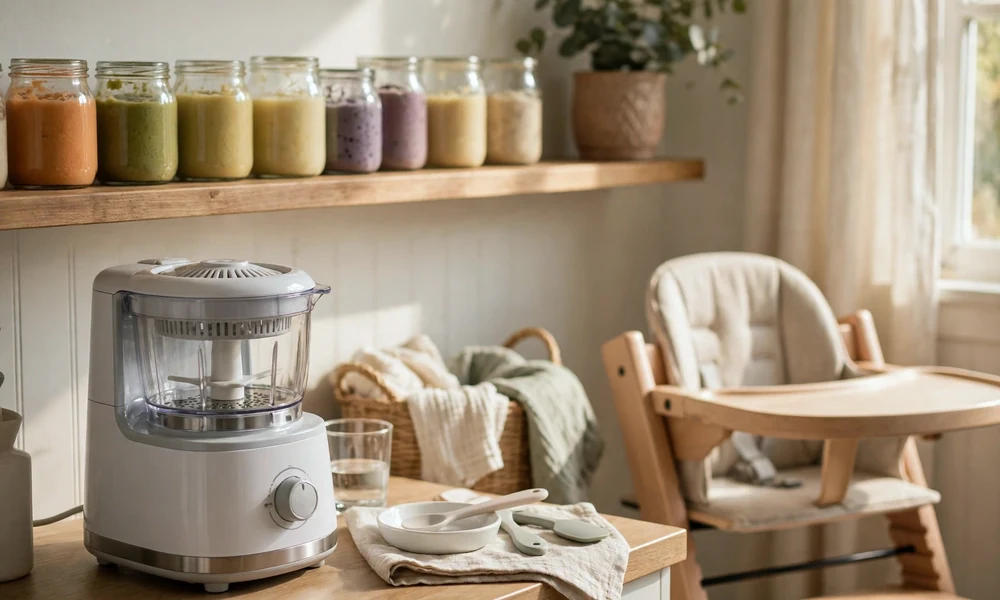
Starting solids is one of those small milestones that quietly rearranges a kitchen. One week the counter holds a kettle and a coffee mug, and the next it holds a steamer, a stack of little glass jars, a soft spoon, and a baby who is very interested in everything except the spoon. A baby food maker exists for that exact moment. It turns a handful of carrot, sweet potato, peas, or pear into a smooth, warm puree without a pot, a colander, and a separate blender to wash afterwards, and it does it in a batch small enough to feel sensible rather than wasteful.
What a baby food maker actually does
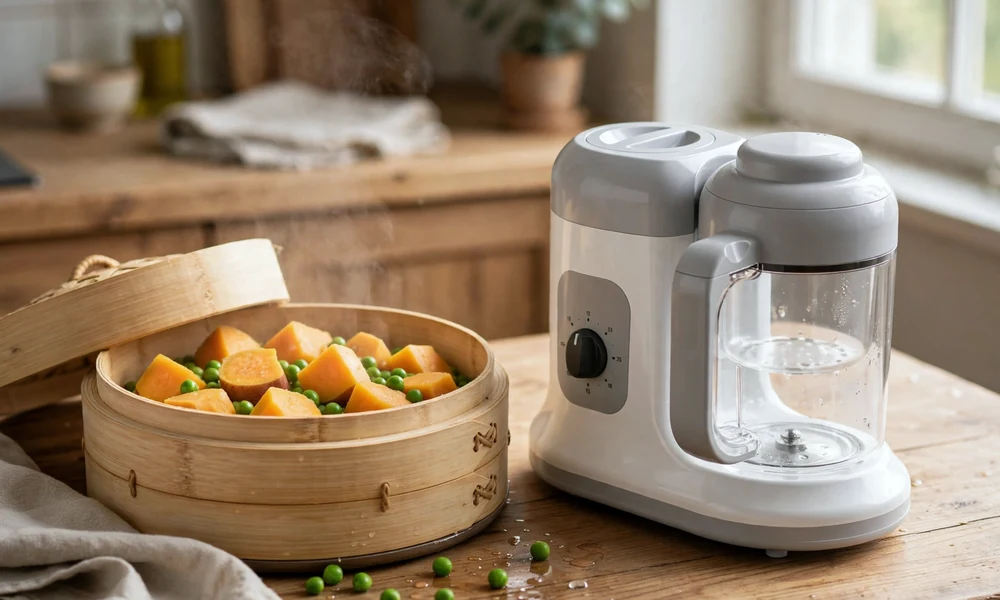
At its simplest, a baby food maker cooks soft food and then turns it into a puree. Most models do that in two stages. First, steam softens the food while keeping more of its flavour and colour than boiling in a large pot of water, because the food sits above the water rather than swimming in it. Then a blade blends the softened food, sometimes with a spoonful of the reserved steaming liquid, milk, or water added to reach the right thickness. Some machines do both jobs in one jug: you load the food, steam it, then flip or switch the jug and blend. Others are really a small steamer with a separate blending step, or a compact blender that expects you to cook the food first.
Texture is the heart of the matter. In the first weeks of weaning, most babies do best with a thin, smooth puree that slides easily off a spoon, with no lumps to catch them by surprise. As weeks pass, the texture can thicken, then become mashed with soft lumps, then move toward soft finger foods. A good baby food maker should handle that whole arc: silky at the start, a little coarser later, and able to stop before everything turns to soup. The machines that fail here usually fail at the smooth end, leaving a grainy finish on root vegetables or fibrous strands in green vegetables, or at the thick end, where a weak motor stalls on a small, dense batch.
The four kinds worth knowing
Shoppers meet four broad designs, and learning to tell them apart makes the rest of the decision easy. Each one has a clear strength, a clear weakness, and a household it suits best.
All-in-one steamer-blenders
This is the design most people picture when they hear the words baby food maker. A jug sits on a heated base. Water in the base turns to steam, the steam rises through the food, and when the timer finishes you blend in the same jug, or you turn the jug over and blend with the same blade. There is one vessel to wash, one set of parts to keep track of, and no hot food to transfer between containers. For a tired parent making a fresh batch after a nap, that simplicity is the whole point.
Blender-only baby food makers
A blender-only model is essentially a small, gentle blender with a baby-sized jug. It does not cook anything. You steam or boil the food separately, tip it in warm, add a little liquid, and blend. The advantage is control and price. A small jug blends a tiny batch far better than a full-sized family blender, which often needs a large volume of food before the blades catch properly, and the whole machine is usually lighter, cheaper, and easier to store. If you already own a good steamer basket or you cook family vegetables most evenings anyway, this can be the most sensible buy of all.
The weakness is the extra step. Cooking separately means another pot, another timer, and another thing to wash, and it is easy to overcook vegetables in a pan while a baby is crying in the next room. Steaming in a basket over a saucepan works well if you keep the pieces even and the water at a gentle simmer, and a microwave steamer can be quicker still. For a broader look at full-sized blending power and jug design, our guide to the best blenders of 2026 is a useful comparison, because the same questions about blade shape, jug size, and smooth results apply at a larger scale.

Steamer-plus-blender sets
Some makers arrive as a small set: a steaming basket or pot, a blending jug, and a handful of storage pots that stack neatly in a drawer. The parts are designed to work together, so the steamed food tips straight into the blender without a juggling act, and the storage pots are sized for one portion each. This is a good middle ground for households that want to batch-cook on a Sunday and freeze the week ahead, because the steamer is usually larger than the steaming chamber of an all-in-one machine.
Manual mashers and hand-powered presses
Manual tools are the quietest option and the easiest to pack. A masher, a small hand-crank mill, or a press with a fine disc can turn a steamed sweet potato or a ripe banana into a soft mash with no electricity and nothing to plug in. They suit travel, grandparents’ houses, and the later stages of weaning, when a baby is ready for texture and a perfectly smooth puree is no longer the goal.
How to choose: the details that decide daily life
Once the type is settled, the smaller details decide whether a maker becomes a daily habit or a cupboard ornament. Start with batch size. A jug that holds around four hundred to six hundred millilitres suits a single meal plus a spare portion, and it blends small amounts without leaving a ring of unblended food above the blades. A much larger jug sounds generous, but it often needs a bigger batch to blend properly, which defeats the point when a baby eats only a few spoonfuls. A much smaller jug is charming and quick, but you will be running it twice a day within a month.
Cleaning is where most owners form their opinion. A baby food maker is used with sticky, starchy food, often in a hurry, and it needs to be ready again by the next meal. The best designs have few parts, smooth internal corners, and a jug that rinses clean under a tap before going into the dishwasher. The worst have a blade housing with a hidden groove, a lid with a rubber seal that traps puree, or a steam chamber that needs descaling every few weeks. Before buying, imagine cleaning it one-handed while holding a baby, because that is how it will usually be cleaned. If a part cannot be reached, rinsed, or dried easily, it will become a chore.
Safety is not a feature to skim past. A good maker has a lid that locks before the blades can run, a base that stays put on a wet counter, and a steam vent that points away from hands. The jug should feel cool enough to handle once blending starts, or it should have a handle that stays clear of the steam. Keep the machine on a flat, stable surface, away from the edge of the counter, and never leave it running unattended while steam is building. These are ordinary kitchen habits, but they matter more when the cook is distracted, tired, and listening for a baby at the same time.
First foods and a simple weekly rhythm
The foods that suit a baby food maker best are the ones that steam to a soft, even texture and blend without stringy fibres. Carrot, sweet potato, butternut squash, parsnip, and courgette are reliable starters. Pear, apple, and banana soften beautifully, and peas blend into a bright, sweet puree once their skins are worked smooth. Cooked lentils and soft-cooked chicken can follow once a baby is ready for more substance, blended with a little of their cooking liquid to keep the texture gentle.
What good looks like in use
A good baby food maker disappears into the routine. You chop a carrot while the kettle boils, steam for fifteen minutes, blend for ten seconds, and the result is a warm, smooth puree with no lumps and no drama. The jug rinses clean, the blade comes out with a twist or a lift, and the whole thing is dry and back on the shelf before the high chair is wiped down. The puree itself should coat a spoon and fall off slowly, not run like soup and not sit like paste. If it is too thick, add steaming liquid a teaspoon at a time. If it is too thin, blend in a little more of the solid food.
The feeding setup around the maker matters too. A steady, comfortable seat at the right height turns a messy milestone into a calm one, and the chair, the spoon, and the bib are part of the same small system. Our guide to the best high chairs of 2026 covers the seats that hold a baby safely at table height, which is where those first spoonfuls are best enjoyed. A maker that lives beside a good chair, with its jars and spoons in one drawer, becomes a habit rather than a project.
Mistakes that waste food and patience
The most common mistake is overfilling the jug. A maker blends best when it has room to move, and a jug packed to the brim pushes food above the blades, where it sits unblended. Fill to the marked line, blend in two short bursts rather than one long one, and scrape down the sides once halfway through. The second mistake is adding too much liquid at the start. It is easy to thin a puree, and almost impossible to thicken one without cooking a whole new batch, so add liquid slowly and stop as soon as the spoon test looks right.
Finally, do not buy for a stage your baby has not reached yet. A machine built for chunky toddler meals will struggle with the silky purees of the first weeks, and a tiny first-stage blender will feel cramped once a baby is eating larger portions. The best choice covers the first six months of solids, from smooth to mashed, and then hands over gracefully to the family blender and the family table. For very small batches, a hand-held tool can also be surprisingly handy, and our comparison of the best vs worst immersion blenders of 2026 shows which small blenders handle a single portion without splashing it across the kitchen.
The verdict
For most households, the best baby food maker in 2026 is a compact all-in-one steamer-blender with a clear jug, a locking lid, a simple timer, and parts that rinse clean in under a minute. It makes the daily batch easy, it keeps the washing up small, and it grows with a baby from smooth first spoonfuls to thicker mashes. If you already steam family vegetables most evenings, a small blender-only model is the cheaper, lighter alternative, and a manual masher is the perfect companion for travel and for the later, lumpier stages.
Buy the machine that fits your counter, your patience, and your baby’s stage, not the one with the longest feature list. Steam evenly, chop evenly, add liquid slowly, and clean the jug before the puree dries. Do that, and the maker will quietly do the job it was bought for: turning ordinary vegetables into warm, smooth food, one small bowl at a time, while you get on with the far more important work of watching a baby discover what food is.