
A bike phone mount is a small accessory that changes a ride more than its size suggests. With a good mount, your phone sits where you can see it, steady enough to read at a glance, and secure enough to stay put over bumps, potholes and rough paths. With a bad one, the phone rattles, slips, turns at the wrong moment, or falls off altogether. The best bike phone mounts of 2026 are not the most complicated or the most expensive. They are the mounts that grip firmly, fit your bike and your phone, hold the screen at a readable angle, and let you get the phone on and off without a struggle.

What Makes a Bike Phone Mount Good
The first thing to judge is grip. A mount has to hold the phone through vibration, sudden stops and the jolt of a kerb or a pothole. Look for a cradle that contacts the phone on at least three sides, or a clamp that closes evenly around it, and a bar attachment that does not rotate under load. If you can twist the mount on the bars with one hand, it is not tight enough, and it will move when the road gets rough. A small rubber pad or silicone lining helps here too, because it stops metal and plastic from sliding against each other and damps the buzz that comes up through the bars.
The second thing is fit. Handlebars are not all the same size, and neither are phones. A good mount comes with shims or an adjustable clamp that fits common bar diameters, from narrow flat bars to thicker oversized bars, and it should clear brake levers, gear shifters, cables and a bell without forcing anything out of place. On the phone side, it should hold your phone with its case on, because most riders do not want to take the case off for every ride. Check the stated width and thickness range before you buy, and measure your phone in its case if you are close to the limit.
The Main Types of Bike Phone Mount
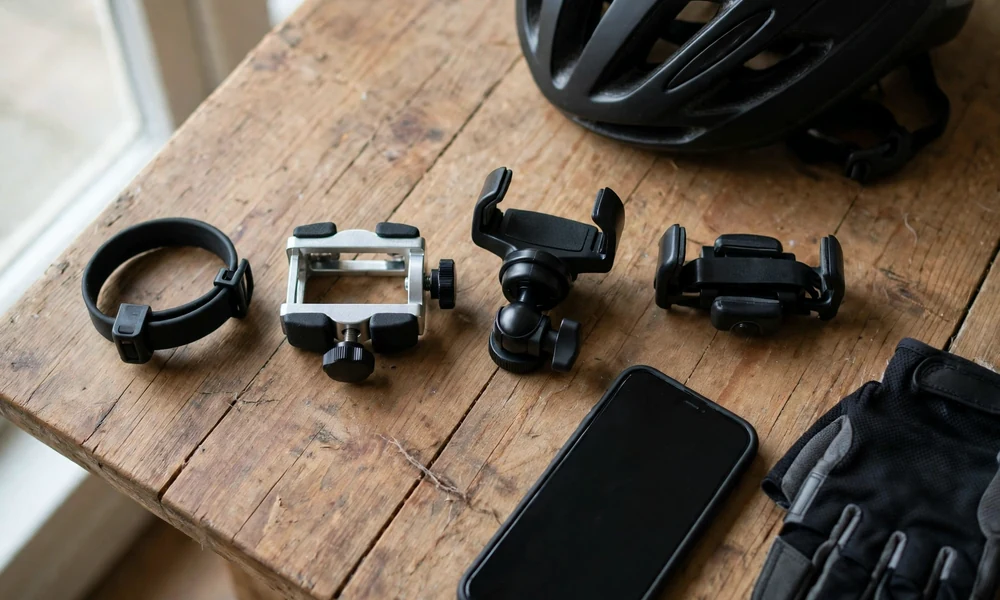
Clamp mounts are the most common type, and for most riders they are the best place to start. A cradle with adjustable arms grips the sides of the phone, and a clamp or a strap fixes the whole unit to the handlebar. They fit a wide range of phone sizes, they are easy to move between bikes, and the phone goes in and out in seconds. Their weakness is bulk: a big cradle can crowd the bars, and a cheap one can loosen over time, so check the clamp regularly and tighten it before a long ride.
Case mounts use a dedicated phone case that locks onto a matching base, often with a quarter-turn twist. The connection is very secure, and the case protects the phone as well as holding it, which is a real benefit in rain or on a trail. The trade-off is that you need the right case for your exact phone model, and changing phones means changing the case. For riders who ride in all weathers and want the most solid hold, this system is hard to beat.
Fit, Compatibility and Your Phone
Before you buy, measure twice. Note your handlebar diameter, the space free on the bars, and your phone’s size with its case on. A mount that fits the bars but not the phone is useless, and one that fits the phone but blocks the brake lever is unsafe. If you ride more than one bike, a mount that moves between bikes without tools is worth paying a little more for, because it saves you buying a second mount or leaving the phone at home on the other bike.
Vibration, Security and Rough Roads
Vibration is the quiet enemy of a phone mount. A constant buzz from the road can loosen a clamp, blur the screen, and, over time, damage a phone’s camera. The best mounts use rubber inserts, silicone pads or a small damper to absorb that buzz before it reaches the phone. If you ride on gravel, cobbles or trails, this matters far more than it does on smooth tarmac. A mount that feels fine on a short test ride around the block can start to rattle after half an hour on a rough surface, so test it on the kind of ground you actually ride.
Weather, Glare and Visibility
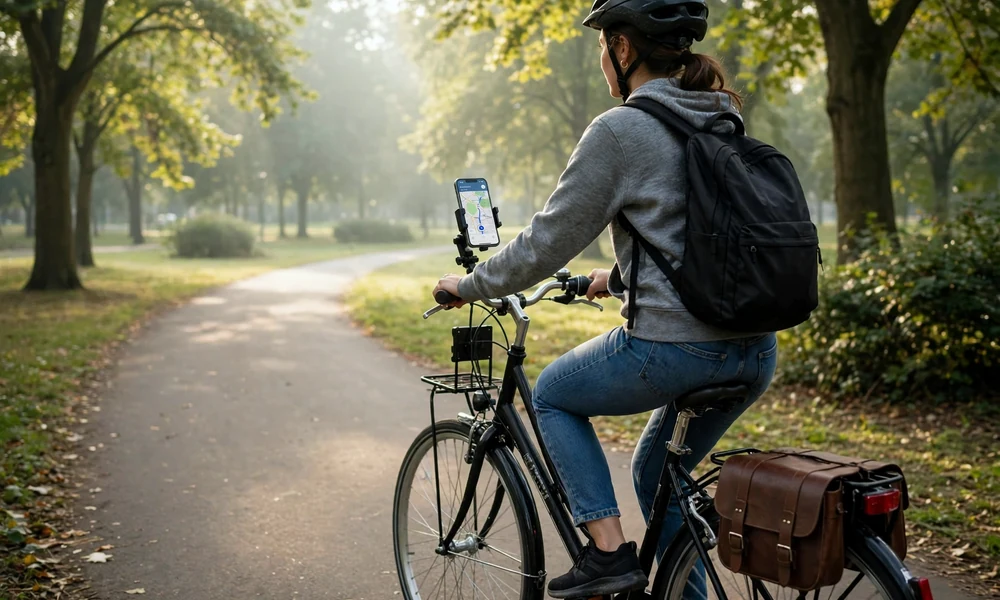
Rain is the first weather test. A mount that holds the phone open to the sky leaves the screen wet, and a wet screen is hard to read and hard to tap. Some mounts come with a rain cover or a waterproof pouch, and some riders use a case mount that seals the phone inside. If you ride in rain often, a cover matters, but it should not make the screen unreadable or trap heat. A clear cover that you can still tap through is the best compromise, and it is worth testing before you rely on it.
How to Fit a Bike Phone Mount
Start by choosing a spot on the bars with a clear view and no interference. The centre of the bars, next to the stem, is the usual place, because it keeps the phone balanced and clear of your hands. If you already have a light or a bike light in the centre, move the mount to one side, but keep it close enough to read without turning your head. Make sure the mount does not touch brake cables or gear cables when you turn the bars fully in both directions.
Fit the bar clamp first, with any shims the mount supplies, and tighten it until the mount does not move when you push it firmly. Do not overtighten: a clamp that is forced can mark the bars or crush a cable. Then set the phone in the cradle, close the arms or the clamp, and check that the phone is centred, that no button is pressed, and that the screen is at a comfortable angle. Give the bars a firm shake and try to twist the phone in the mount. If anything moves, tighten the clamp a little more and test again.
Riding With Navigation Safely
A phone mount is a tool for glances, not for staring. Set your route before you set off, start navigation, and put the phone in its mount. Then ride, and look at the screen only when you need to, for a second at a time, on a straight, quiet stretch. If you need to change the route, type a new address, or answer a message, pull over and stop. No journey is worth a crash, and a phone in your hand while you ride is a danger to you and to everyone around you.
Mistakes to Avoid
The most common mistake is buying on price alone. A very cheap mount often uses thin plastic, a weak spring, or a clamp that loosens with vibration. It may feel fine in the shop, but it will not stay fine on the road. Spend a little more on a mount with a solid clamp, rubber lining, and a locking mechanism, and it will last longer and protect a phone worth many times its price.
The third mistake is mounting the phone where it blocks something else. A phone in the centre can hide a bike computer or cover the bell, and a mount on the side can get in the way of a hand on a narrow bar. Plan the whole cockpit before you buy: light, bell, computer and phone all need a place, and they should not fight each other. A bike bell is a small thing, but it is a safety essential, and it should stay within easy reach of your thumb.
Which Mount Suits Your Riding
Commuters need a mount that is quick, simple and weatherproof. A clamp mount with a rain cover, or a case mount that seals the phone, suits a daily ride through traffic and rain, and a mount that comes off the bike easily is useful when you lock the bike outside. The phone should be easy to remove at the end of the ride, because you will do it twice a day, every day.
Mountain bikers and gravel riders need the toughest mount of all. A case mount with a twist lock, or a clamp mount with a safety tether, is the safest choice on rough ground, and rubber damping is essential. A silicone band mount is not enough here: the phone will bounce, the band will stretch, and the risk of a fall is high. If you ride trails, treat the mount as safety equipment, not as an accessory, and check it before every ride.
Touring riders need a mount that works for hours at a time. Battery life matters, so a mount that leaves the charging port free is important, and a mount that holds the phone steady for a whole day without loosening is essential. A case mount that protects the phone from rain and dust, or a clamp mount with a rain cover, will serve a tour better than a light, open cradle. Comfort matters too: the phone should be at a height and angle you can read without hunching over the bars.
Care, Maintenance and Longevity
A phone mount needs very little care, but a little care goes a long way. Wipe it down after a wet or muddy ride, and check the clamp and the cradle arms for wear. Rubber pads wear out over time, and a worn pad will let the mount slip. Most makers sell spare pads, and replacing them is cheaper than replacing the whole mount. If the mount uses a spring, check that it still closes firmly, and if it feels weak, replace the mount before it fails on a ride.
Store the mount sensibly. If you take it off the bike, keep it somewhere dry and clean, and do not leave it in direct sun for long periods, because heat and sunlight age plastic and rubber. If you leave it on the bike, make sure it is not the first thing a thief sees, and consider taking it off when you park in a busy place. A mount that lasts for years is a better buy than a cheap one you replace every season.
The Bottom Line
The best bike phone mount for you is the one that fits your bike, fits your phone with its case on, holds steady over the roads you ride, and lets you see the screen with a quick glance. For most riders, a solid clamp mount is the best starting point: it fits a wide range of phones, it is easy to use, and it is secure enough for commuting and road riding. For rough ground and all-weather riding, a case mount with a twist lock is the safer choice, and for a neat road setup, an out-front mount is hard to beat. Whatever you choose, fit it carefully, test it on a short ride, and check it regularly. A phone that stays put, a screen you can read at a glance, and hands that stay on the bars are what a good mount is really for.


