
A boxing glove is a strange piece of kit. It has to do two opposite jobs at once: protect the hand throwing the punch and soften the blow for whatever it lands on. A good glove does both so well that you stop thinking about it after the first round. A bad glove does neither. It pinches the knuckles, slides around on the hand, and leaves the wrist aching long after the bag session is over. The best boxing gloves of 2026 are not the flashiest pairs on the shelf, and they are not always the most expensive. They are the gloves that fit snugly, spread the impact evenly, and still feel as good in the twelfth round as they did in the first.
What Makes a Glove Good
The first thing to judge is the padding. A good glove spreads the force of a punch across the whole knuckle area instead of letting it concentrate on one spot. The padding should feel firm and even when you press it, with no thin patches over the knuckles and no lumps that dig in when you make a fist. Cheap gloves often feel soft and comfortable in the shop, then go flat after a few weeks of bag work, leaving the knuckles to take the punishment directly. Padding that holds its shape is the difference between a glove that lasts a year and one that is useless by spring.
The second thing is wrist support. Almost every hand injury in boxing starts at the wrist, not the knuckles. A good glove locks the wrist in a straight line with the forearm, so the force of the punch travels through the arm instead of bending the joint sideways. Look for a long, firm cuff that wraps the wrist properly, whether it closes with laces or with a wide hook-and-loop strap. Laces give the tightest, most even hold and are the choice of most serious boxers, but they need a training partner to tie them. A good strap closure is the practical choice for anyone training alone, and it should be wide enough to cover the whole wrist without gaps.
The Main Types of Boxing Glove
Bag gloves are built for hitting heavy bags, pads and mitts, and they are the gloves most people should buy first. They have dense, firm padding designed to take thousands of impacts against a hard surface, and they are usually lighter than sparring gloves so the arms do not tire as quickly. A good bag glove protects the knuckles without feeling like a pillow, and it lets the boxer feel the bag through the padding just enough to know when a punch has landed cleanly. For anyone training two or three times a week, a solid pair of bag gloves is the workhorse of the whole kit.
Sparring gloves are a different tool. They are bigger, usually sixteen ounces, and their padding is softer and thicker, because their job is to protect the sparring partner as much as the wearer. Hitting a person with a hard bag glove is a quick way to lose training partners and gain a bad reputation. Sparring gloves spread the impact over a wider area and slow the punch down just enough to make hard rounds safe. Every gym has a rule about sparring weight, and most insist on sixteen ounces, so check before buying. A glove that is fine for the bag can be the wrong glove for sparring.
How to Choose Your Size and Weight
Glove weight is measured in ounces, and the number is really a measure of padding, not of the glove itself. Lighter gloves, ten or twelve ounces, are faster and better for bag work and competition. Heavier gloves, fourteen to sixteen ounces, carry more padding and are better for sparring and for building shoulder strength. As a rough guide, a lighter person under seventy kilos will usually be comfortable in twelve or fourteen ounces, while a heavier person will want fourteen or sixteen. The best test is simple: put the glove on over a hand wrap, make a fist, and throw a few punches in the air. If the glove feels like a natural extension of the hand, the weight is right.
Fit matters as much as weight. A glove should feel snug around the hand and wrist with no room to rattle, but it should never pinch the fingers or cut off the circulation. The fingers should sit comfortably inside the glove with a little space at the tips, and the thumb should be attached to the glove body, as it is on every modern design, so it cannot catch on anything and bend backwards. Always try gloves on over hand wraps, because a glove that fits a bare hand will be too tight once the wraps are on. A glove that fits properly feels secure from the first minute, and it should not need a month of breaking in before it stops hurting.
The Best Boxing Gloves of 2026
The best all-round training glove of 2026 is a mid-priced leather glove with layered foam padding and a wide strap cuff. It is firm enough for heavy bag rounds, forgiving enough for light sparring, and comfortable enough to wear for an hour without the hands going numb. The leather breaks in gently over the first few weeks and then holds its shape for a long time, while the layered padding keeps its spring instead of going flat. For the boxer who trains a few times a week and does a bit of everything, this is the glove that makes the most sense, and it is the pair most people should start with.
The best bag glove this year is a dense, compact glove built purely for hitting the heavy bag. Its padding is firmer than a training glove, so the knuckles stay protected through long rounds on a hard bag, and the compact shape keeps the punches fast and sharp. It is not the glove for sparring, and it does not pretend to be. It is a specialist, and it does its one job better than any all-rounder can. For the boxer whose training is mostly bag work, pads and conditioning, this is the glove that will last longest and protect best.
The best sparring glove of 2026 is a sixteen-ounce glove with soft, deep padding and a long, supportive cuff. It feels big in the hand, as it should, because its job is to spread every punch over as wide an area as possible. The padding stays soft round after round, and the wrist support keeps the hand straight even when the arms are tired and the form starts to slip. It is the glove that keeps training partners happy and keeps the boxer training the next day instead of nursing sore hands. Every serious gym bag should have a pair.
The best beginner glove is an affordable training glove sold as a complete starter set, with the gloves, a pair of hand wraps and a small gym bag in the box. It costs less than a month of most gym memberships, and it removes every excuse not to start. The glove itself is a straightforward fourteen-ounce training glove, easy to put on, easy to close with a strap, and forgiving on the hands while the technique is still developing.
The best premium glove of 2026 is a hand-finished leather glove with a lace closure, built the way gloves have been built for decades. The leather is thick and smooth, the stitching is tight and even, and the padding is layered by hand so it feels the same across the whole knuckle area. It needs a training partner to lace it up, and it costs more than most people will ever spend on a glove, but it is the glove that serious boxers dream about. It lasts for years, it feels better the more it is used, and it is the closest thing to a perfect glove that money can buy.

What Else You Need
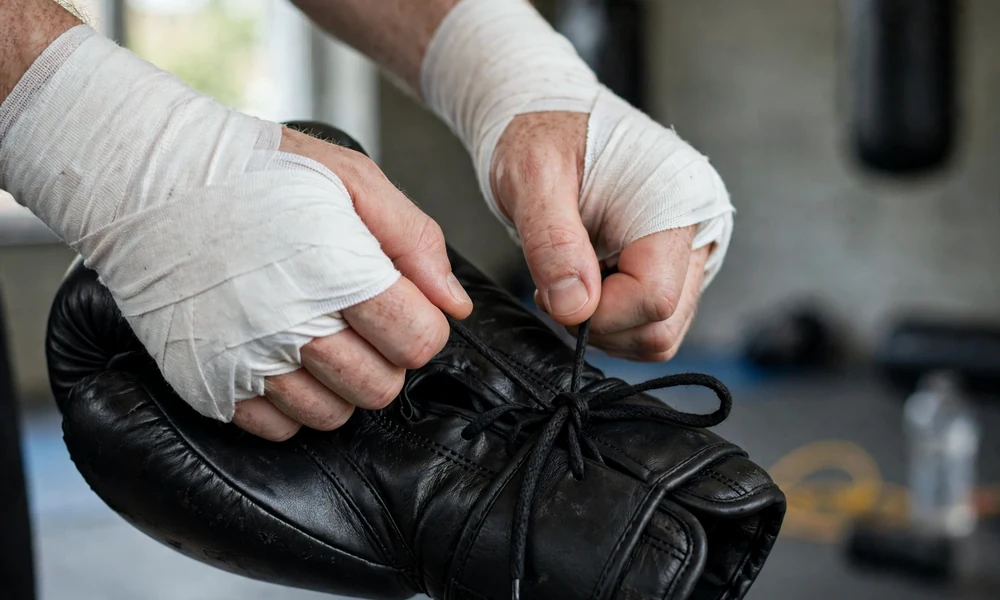
A glove on its own is only half the kit. Hand wraps matter as much as the glove, and they should be worn every single session. The wrap supports the small bones of the hand and holds the wrist in line, and it soaks up the sweat that would otherwise rot the glove from the inside. A pair of wraps costs very little and lasts for months, and putting them on becomes a ritual that takes two minutes once it is learned. Skipping wraps to save time is the fastest route to a sore hand and a smelly glove.
Common Mistakes to Avoid
The biggest mistake is buying gloves that are too light for the training being done. A twelve-ounce glove feels fast and sharp on the bag, but it offers far less protection than a fourteen or sixteen-ounce glove, and the knuckles pay the price over time. The second mistake is buying the cheapest gloves available and expecting them to last. Cheap gloves use thin foam that flattens within weeks, and once the padding is gone, the glove is not just useless, it is dangerous. Spending a little more on a glove with proper layered padding is cheaper than replacing a dead pair every two months.
How Boxing Fits a Training Week
Boxing is one of the few workouts that trains the whole body at once. The legs drive the punches, the core twists behind them, and the shoulders carry the gloves for round after round. That full-body demand is why boxers are among the fittest athletes in any sport, and it is also why boxing pairs so well with other training. A morning of bag work and an evening of stretching makes a balanced day, and many boxers keep a best exercise balls routine as their way to build core strength between sessions. The same balance and control that steadies a punch makes for better work on the ball, and both reward patience over brute force.
The hobby also builds the kind of hand-eye coordination that carries into other sports. The timing and accuracy of boxing have a lot in common with the clean swing of a golf club or the quick hands of a baseball swing, and boxers often find they pick up those games faster than expected. Readers who enjoy that kind of precision will find plenty to like in the best golf gloves and the best baseball bats guides, which cover the same idea from a different angle: the right gear, matched to the player, makes the whole game more fun.
The Verdict
The best boxing gloves of 2026 are the ones that fit the boxer wearing them. For most people that means a mid-priced leather training glove in fourteen ounces: firm, forgiving and able to handle bag work and light sparring alike. For the bag specialist, a dense compact bag glove is the better tool. For the sparrer, a soft sixteen-ounce glove is the only sensible choice. Whatever the choice, wear hand wraps every time, let the gloves dry after every session, and buy the best padding you can afford. A glove chosen this way will not just protect the hands on the first day; it will still be protecting them years from now, and every clean punch will feel like it was earned.


