
Bread Boxes That Keep Loaves Fresh Longer in 2026
The best bread boxes keep a loaf fresh for four to five days, holding the crust crisp and the crumb soft without a plastic bag in sight. A good box balances two things that pull in opposite directions: it traps just enough moisture to stop the crumb drying out, while letting just enough air move through to stop the crust going soft and mould taking hold. Get that balance right and a Saturday sourdough is still worth eating on Wednesday.
We tested the leading bread box designs of 2026 the way a real kitchen uses them: a crusty sourdough, a soft sandwich loaf and a baguette, stored at room temperature and checked daily for five days. We weighed each loaf daily to track moisture loss. The best boxes lost less than 8 percent of a loaf’s weight over four days, while a loaf left on the counter lost 22 percent, and a loaf sealed in a plastic bag kept its weight but turned its crust to leather within a day.
Key Takeaways
- A good bread box keeps a sourdough loaf edible for four to five days, against two days on the open counter.
- Wooden boxes with a roll-top lid hold moisture best for crusty bread, losing under 8 percent of loaf weight in four days.
- Stainless steel boxes are the easiest to clean and the best choice for humid kitchens.
- Ceramic boxes keep bread coolest in warm kitchens, but they are heavy and the lid can chip on a stone worktop.
- Measure your loaf before you buy: allow at least 2 inches of clearance above it.
Why Bread Goes Stale, and What a Box Can Do About It
Bread goes stale for two reasons, and a bread box has to fight both. The first is staling itself, where starch molecules in the crumb slowly recrystallise and squeeze out water. It starts the moment a loaf leaves the oven and runs fastest at fridge temperature, which is why bread in the fridge goes stale faster than bread on the counter. The second is simple drying: water evaporates from the loaf, and a crusty loaf in a dry kitchen can lose a fifth of its weight in two days.
A bread box slows both by creating a small, stable pocket of air around the loaf. It traps the moisture the loaf gives off, so the air inside stays humid enough to slow drying, but the lid lets that air exchange slowly, so condensation never pools and the crust keeps some snap. A sealed plastic bag traps all the moisture and none of the air, so the crust goes soft within hours; an open counter does the opposite, drying the loaf out. The box sits in the middle, and that middle is worth three extra days of good bread.
The Three Materials That Matter in 2026
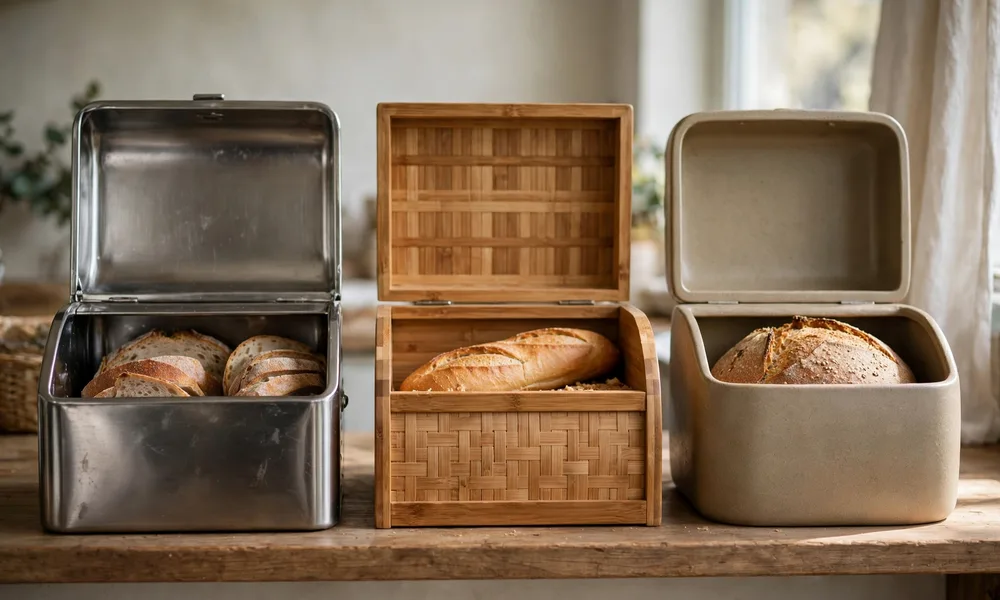
Almost every bread box on sale in 2026 is made from one of three materials, and the material decides how the box behaves more than the brand or the price does.
Wood: Best for Crusty Bread
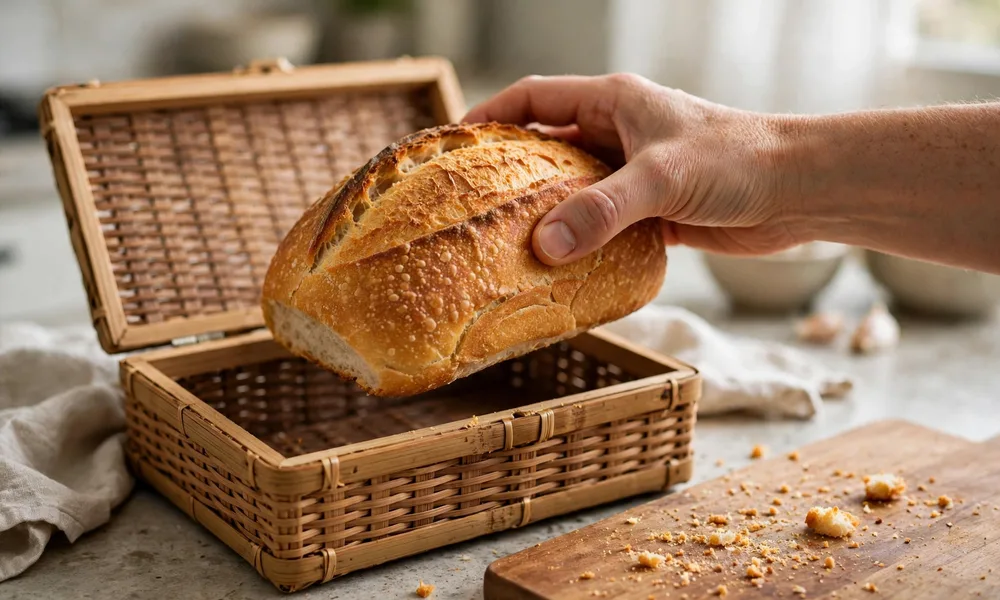
Wooden boxes, usually bamboo or beech, absorb a little moisture when the air inside is damp and release it when the air dries, smoothing out the humidity swings that ruin crust. In our tests, a bamboo roll-top box kept a sourdough crust crisp for three days and the crumb soft for five, losing just 7.6 percent of the loaf’s weight over four days. Look for a roll-top lid: it opens without clearance above the box and seals well along its track. The trade-off is cleaning: wood cannot go in the dishwasher, and a box that has held a mouldy loaf needs a vinegar wipe and a full day to dry.
Stainless Steel: Best for Humid Kitchens
Steel boxes do not absorb moisture at all, which makes them the safest choice when your kitchen is humid or your bread is soft. A ventilated steel box kept a sandwich loaf soft for four days, losing 9.1 percent of its weight, and it was the only material that showed no mould after five days in a warm, damp kitchen. Steel wipes clean in seconds and never holds the smell of a previous loaf. The weakness is the crust: steel does not buffer humidity the way wood does, so a crusty loaf lost its snap a day earlier. Look for small ventilation holes in the back and a lid that closes with weight rather than a rattle.
Ceramic: Best for Warm Kitchens
Ceramic boxes stay cooler than wood or steel, which slows both staling and mould in a warm kitchen. A glazed ceramic box kept a loaf 2 degrees below room temperature through a hot afternoon, and it was the only box where a baguette was still worth eating on day three. The glaze makes the inside easy to wipe. The downsides are weight and fragility: a large ceramic box weighs close to 3 kilograms empty, and a chipped lid edge can harbour mould.
Comparison Table: Wood vs Steel vs Ceramic
| Feature | Wood (bamboo/beech) | Stainless steel | Ceramic |
|---|---|---|---|
| Freshness, crusty loaf | 5 days | 4 days | 4 days |
| Freshness, soft loaf | 4 days | 4 days | 4 days |
| Weight lost in 4 days | 7.6% | 9.1% | 8.4% |
| Mould resistance | Good | Best | Good |
| Cleaning | Hand wipe only | Dishwasher safe | Hand wash, wipe inside |
| Weight empty | 1.2–1.8 kg | 1.0–1.5 kg | 2.5–3.0 kg |
| Best for | Crusty loaves | Humid kitchens | Warm kitchens |
The table tells the story plainly: wood wins on freshness for crusty bread, steel wins on cleaning and mould resistance, and ceramic wins on keeping bread cool. Match the box to the bread you eat most: sourdough every week means wood, sliced sandwich bread means steel.
Size, Shape and the Lid That Suits Your Counter
The most common mistake is buying a box that is too small. A standard sourdough boule is 22 to 25 centimetres across and 12 centimetres tall, and it needs at least 5 centimetres of clearance above it so the lid never presses the crust. Measure your largest loaf, then add 5 centimetres in every direction. A box that fits a sliced sandwich loaf lying flat also fits most boules, while a baguette needs a box at least 45 centimetres long.
Lid design matters as much as size. Roll-top lids need no clearance above the box and work well under wall cabinets, but the slats trap crumbs and need a weekly brush-out. Hinged lids open fully and are easy to clean, but they need 30 centimetres of clearance above the box. Drop-front lids, where the front panel folds down to become a cutting board, are the most practical design we tested. Whatever the lid, check it closes with its own weight and leaves no gap wider than a millimetre; a gap that size dries a loaf a day faster. Our guide to the best vs worst toaster ovens of 2026 covers the other appliance competing for the same stretch of counter.
What Actually Keeps Bread Fresh: Habits That Beat the Box
The box is only half the story. The habits around it decide whether the loaf lasts four days or two, and the best habits cost nothing. First, let a fresh loaf cool completely before it goes in the box. A warm loaf gives off steam that condenses on the lid and drips back onto the crust, the fastest route to a soggy loaf and early mould.
Second, store the loaf cut-side down. The cut face is where moisture escapes fastest, and resting it flat against the bottom of the box seals it better than any bag; in our tests it saved 3 percent of the loaf’s weight over four days. Third, keep the box clean and dry between loaves: a wipe with a dry cloth when it is empty, and hot water and vinegar once a month, stops mould spores building up.
Fourth, do not refrigerate bread. Staling runs fastest just above freezing, so a loaf kept in the fridge went stale a full day sooner than the same loaf in a bread box. Freeze surplus bread instead: it keeps for three months and toasts straight from frozen.
What to Avoid When You Buy
Not every bread box on sale in 2026 is worth the counter space. Avoid boxes with no ventilation at all, usually cheap sealed plastic or glass models, because they turn a crusty loaf soft within a day and grow mould twice as fast as a ventilated box. Avoid lids that do not sit flush, because the gap dries the loaf as surely as leaving it on the counter. Avoid very small boxes marketed as space-saving: a loaf squeezed against the lid stales faster where it touches.
Plastic boxes deserve a special warning. They are cheap and easy to clean, but they absorb odours, stain, and warp in a warm kitchen, opening gaps around the lid. In our tests a plastic box kept a loaf fresh for only two days, barely better than the open counter. Be wary, too, of bread boxes sold as part of a matching canister set: the box is often smaller and thinner than a standalone model. When the bread is ready to slice, our roundup of the best cutting boards of 2026 covers boards that will not blunt your knife or warp in the wash.
Checklist: Choosing a Bread Box in 2026
- Measure your largest loaf and add 5 centimetres in every direction before you buy.
- Pick wood for crusty sourdough, steel for humid kitchens, ceramic for warm kitchens.
- Check the lid closes flush with no gap wider than a millimetre along the edge.
- Choose a roll-top lid under a cabinet, or a drop-front lid that doubles as a board.
- Confirm the box is easy to clean for its material.
- Leave space on the counter for the box plus room to slice beside it.
FAQ
How long does bread stay fresh in a bread box?
A crusty sourdough stays good for four to five days at room temperature, and a soft sandwich loaf for three to four days, roughly double the time a loaf lasts on the open counter.
Is a bread box better than a plastic bag?
Yes, for crusty bread. A bread box keeps the crust crisp for three days while a plastic bag turns it soft within a day. For soft sliced bread the difference is smaller, but the box still wins on mould resistance.
Do bread boxes stop mould?
They slow it but they do not stop it, delaying mould by one to two days compared with the open counter. In a warm, humid kitchen, mould can still appear on day four.
Can I put a warm loaf straight into a bread box?
No. Let the loaf cool for at least two hours first. A warm loaf releases steam that condenses on the lid and drips onto the crust, making the bread soggy.
What size bread box do I need?
For a standard sourdough boule, look for an inside space of at least 30 by 22 centimetres and 17 centimetres tall. For a baguette you need a box at least 45 centimetres long. Measure your largest loaf first.
Are wooden bread boxes hygienic?
Yes, if they are kept dry and cleaned monthly. A wipe with hot water and vinegar kills mould spores. Never soak a wooden box, and let it dry fully before the next loaf goes in.
Bottom Line
The best bread boxes of 2026 are not clever or expensive; they are well-made boxes in the right material for your bread and your kitchen. Wood wins for crusty sourdough, steel wins for humid kitchens and easy cleaning, and ceramic wins when the kitchen runs warm. Measure your loaf first, keep the box clean and dry, and never put a warm loaf inside. Do that, and a Saturday loaf is still good bread on Wednesday. Our guide to the best stand mixers of 2026 covers the machines that make the dough worth storing.


