
What Is the Best Corkboard for a Busy Kitchen Wall in 2026?
The best corkboard for a busy kitchen wall in 2026 is a natural cork board with a solid frame, thick enough to hold a pin firmly, large enough to carry the week’s life — school notes, shopping lists, appointment cards, recipes — without looking crowded, and mounted where the whole household actually passes. A kitchen corkboard is not decoration. It is the family noticeboard, and in a busy kitchen it takes more punishment than any other board in the house: steam, grease, pins going in and out a dozen times a day. The right board takes all of that and still looks good in a year. The wrong one crumbles, sheds, stains and ends up in the bin.
This guide explains what makes a corkboard survive a kitchen, how the materials differ, what size works on a busy wall, and how to mount and maintain one that stays useful.
Key takeaways
- Natural cork is the only material that truly self-heals around pin holes; synthetic and thin cork sheets crumble and shed within months of daily use.
- Thickness matters: look for at least 10 mm of real cork, or a cork layer bonded to a firm backing board, so pins sit securely and the board does not bow.
- A board around 90 x 60 cm suits most kitchen walls — big enough for the whole household’s notes, small enough to fit beside the fridge or by the door.
- The frame is not decoration: a solid wood or aluminium frame protects the cork edges, which are the first part to crumble.
- Mount it where people naturally pause — by the back door, beside the fridge, near the kettle — not on a wall nobody walks past.
Why the kitchen is the hardest room for a corkboard
Every room has a noticeboard, but the kitchen board works harder than all of them. It carries the shopping list, the school calendar, the plumber’s card, the recipe torn from a magazine, the appointment letter and the child’s drawing — all at once, in a room that is warm, steamy and busy. Nobody pins things gently in a kitchen: pins go in at an angle, in a hurry, with one hand, while the other holds a phone or a pan.
Natural cork, reconstituted cork and the fakes
Corkboards are made from three very different materials, and the price usually tells you which one you are looking at. Natural cork is cut from the bark of the cork oak, and it is the only material that genuinely self-heals: the tiny air-filled cells close back around a pin hole when the pin comes out, so the board can take thousands of pins over years without falling apart. It costs the most, and it is worth it for a board used every day.
Reconstituted cork is made from cork granules pressed together with a binder. It looks like cork and it is cheaper, but it does not self-heal: the binder breaks down around pin holes and the surface crumbles at the edges. It is fine for a board pinned a few times a month, not for a kitchen board pinned a dozen times a day. Then there are the fakes: thin cork-look vinyl sheets and foam boards with a cork print — decoration, not noticeboards, and a pin pushed into one will fall out or tear a hole.
The test is simple: press a pin in, pull it out, and look at the hole. On natural cork it nearly disappears; on reconstituted cork it stays visible; on a fake the surface tears. Buying online, check the thickness and weight, and make sure the specification says natural cork, not cork-effect or cork-look.
| Material | Pin-holding | Self-healing | Kitchen life | Best for |
|---|---|---|---|---|
| Natural cork (10 mm+) | Excellent, pins sit firm | Yes, holes close up | 5–10 years | Busy kitchen walls, daily use |
| Reconstituted cork | Good at first, loosens over time | Partially | 1–3 years | Light use, spare rooms |
| Cork on foam backing | Poor, pins wobble | No | Under a year | Temporary displays only |
| Cork-effect vinyl / foam | Very poor, tears | No | Months | Decoration, not pinning |
| Cork tiles (self-adhesive) | Fair, depends on thickness | Partially | 1–2 years | Covering a large wall cheaply |
| Combination board (cork + whiteboard) | Good on the cork half | Yes, on the cork side | 3–5 years | Kitchens that need writing space too |
If the budget only stretches to reconstituted cork, buy the thickest board you can find and expect to replace it sooner. For a board pinned daily, natural cork is the only honest choice.
What size works on a busy kitchen wall?
Kitchen walls are broken up by cabinets, windows, tiles and appliances, and the free space is usually a strip beside the fridge, a patch by the back door, or the wall above the worktop. Measure that space before you buy anything: a board that overlaps a cabinet door or hangs over a hob is worse than no board at all.
For most kitchens, a board around 90 x 60 cm is the right size: large enough to hold the shopping list, the week’s appointments, a school note and a recipe at the same time. A 60 x 45 cm board suits a small kitchen; a 120 x 90 cm board is a serious family command centre, but it needs a genuinely free wall, and in most kitchens that wall does not exist.
Frames, backing and the combination board
The frame is the part of a corkboard that fails first, and the part most buyers ignore. A solid wood frame protects the cork edges from crumbling; an aluminium frame is lighter, easier to clean and better in a steamy room, since wood can swell near a kettle or hob. A plastic frame is the cheapest option and usually the first to crack. Check the frame is fixed to the backing properly: one only glued on will come away when the board is lifted off the wall.
The backing matters almost as much as the cork. A firm backing board — MDF or hardboard — keeps the board flat and gives pins something to bite into; a board with no backing will bow in a warm kitchen and pins will push straight through. Choose a backing at least 3 mm thick and a cork layer at least 10 mm: thinner than that, pins will not sit securely.
Where to mount it — and how
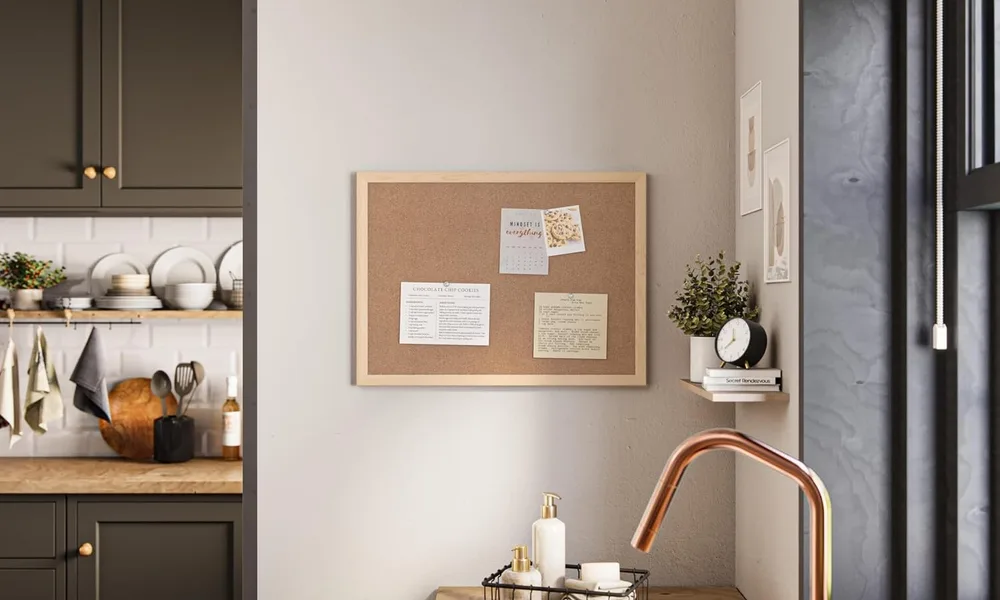
Placement is everything with a kitchen corkboard. The best spot is where people naturally pause: beside the back door, beside the fridge, or on the wall by the kettle, where there is a minute of waiting built into the day. A board on a wall nobody walks past is a board nobody uses, and a board behind a door gets knocked every time the door opens.
Keep it away from direct steam and splashes. Above the hob is the worst spot in the kitchen: steam, grease and heat will stain the cork and loosen the frame within months. Beside the sink is nearly as bad. Cork can cope with a normal kitchen atmosphere, but it cannot cope with being wet.
Mounting is straightforward but worth doing properly. A 90 x 60 cm natural cork board weighs 3–5 kg, so it needs proper wall fixings, not the sticky pads in the box. On a solid wall, ordinary plugs and screws are fine; on a tiled wall you will need a masonry drill bit; on plasterboard, cavity fixings.

Keeping it useful: pins, tidiness and cleaning
A corkboard only works if it stays current. Every Sunday, take down anything out of date: old appointment cards, last week’s shopping list, the school note from a term ago. A crowded board is a board nobody can read, and five minutes a week keeps it useful.
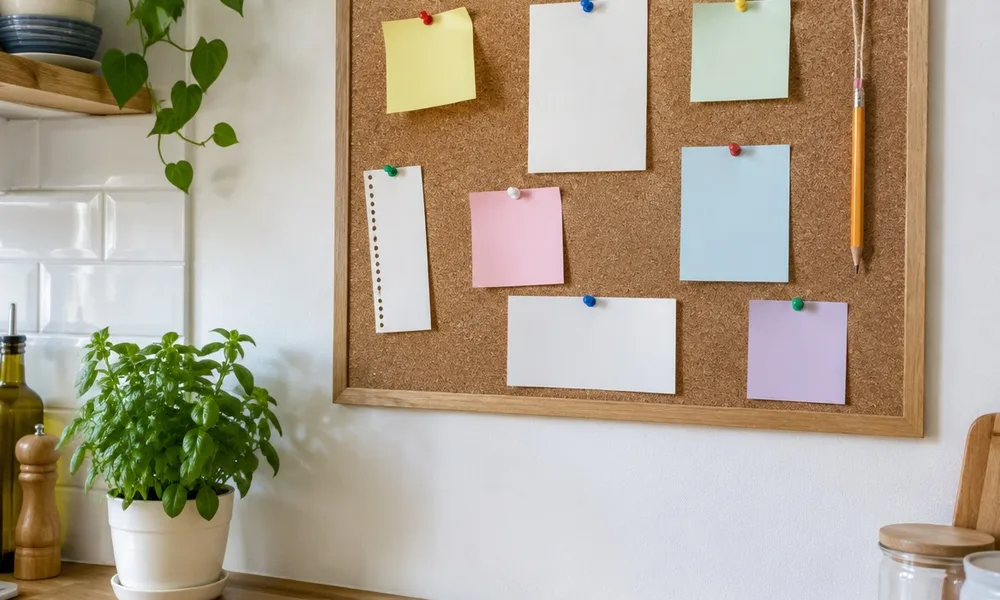
Pins deserve a little thought too. Pushpins with a large, flat head are easiest to grip with wet or busy hands and hold heavier paper without tearing through it. Keep a small pot beside the board for spares, and colour-code in a busy household — one colour per person, or one colour for urgent things — so a crowded board stays readable at a glance.
Cleaning a corkboard is gentle work: dust it with a soft brush or dry cloth, and wipe marks with a barely damp cloth and a drop of washing-up liquid. Never soak cork — it swells and will not go back — and never use bleach, which strips the natural oils that keep it springy.
A kitchen corkboard sits alongside the rest of the kitchen’s organisation. Good pantry organisers keep the shelves as tidy as the wall, a bread box below keeps the morning routine in one place, and the right cereal bowls finish a household that eats together before the day begins.
Choosing well: a quick checklist
- Buy natural cork, at least 10 mm thick, on a firm backing — not cork-effect vinyl or thin foam.
- Choose around 90 x 60 cm for a family kitchen, smaller only if the free wall space demands it.
- Pick a solid wood or aluminium frame; avoid plastic frames, which crack first.
- Mount it where people naturally pause — by the back door, beside the fridge, near the kettle — and keep it away from steam and splashes.
- Use proper wall fixings for your wall type, and never rely on sticky pads for a board that will be pinned daily.
- Clear out-of-date notes every Sunday, keep spare pushpins beside the board, and clean the cork gently with a barely damp cloth.
Frequently asked questions
What is the best corkboard material for a kitchen?
Natural cork, at least 10 mm thick on a firm backing. It self-heals around pin holes, holds pins firmly and lasts five to ten years in a busy kitchen. Reconstituted cork crumbles sooner, and cork-effect vinyl is decoration, not a noticeboard.
What size corkboard should I buy for a kitchen wall?
Around 90 x 60 cm suits most family kitchens: large enough for the shopping list, appointments and school notes at once. Go smaller only if the free wall space is genuinely limited, and measure the space before buying.
Why do pins keep falling out of my corkboard?
Usually because the cork is too thin, reconstituted rather than natural, or worn out around the pin holes. Thick natural cork grips pins firmly; if pins fall out of a board within months, the material is the problem, not the pins.
Can I put a corkboard above the hob or beside the sink?
It is best not to. Steam, grease and splashes stain cork, loosen the frame and shorten the board’s life. Mount it on a drier wall — by the back door, beside the fridge or near the kettle — instead.
How do I clean a corkboard?
Dust it with a soft brush or dry cloth, and wipe marks gently with a barely damp cloth and a drop of washing-up liquid. Never soak cork, and never use bleach or harsh cleaners, which strip the oils that keep it springy.
Is a combination cork and whiteboard a good idea for a kitchen?
Yes, when wall space is tight: the whiteboard half carries the shopping list and the cork half carries cards and notes. Check that the cork half is still thick enough to hold pins firmly, as it is often thinner than on a dedicated board.
The bottom line
The best corkboard for a busy kitchen wall is a natural cork board around 90 x 60 cm, at least 10 mm thick on a firm backing, in a solid wood or aluminium frame, mounted where the household naturally pauses and kept clear of steam. It costs more than the thin board on the supermarket shelf, but it is the difference between a family noticeboard that organises the week for years and one that crumbles and gets ignored within months. Buy the cork first, the size second, and the spot third — and clear it every Sunday.


