A good camping knife is the tool you will reach for a dozen times a day at camp, often without thinking about it. The best camping knives in 2026 are fixed-blade tools built for real outdoor work: splitting kindling, carving tent pegs, slicing food, cutting cord, and shaping the small wooden things a campsite always seems to need. A camping knife is not a pocket knife and it is not a kitchen knife. It is a stout, full-tang blade with a comfortable handle and a safe sheath, made to be used hard, in the rain, with cold hands.
This guide sorts the useful from the ornamental. It explains what a camping knife actually has to do, how blade shape, length, steel, and handle design change the way a knife works, and which trade-offs are worth making for the kind of camping you do. Whether you camp from a car with the family or walk miles into the hills with everything on your back, the right knife fits your hand, holds its edge, and stays comfortable after a long day of use.
Key Takeaways
The Best Camping Knives Compared
| Knife | Blade length | Steel | Weight | Best for |
|---|---|---|---|---|
| Classic Drop Point Camp Knife | 11 cm | Stainless steel | 210 g | All-round camp use |
| Lightweight Bushcraft Knife | 10 cm | High-carbon steel | 170 g | Carving and fire craft |
| Heavy-Duty Chopping Knife | 14 cm | Stainless steel | 320 g | Batoning and splitting |
| Compact Camp Knife | 9 cm | Stainless steel | 150 g | Backpacking and food prep |
| Wide-Blade Camp Kitchen Knife | 12 cm | Stainless steel | 230 g | Cooking at camp |
What Makes a Camping Knife Different
The most important difference is that a camping knife is a fixed blade. The blade and handle are one solid piece of steel, with no hinge, no pivot, and no lock to jam with mud or sap. That makes it stronger and easier to clean than any folding knife, and you can use the spine to strike a fire steel without worrying about the blade folding shut on your fingers. Our guide to the best pocket knives covers the folding knives that are perfect for everyday carry, but at camp a fixed blade does the heavy work better and more safely.
Size is the second difference. Most good camp knives have blades between 9 and 14 centimetres long, long enough to slice a tomato, carve a spoon, or split a wrist-thick log, and short enough to control precisely when you are whittling or preparing food. A blade much longer than that becomes a chopping tool rather than a cutting tool, and it is harder to carry and harder to use for fine work.
Blade Shapes and What They Are For
The drop point is the best all-round blade shape for a camping knife, and it is the shape most buyers should choose. The spine runs straight and then curves gently down to the tip, giving you a strong point that is hard to break and a long, curved edge that suits slicing. It handles food preparation, carving, and general cutting without a weakness, and the tip is strong enough to drill a hole in wood without snapping.
A clip point has a thinner, sharper tip, with part of the spine cut away to make a fine point. It is excellent for detail work and piercing, but the thin tip is more likely to break if you pry with it or drop the knife on a rock. It suits campers who do a lot of carving, but it is less forgiving than a drop point when the knife is used hard.
Blade Steel: What Actually Matters
Blade steel decides three things: how long the edge stays sharp, how easily it rusts, and how hard it is to sharpen again. No steel wins on all three, so the right choice is a balance between edge holding, toughness, and maintenance. For most campers, the quality of the heat treatment matters more than the exact steel, because it decides whether the blade holds an edge or chips.
Stainless steels such as 14C28N, VG-10, and 440C resist rust well, take a sharp edge, and are easy to sharpen with a simple stone or a pocket sharpener. They are the sensible choice for most buyers, especially if you camp in wet weather or near the sea. A stainless camping knife can be rinsed, wiped, and put away without drama, and it will still be ready next weekend.
Handles: Grip, Comfort, and Safety
The handle is the part of the knife you actually touch, and it matters more than most buyers expect. A good camp knife handle fills your hand without forcing your fingers into one position, and it stays secure when it is wet, muddy, or covered in food. Wood looks beautiful and feels warm in cold weather, but it can swell or crack when soaked. Rubber and textured synthetic handles grip better in the rain and need no maintenance.
Check the guard, the small raised section between the handle and the blade. It stops your hand sliding forward onto the edge when you push hard, and it is an important safety feature on a knife used with cold or tired hands. A knife with no guard looks sleek, but it is riskier for heavy work such as batoning, where your hand can slip forward with real force behind it.
Sheaths and How You Carry the Knife
A good sheath matters as much as the blade, because it is what keeps you and everyone around you safe. The sheath should hold the knife firmly so it cannot fall out when you bend over or climb, but it should release cleanly with one hand when you need the knife. It should cover the whole edge and the tip, and protect the blade from rain and knocks in your pack.
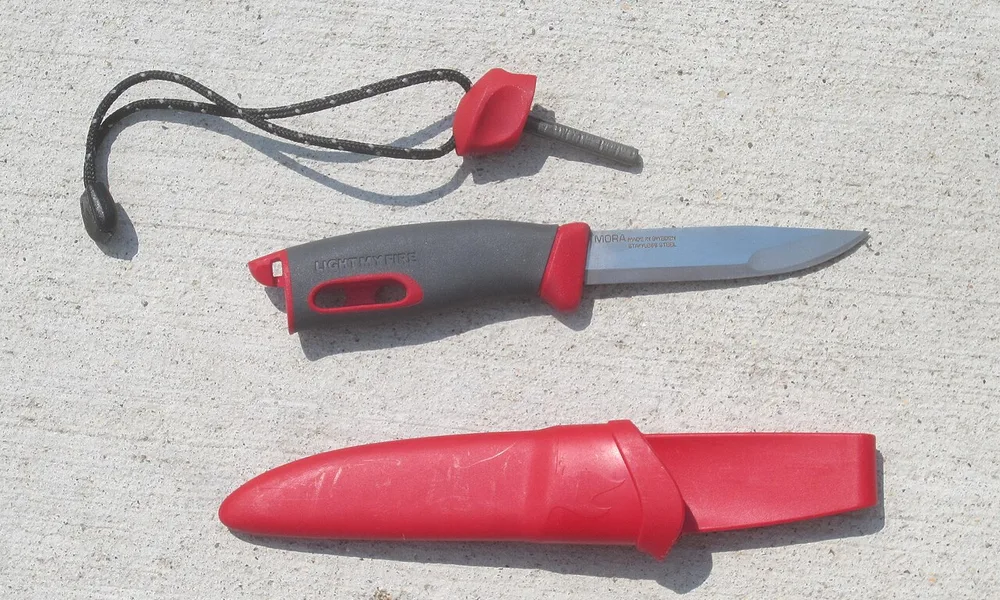
Think about where the knife will live on a trip. A belt sheath is convenient at camp but can dig into your hip on a long walk, while a knife in a pack is safer on the move but slower to reach. Many campers carry the knife on their belt at camp and in their pack on the trail, which keeps the blade accessible when it is useful and out of the way when it is not.
Real Camp Jobs a Good Knife Should Handle
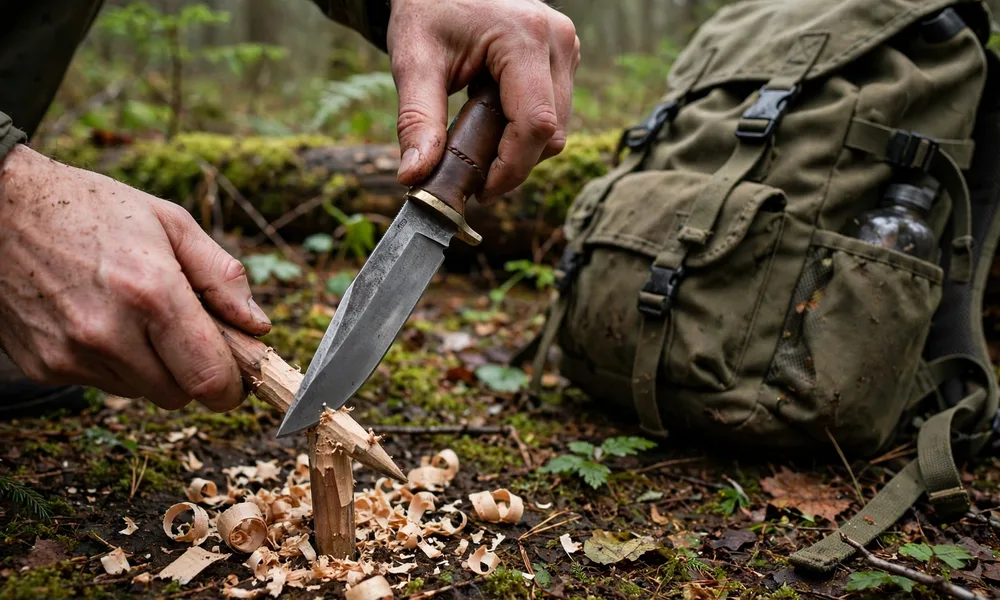
Remember that a knife is only one part of a camp tool kit. A folding saw cuts logs faster, an axe splits them better, and pliers grip what a knife cannot. The best multitools earn their place by covering the small fixing and gripping jobs a knife cannot do, and our guide to the best multitools is worth reading if you want one tool that does a little of everything. The camping knife stays the star of the kit, though, because it is the tool you reach for first and use most.
Sharpening and Looking After Your Knife
A blunt knife is more dangerous than a sharp one, because it needs more force to cut and slips more easily. Keeping your camping knife sharp is a simple habit, not a specialist skill. A small sharpening stone or pocket sharpener will bring back an edge in a few minutes at camp, and a proper sharpening session at home after each trip will keep the blade in good condition for years.
Mistakes to Avoid When Buying a Camping Knife
The third mistake is ignoring the sheath. A cheap sheath that lets the knife rattle loose, or that soaks up rain and holds it against the blade, will ruin a good knife and can cause a nasty cut. Spend a little of your budget on a sheath that fits well and holds the knife securely.
Before You Buy Checklist
Frequently Asked Questions
What is the best blade length for a camping knife?
Between 10 and 13 centimetres suits most campers. That length is long enough to split kindling, prepare food, and carve wood, and short enough to control precisely. Shorter blades suit backpacking, where weight matters, and longer blades suit car camping, where chopping is more common.
Is a fixed blade or a folding knife better for camping?
A fixed blade is better for camp work. It is stronger, easier to clean, and has no pivot or lock that can fail or clog with dirt. A folding knife is fine for light jobs and everyday carry, but for batoning, carving, and food preparation at camp, a fixed blade is safer and more capable.
What steel should I choose for a camping knife?
Stainless steel is the best choice for most campers because it resists rust and needs little maintenance. High-carbon steel holds a finer edge and is easier to sharpen in the field, but it must be dried and oiled after every use. Beginners should start with stainless.
How do I sharpen a camping knife at camp?
Carry a small stone or pocket sharpener and work the blade at about 20 degrees, alternating sides until you feel a slight burr along the edge. Remove the burr with light strokes and test the edge on paper or a sliver of wood. A few minutes of care keeps the knife safe and effective.
Can I take a camping knife on a plane?
Not in hand luggage. Camping knives must go in checked baggage, packed securely in their sheath and wrapped so they cannot injure baggage handlers. Rules vary by country, so check the regulations for every place you travel through before you pack.
How should I store my camping knife between trips?
Clean the blade with warm water and soap, dry it completely, and wipe carbon steel with a thin film of oil. Store it out of its sheath in a dry place, and check the handle and sheath for wear before each trip. A knife stored dry and clean will last for decades.
The Bottom Line
The best camping knife is not the most expensive one or the most dramatic-looking one. It is a fixed-blade, full-tang knife with a blade of 10 to 13 centimetres, a handle that stays secure in wet hands, and a sheath that holds it safely. Choose stainless steel for easy care, a drop point for all-round use, and a size that fits the camping you actually do. Buy it once, learn to sharpen it, look after it, and it will be the tool you reach for on every trip for years to come.