Every cat owner knows the scene: you spend good money on a handsome cat tree, carry it home, assemble it with hope in your heart, and your cat walks straight past it to sleep in the cardboard box it came in. The best cat trees of 2026 are the ones that break that pattern. A cat tree your cat will actually climb needs height worth climbing to, perches wide enough to sprawl on, sisal worth scratching, and a base heavy enough that it never wobbles.
Key takeaways
- The best cat trees put the tallest perch near a window, because the view is the real reward for climbing.
- Stability matters more than looks: a wobbling tower teaches a cat to stay away from it for good.
- Sisal-wrapped posts beat carpeted posts for scratching, and they last far longer too.
- Perches should be at least 14 inches across, or most adult cats will not bother lying on them.
- Multi-cat homes need more than one high spot, or the top perch becomes a source of daily arguments.

Why most cat trees go ignored
Cats are not being ungrateful when they ignore a new tree. They are being cats. A cat judges furniture the way a building inspector judges a staircase: is it stable, does it lead somewhere worth going, and can I see what is happening from up there? Most cheap trees fail at least one of those tests. The base is too light, so the whole tower sways when the cat jumps on. The perches are small, curved, or edged with a raised rim that digs into a sleeping cat’s ribs. The tallest platform sits in a corner with nothing to look at. From the cat’s point of view, the sofa arm is a better deal, and the sofa arm is where they end up.
There is also the question of smell. A new tree straight out of the box smells of factory, glue, and packaging. Cats trust their noses more than their eyes, and a strange smell is a reason to keep a distance. Forcing the issue by placing the cat on the tree usually backfires, because a cat that feels cornered on a wobbly platform will remember the experience and avoid the tower for months.
What to look for in a cat tree
The marketing focuses on colour and style, but the cat focuses on structure. These are the five things that decide whether a tree gets climbed or gathers dust.
Height that means something
Cats climb to feel safe and to survey their territory. A tree that is only two feet tall offers neither. For most homes, a tree between four and six feet tall hits the sweet spot: high enough to feel like a vantage point, low enough to fit under a normal ceiling with room to spare. Small kittens and older cats do better with stepped platforms no more than a foot apart, so nobody has to make a leap they cannot manage.
A base that does not move
A good rule is that the base should be at least 24 inches square for a five-foot tree, and heavier is better. Solid wood bases beat hollow particleboard, and a tree that can be bolted to the wall is the gold standard for big, athletic cats. One bad wobble can put a cat off the tree permanently.
Scratching posts that actually get scratched
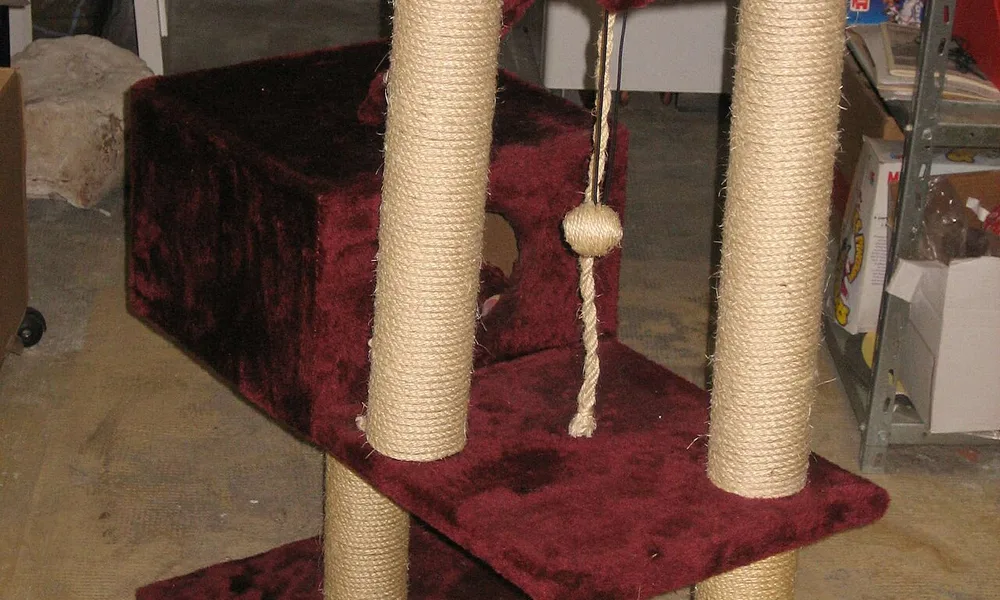
Sisal rope is the material cats prefer for scratching, and it is not close. Carpeted posts look softer, but claws snag in carpet loops, and once the carpet frays the post looks ruined. Check how the sisal is fixed: tightly wound and stapled at both ends lasts, while loosely glued rope unwinds within months. It is also the feature that saves your furniture, and if your sofa is already taking damage, our guide to choosing a sofa that survives real life is worth reading alongside this one.
Perches and hideaways in the right sizes
Measure your cat. A perch that looks generous in a product photo can be far too small for a large adult cat, especially a Maine Coon or a big tabby. Fourteen inches across is the minimum for a comfortable lounging perch, and sixteen is better. Cats like options: one high open perch for watching, one enclosed hideaway for sleeping, and one mid-level platform for staging the next jump.
Materials that survive real life
Carpet-covered trees are warm and quiet, but they trap hair and are hard to clean. Faux fur is softer and easier to vacuum. Solid wood and rattan trees look better in a living room and wipe clean, but they can be slippery for older cats unless the perches have a non-slip pad.
The best cat trees of 2026 at a glance
There is no single winner for every home, because a studio flat and a three-cat household need very different furniture.
| Cat tree | Best for | Height | Key strength | Watch out for |
|---|---|---|---|---|
| Tall multi-level tower | Active climbers | 5–6 ft | Several perches and a top lookout | Needs a heavy base and wall anchor |
| Floor-to-ceiling tree | Confident cats, small rooms | 8–9 ft | Tiny footprint, huge climbing height | Needs a solid ceiling to brace against |
| Wide condo tree | Shy cats and nappers | 4–5 ft | Enclosed hideaways and soft perches | Perches can be small for large cats |
| Modern wood tree | Design-led living rooms | 3–4 ft | Looks like furniture, wipes clean | Lower height, fewer scratching posts |
| Compact corner tree | Flats and small spaces | 3–4 ft | Fits a corner, still has a top perch | Not enough for two cats at once |
| Heavy-duty large-breed tree | Big cats and multi-cat homes | 5–6 ft | Extra-wide perches, reinforced posts | Heavy to move and takes up floor space |
The best cat tree for your home
The right tree depends on your cat and your room, not on the bestseller list. A tree belongs where the cat already spends time, ideally beside a window, because a perch with a view of birds and street life is its own reward. A tree hidden in a spare room is a tree that will be ignored, however good it is.
For small flats
In a small flat, a corner tree or a floor-to-ceiling pole makes the most of vertical space without eating floor space. Wall-mounted shelves paired with a short scratching post can work even better, because they turn an empty wall into a climbing route. The same thinking applies to the rest of the room, and our roundup of the best and worst coffee tables shows how to pick living-room furniture that earns its floor space.
For large and heavy cats
Big cats need trees built like furniture, not toys. Look for perches at least 16 inches across, posts at least four inches thick, and a base that weighs enough to stay put when a seven-kilo cat jumps on it from the sofa. Bolted construction beats glued joints, and a tree that can be fixed to the wall is worth the extra effort.
For multi-cat homes
Two cats need two high spots, at minimum. Cats are territorial about height, and the cat that controls the top perch controls the room. A single tall tree in a two-cat home often means one cat gets the view and the other gets the floor, which leads to tension and ambushes at the base. Separate feeding and resting spots matter for the same reason, and if a dog shares the house, our guide to finding a dog bed your dog will actually use covers the same territory logic for the other four-legged resident.
How to get your cat to actually use the tree
Most cats need an invitation, not an instruction. Start by putting the tree in the right place before you worry about anything else. The best spot is beside a window the cat already watches from, or next to the sofa where the family sits in the evening. Once it is placed, make the perches smell familiar by draping a blanket the cat has slept on over the top platform. A few treats placed on the middle perch, one step at a time over several days, will lure most cats upward without any handling at all.
Play is the best persuader. Dangle a wand toy up the side of the tree so the cat has to climb a step to reach it, then a step higher the next day. Never pick the cat up and put it on the top platform: a cat that feels trapped up high will jump down in a panic, and the tree will be associated with that fright for a long time. Patience works better.
Maintenance matters too. Vacuum the perches weekly, because a thick layer of shed fur puts cats off. Tighten the bolts every few months, especially on tall trees, since a tree that slowly loosens will start to wobble and the cat will notice before you do.

Cat tree buying checklist
- Measure your ceiling and your floor space before ordering,
- Pick a base at least 24 inches square for a five-foot tree, and heavier is always better.
- Check perch size against your cat: 14 inches across is the minimum for an adult cat.
- Choose sisal-wrapped posts over carpeted posts for scratching that lasts.
- Place the tree beside a window or the family sofa, never in a spare room.
- Make sure there is more than one way up and down if two or more cats share the home.
Frequently asked questions
How tall should a cat tree be?
For most homes, four to six feet is ideal. That is high enough to give the cat a real vantage point and a satisfying climb, without hitting the ceiling or dominating the room.
Where is the best place to put a cat tree?
Beside a window is the classic answer, because the view is the reward for climbing. Avoid hallways, spare rooms, and spots behind doors, where the tree will be out of sight and out of mind.
Why does my cat sleep in the box instead of the tree?
Boxes are warm, enclosed, and smell familiar, while a new tree smells of factory and glue. Give it time, and make the tree smell like home by draping a used blanket over the perch. Most cats come around within two weeks if the tree is in the right spot.
Are carpeted or wooden cat trees better?
Carpeted trees are warmer, quieter, and kinder to older cats’ joints, but they trap hair and are hard to clean. Wooden trees look better and wipe clean, but they can be slippery and offer less scratching surface.
How do I stop my cat scratching the sofa instead of the tree?
Put a tall sisal post right next to the spot on the sofa your cat scratches, because cats scratch where they already like to scratch. Reward the cat every time it uses the post, and make the sofa less appealing with a throw over the scratched area.
How long should a good cat tree last?
A well-built tree should last three to five years of daily use, and longer if the sisal can be re-wrapped and the perches are bolted rather than glued. Replace the tree when the base wobbles despite tightening, when posts are stripped bare, or when the perches sag.
Bottom line
The best cat tree is the one your cat actually climbs, and that comes down to height, stability, sisal, and placement beside a window. Buy the tallest well-built tree your room can take, put it where the cat already likes to be, and give it two weeks before judging it. Get those four things right and the cardboard box will finally lose.