Top Chair Mats That Protect Floors Without Cracking in 2026
The best chair mats in 2026 protect your floor without cracking, curling or turning cloudy after a few months of daily rolling. A good chair mat is almost invisible when it works: your chair glides, your hardwood stays scratch-free, and your carpet keeps its pile instead of flattening into a worn track. A bad one cracks at the edges, slides around, and ends up in the bin within a year.
This guide compares the main types of chair mat, explains which thickness and material suit hardwood, laminate and carpet, and shows how to size, place and care for a mat so it lasts. The goal is simple: a mat you forget about because it does its job every single day.
Key takeaways
- Polycarbonate mats are the toughest choice for hard floors, resisting cracks far better than thin PVC or vinyl mats.
- Match the mat to the floor: a flat mat for hardwood and laminate, and a mat with gripper studs for low-pile carpet.
- A mat should extend at least 10 centimetres past your chair on every side, so the casters never roll off the edge.
- Thickness matters: 2 millimetres or more holds up under a heavy chair, while mats under 1.5 millimetres crack sooner.
- Clear mats keep a room looking open, while a frosted or tinted mat hides scuffs and dust between cleans.
Why a chair mat matters more than it looks
An office chair concentrates a surprising amount of force into four small wheels. Every time you roll forward to type, lean back to think or swivel to reach a shelf, those casters press, drag and grind against the same small patch of floor. On hardwood, that means fine scratches that catch the light. On laminate, it means worn patches where the finish thins. On carpet, it means flattened pile and a permanent dent that no amount of vacuuming lifts.
A chair mat spreads that load across a wide, smooth surface. The wheels roll instead of digging in, the floor underneath stays untouched, and the chair itself moves more freely, which is kinder on your back and shoulders because you stop pushing against resistance. In a home office that gets eight hours of use a day, a mat is one of the cheapest pieces of floor insurance you can buy.
Chair mat materials, compared
Four materials dominate the chair mat market, and the differences between them are stark. Polycarbonate is the premium option: rigid, clear and very hard to crack, even under a heavy chair and a heavier user. It stays transparent for years, does not yellow in sunlight, and handles temperature changes without going brittle. It costs more, but it is the material to choose if you want to buy once.
PVC, or vinyl, is the budget standard. It is flexible, cheap and widely available in many sizes, but it is also the material most likely to crack. Thin PVC mats, especially those under 1.5 millimetres, go brittle with age and split at stress points. Thicker PVC performs better and suits lighter chairs, but it can yellow over time and may curl at the edges in a warm room.
Tempered glass mats are the newest option. They look superb, roll beautifully and never crack in the usual sense, though they can chip if dropped on a corner and they are heavy to move. They suit design-led offices and hardwood floors, and they wipe clean in seconds. The trade-off is price and weight, plus the need for a flat floor, since glass does not flex over uneven boards.

| Material | Crack resistance | Best floor | Clarity | Price |
|---|---|---|---|---|
| Polycarbonate | Excellent | Hardwood, laminate | Crystal clear | Higher |
| PVC / vinyl | Fair to good | Hardwood, low carpet | Clear, may yellow | Low |
| Tempered glass | Excellent* | Hardwood, flat floors | Crystal clear | Highest |
| Studded PVC | Fair | Low-pile carpet | Clear | Low |
*Glass does not crack like plastic, but it can chip at the edges if knocked hard.
Hard floors: what to look for
On hardwood and laminate, the mat has one job above all: stay put and stay clear. A mat that slides across the floor is worse than no mat at all, because it bunches up and creates a trip hazard. Look for a smooth-backed mat designed for hard floors, and check that the underside is genuinely flat rather than studded. Studs are for carpet; on a hard floor they scratch the finish they are meant to protect.
Thickness is the second decision. A mat of 2 millimetres or more feels solid under the wheels and resists the dents that form where a chair sits for hours. Thinner mats feel flimsy, show every wheel mark and crack sooner at the edges. If your chair is heavy, or the person using it is, step up to the thickest mat in the range you can afford.
Clarity matters more than most people expect. A cheap mat can look cloudy or slightly blue, which dulls a beautiful wooden floor. A good polycarbonate mat is almost invisible, so the grain of the wood shows through and the room keeps its look. If your floor is dark, a frosted mat can be a smarter choice than a clear one, because it hides dust and scuff marks that show up quickly on a glossy surface.
Carpet: gripper studs and pile height
Carpet changes the rules completely. A smooth-backed mat will slide on carpet, so carpet mats have small studs or cleats on the underside that grip the pile and hold the mat in place. The studs need to match the carpet: short studs for low-pile office carpet, longer studs for thicker pile. A mat with studs that are too short will drift; one with studs that are too long will not sit flat.
Pile height is the limiting factor. On low-pile commercial carpet, a chair mat works well and the chair rolls easily. On medium pile, a thicker, more rigid mat is needed to stop the wheels sinking. On deep, plush carpet, most mats struggle, and the honest answer is often a rigid polycarbonate mat or a glass mat, which spreads the load and keeps the chair moving. If the carpet is very thick, measure the pile before ordering and choose a mat rated for that depth.

Size and shape: getting it right first time
Most chair mats come in rectangles, with or without a lip that extends under the desk. The lip version looks odd at first, but it protects the floor where your feet rest and where the chair rolls forward to the keyboard. A standard rectangle of 120 by 90 centimetres suits a single desk and a chair that stays mostly in place. If you swivel often, or your desk is wide, go larger.
The rule to remember is simple: the mat should extend at least 10 centimetres past the chair in every direction the wheels travel. Sit in the chair, roll to your furthest normal position, and check where the wheels end up. If a wheel rolls off the edge of the mat, it will catch the lip, the mat will lift, and the floor at the edge will take the wear instead.
What makes a mat crack, and how to stop it
Cracking has four main causes, and three of them are avoidable. The first is thin material: a mat under 1.5 millimetres simply does not have enough substance to absorb years of rolling, and it will split at the corners or along the wheel track. The second is cold: PVC goes brittle in a cold room, so a mat that lives in an unheated spare room in winter is at risk. The third is sunlight: strong, direct sun degrades cheap plastic over time, so a mat in front of a south-facing window ages faster.
The fourth cause is the chair itself. Hard, narrow casters concentrate force into a small area, while wider, softer casters spread it. If your chair has small plastic wheels, consider swapping them for rollerblade-style casters, which are wider, quieter and far kinder to both the mat and the floor. The combination of a good mat and good casters is the single best way to stop cracking.
Chair mat checklist: before you buy
- Measure your rolling area and add 10 centimetres in every direction before choosing a size.
- Match the backing to the floor: smooth for hardwood and laminate, studded for carpet.
- Choose polycarbonate or glass for the longest life, and avoid mats thinner than 2 millimetres.
- Check the mat is rated for your carpet pile height if you have carpet.
- Pick clear for a showpiece floor and frosted for a busy, everyday room.
- Consider wider rollerblade-style casters to protect both the mat and the floor.
Setting up and caring for your mat
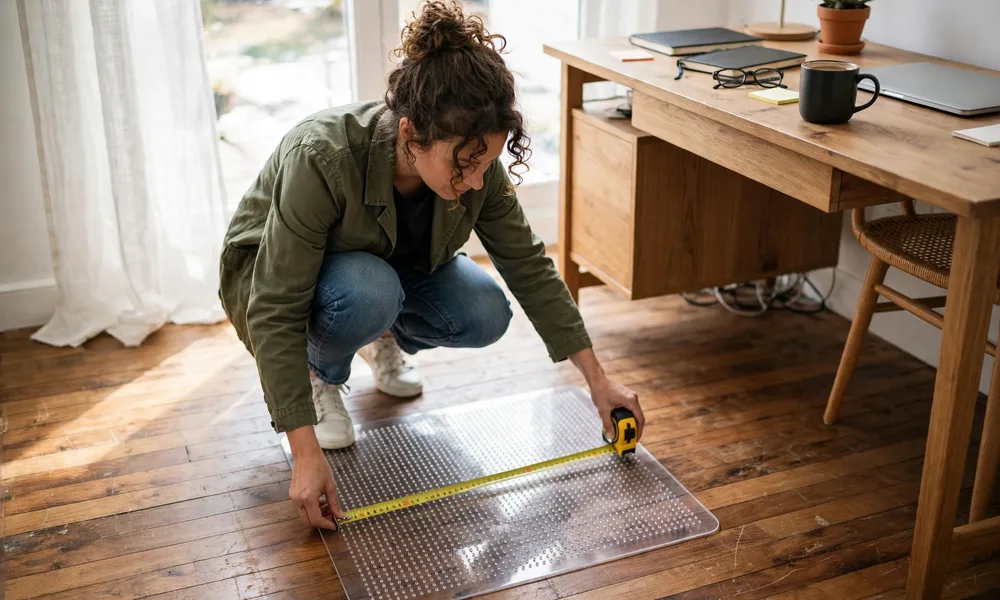
When the mat arrives, let it lie flat for a day before use, especially if it was shipped rolled. A mat that is still curled will lift at the corners and catch the chair wheels. Place it on a clean, dry floor, smooth side down on hard floors and studded side down on carpet, and check that it sits flat before you put the chair on it.
For a home office, the rest of the setup matters too. A well-chosen desk mat protects the desk surface in the same way a chair mat protects the floor, and the two together give the whole workspace a finished feel. Pair the mat with a supportive ergonomic chair and the chair will roll smoothly instead of fighting the floor, which is the point of the whole exercise. And if the room needs softening, a good area rug can define the space around the desk without getting in the way of the wheels.
Frequently asked questions
How thick should a chair mat be?
For most home offices, 2 millimetres or more is the right thickness. Thinner mats crack sooner and show wheel marks, while thicker mats feel solid and last longer. On carpet, go thicker still, because the mat has to stay rigid over a soft surface.
Will a chair mat damage hardwood floors?
A smooth-backed mat designed for hard floors will not damage hardwood. Damage happens when a mat is used on the wrong floor, when grit gets trapped underneath, or when a studded carpet mat is placed on wood. Keep the floor clean under the mat and use the right backing.
Do chair mats work on carpet?
Yes, on low- and medium-pile carpet, provided the mat has gripper studs matched to the pile height. On very deep pile, a rigid polycarbonate or glass mat works best. Measure the pile before buying and choose a mat rated for it.
Why did my chair mat crack?
The usual causes are thin material, cold temperatures, direct sunlight and narrow, hard casters. A mat under 1.5 millimetres, a cold room or a south-facing window all shorten its life. Thicker polycarbonate and wider casters are the best fixes.
How do I stop a chair mat sliding?
Clean the floor and the underside of the mat, check the backing matches the floor, and consider a non-slip underlay on very smooth floors. On carpet, make sure the studs are long enough to grip the pile.
Is glass or polycarbonate better?
Polycarbonate is lighter, cheaper and easier to move, and it suits most rooms. Glass looks better, rolls beautifully and never yellows, but it is heavy, expensive and can chip at the edges. For most people, polycarbonate is the better all-round choice.
The bottom line
The best chair mats in 2026 are the ones you never think about: thick enough not to crack, matched to your floor, sized generously and made from a material that lasts. Polycarbonate is the safest bet for most homes, glass is the premium choice for a design-led room, and a good PVC mat can work if it is thick and the chair is light. Measure first, buy the right backing for your floor, and pair the mat with wider casters. Your floor will thank you for years.