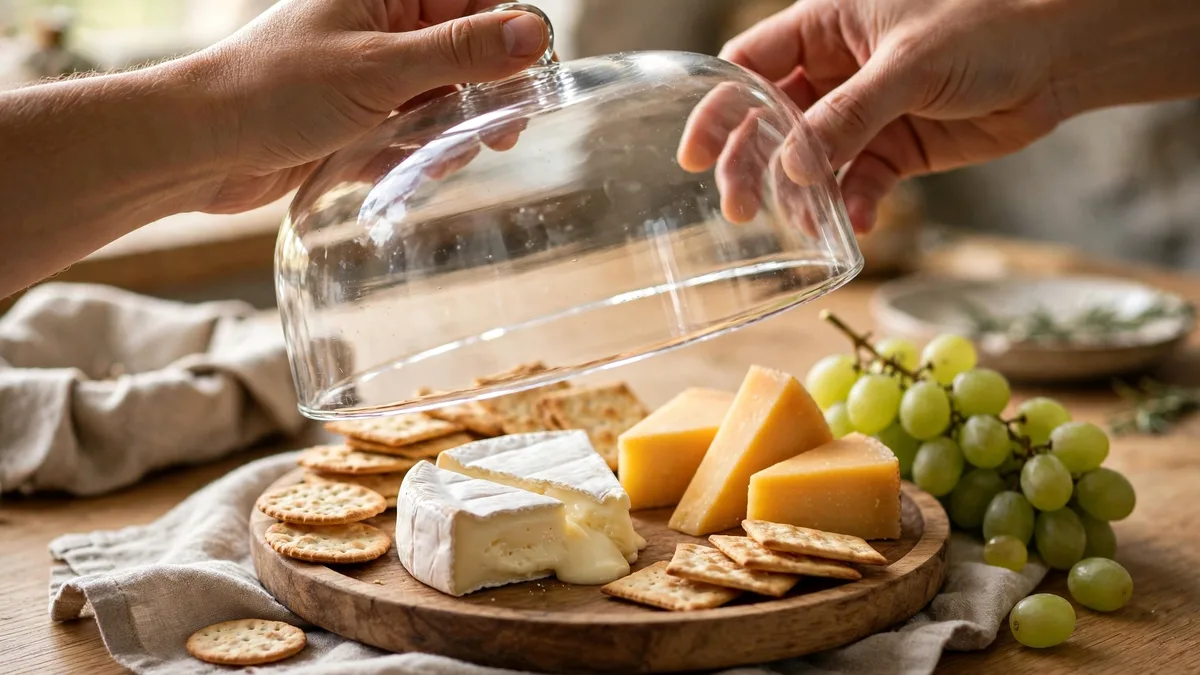
The best cheese servers in 2026 do a job no flat board can do: they carry cheese to the table, keep it covered until it is eaten, and present it like the centrepiece it is. A cheese server is a handled serving piece, usually a board or tray with a glass dome that lifts off. Without a cover, a soft brie skins over, a hard cheddar dries at the edges, and flies find the board before the guests do. With one, the cheese stays fresh and clean all evening, and lifting the dome becomes part of the occasion. This guide compares the cheese server with the cheese knife, and explains the server types, domes and base materials worth buying in 2026.
Key Takeaways
- A cheese server is a handled tray with a dome cover; it carries and covers cheese, while a cheese knife only cuts it.
- The dome is the whole point: it shows the cheese off, keeps it fresh and keeps dust and flies away, but it adds weight and needs a safe place to rest when lifted.
- Wood bases are warm and kind to knives, marble bases stay cool and suit soft cheeses, and slate bases look modern but dull blades fast.
- A low dome suits flat wedges and a tall dome suits whole wheels and stacked spreads.
- If you already own good knives, buy the server first; if you own a good board but no proper cheese knife, buy the knife first.
Cheese Servers vs Cheese Knives: Two Different Upgrades
Hosts usually face this choice in the same order: the board is bought, the cheese is chosen, and then something feels missing. One option is a cheese server, the domed serving piece that turns the board into a presentation. The other is a set of cheese knives, the specialist blades that cut soft, semi-hard and hard cheeses cleanly. Both are genuine upgrades, but they solve different problems.
The server wins on presentation and freshness. A covered cheese keeps its moisture, its aroma stays where it belongs, and the table looks finished the moment the dome goes on. The knife wins on function: a brie cut with a chef knife smears, a parmesan cut with a thin blade shatters, and no dome fixes a bad cut. Our guide to how to pick a cheese knife for soft and hard cheeses covers the blade shapes in full: soft cheeses need a thin, holed blade, hard cheeses need a short, sturdy one, and semi-hard cheeses need a flat, medium blade. If your knives already do that job, the server is the better next buy.

What a Cheese Server Actually Is
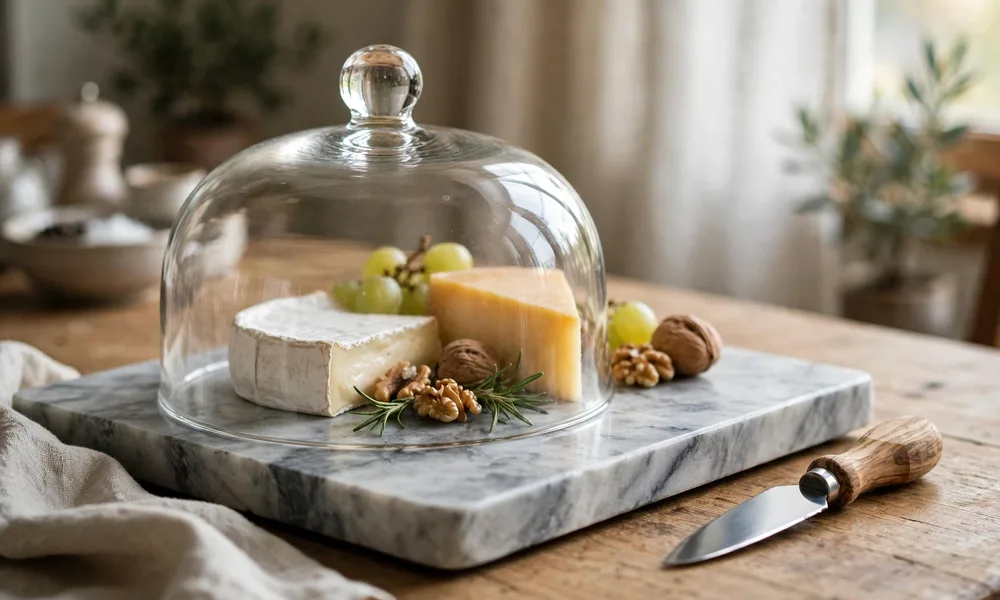
A cheese server is built around two parts: a base and a cover. The base is a flat tray or board, usually wood, marble or slate, often with a handle at one end so it can be carried from the kitchen to the table with one hand. The cover is a dome, almost always glass, with a knob handle on top. Lift the dome and the cheese is revealed; set it back and the cheese is protected again. Some servers are sold as a set with matching knives that slot into the base, and those sets are often the best value, because the knives are sized to the board.
That combination is what separates a server from a board. A board is a flat surface for cutting and arranging, and our guide to cheese boards that make entertaining easy covers boards in depth: materials, sizes, juice grooves and handles. A server adds the dome and the carrying handle, and with them a different job: keeping cheese in serving condition rather than just holding it.
The Main Types of Cheese Server Compared
| Server type | Base | Dome | Best for | Watch out for |
|---|---|---|---|---|
| Wooden paddle server | Acacia or walnut | Glass, low to medium | Everyday entertaining | Dome can slide |
| Marble server | Marble slab | Glass, medium to tall | Soft cheeses, warm rooms | Heavy, chips if dropped |
| Slate server | Slate slab | Glass, low | Modern tables | Dulls blades fast |
| Footed server | Wood or ceramic | Glass, tall | Whole wheels | Awkward to store |
| Server set with knives | Wood, with slots | Glass, medium | Gifting, first set | Check every knife is useful |
The wooden paddle server is the best choice for most households in 2026. Acacia is the most common hardwood, with a warm grain and natural stain resistance, and a paddle handle makes the loaded server easy to carry with one hand. Wood is kind to knife edges, which matters because guests will cut on the base even when they should not, and it survives a knock that would chip marble. The weakness of wood is the dome: on a smooth, oiled surface a glass dome can slide if the table is bumped, so look for a shallow groove that seats the dome, and always lift it straight up rather than sliding it sideways.
Marble servers suit soft cheeses best. Stone stays cool, which keeps a brie firm and a camembert from slumping on a warm evening, and a white or grey marble slab looks striking under a glass dome. The trade-offs are weight and fragility: a marble server is heavy when loaded, it chips if dropped, and cutting directly on stone blunts a good knife in a single evening. Cut the cheese on wood first, then arrange it on the marble for serving. Slate is the modern alternative: dark, dramatic, and happy with chalk labels beside each cheese. It shares marble’s knife problem, and slate is brittle at the edges, so a dropped corner can snap clean off.
The Dome: Height, Glass and the Knob
The dome decides more of the experience than the base does, and it is the part buyers check least. A low dome, around 10 to 12 centimetres, suits flat wedges and a single layer of accompaniments, and it stores easily. A tall dome, 15 centimetres or more, suits whole wheels, a soft-ripened round standing proud, and spreads stacked with fruit and nuts. Measure the tallest cheese you serve regularly, then add three centimetres for the garnish and the air that keeps the dome from touching the rind. A dome that rests on the cheese is worse than no dome at all, because it sticks and tears the rind.
Glass quality matters too. Clear, thick glass shows the cheese properly and survives being lifted a hundred times; thin glass flexes, fogs and chips at the rim. Look for a rolled or thickened rim rather than a sharp cut edge, and a knob that is easy to grip with damp hands. A round ball knob looks classic but can slip in a greasy hand, while a flat, wide knob gives a surer grip. If the dome fogs within minutes, lift it for a minute and let the air change before setting it back.
How to Use a Cheese Server Well
At the table, lift the dome straight up with both hands if it is large, and set it down on a folded cloth rather than directly on the table, where the rim can chip or leave a ring. After the party, wash the base by hand, dry the dome straight away so water spots do not form, and store the dome upright or on its side with a cloth between it and anything hard. A dome stored rim-down on a shelf is a dome waiting to chip, and a chipped rim is the end of a server, because it will never sit true again.

Who Should Buy a Server, and Who Should Not
A cheese server is worth buying if you entertain often, serve cheese as a course rather than a snack, or host buffets where the cheese sits out for an hour or more. It earns its cupboard space through repetition: a dome lifted at every gathering, a board carried to the table without a second trip, and cheese that still looks and tastes fresh at the end of the evening.
It is not worth buying if you eat cheese alone at the kitchen counter, if your cupboards are already full of boards, or if you have no proper cheese knife yet. A server over cheese cut with a bread knife is decoration over a problem, and the money is better spent on the knives first. It is also a poor buy for a very small kitchen, because the dome is bulky and awkward to store, and for a household with small children, because a glass dome at table height is a breakage waiting to happen. In those cases, a good flat board and a proper knife set do the job better. The guide to charcuterie boards is the better next read if your spread is mostly meats, fruit and dips rather than cheese alone, because a charcuterie board is built for variety where a server is built for cheese.
Your Cheese Server Checklist
- A dome tall enough for your tallest cheese, with three centimetres of clearance above the rind.
- A base with a groove or rim that seats the dome, so it cannot slide when the table is bumped.
- A handle that is part of the base, not screwed on, and long enough to carry the loaded server with one hand.
- Wood for everyday cutting, marble for soft cheese on warm evenings.
- A knob you can grip with damp hands, and a rim thick enough to survive a hundred lifts.
- A size that serves your usual gathering, around 30 centimetres round or 40 by 25 centimetres rectangular.
Frequently Asked Questions
What is the difference between a cheese server and a cheese board?
A cheese board is a flat surface for cutting and arranging cheese, while a cheese server adds a dome cover and usually a carrying handle, so the cheese stays fresh and covered until it is eaten. A board suits a quick snack; a server suits a dinner party or a buffet.
Should I buy a cheese server or cheese knives first?
Buy the knives first if you still cut cheese with an ordinary kitchen knife, because a bad cut ruins good cheese and no dome fixes it. Buy the server first if you already own good cheese knives.
Does a glass dome make cheese sweat?
A tightly sealed dome can trap humidity and make a soft cheese sweat, especially if the cheese was cold when it went under. Let the cheese warm up before covering it, lift the dome once halfway through to change the air, and wipe the inside with a dry cloth if it fogs.
Can I cut cheese directly on a marble cheese server?
You can, but you should not: cutting on marble or slate blunts a good knife quickly. Cut the cheese on a wooden board first, then arrange it on the marble server for serving, where the cool stone keeps soft cheese firm.
How do I stop the dome sliding off the base?
Choose a base with a shallow groove or a raised rim that the dome sits inside, and always lift the dome straight up rather than sliding it sideways. A dome on a smooth, oiled wooden base with no groove will slide if the table is bumped.
How do I store a cheese server dome safely?
Store the dome upright or on its side with a cloth between it and anything hard, never rim-down on a shelf, where the rim can chip. A chipped rim means the dome will never sit true again.
Bottom Line
Verdict: The Best. The best cheese servers in 2026 are wooden paddle servers with a clear glass dome tall enough for the cheese you serve most, a groove that seats the dome, and a handle that is part of the base. Buy the server first if your knives are already good, and buy the knives first if they are not, because the server presents and protects while the knife cuts, and neither one replaces the other. Measure your tallest cheese, add three centimetres, and choose the dome to fit it.