Top Chives for Fresh Cooking in 2026
The best chives for fresh cooking in 2026 are the ones that taste like spring in a snip: bright green, hollow and crisp, with a mild onion flavour that lifts a dish without taking it over. Chives are the gentlest member of the onion family, and that gentleness is exactly why cooks reach for them. A handful turns plain scrambled eggs into something finished, and gives a baked potato its classic topping. This guide explains how to pick good chives, keep them fresh, cut them properly and use them in the dishes where they shine most.
Key takeaways
- Fresh chives should be bright green, firm and hollow, with no yellow tips, slime or limp stems.
- Snip chives with scissors or a sharp knife at the last moment, because cutting them early dulls both colour and flavour.
- Common chives suit everyday cooking, while garlic chives bring a flatter leaf and a gentle garlic note.
- Store cut chives upright in water in the fridge, and use them within a week for the best flavour.
- Chives are a finishing herb, not a cooking herb: add them at the end so their delicate flavour survives.
How the best chives were chosen
Every form of chives below was judged on five measures. Freshness comes first: colour, firmness and a clean, mild onion scent, with no yellowing or damp patches. Flavour is second, because the best chives taste of mild onion with a fresh green edge, never harsh or bitter. Versatility is third: the forms that work across eggs, potatoes, soups, salads and dips rank higher than one-trick options. Keeping quality is fourth, since chives that stay crisp for a week beat ones that wilt in two days. Value is fifth: the real cost per use before the bunch fades.
Two notes before the list. First, this guide is about chives as food, not about the tools around them. The scissors that snip them, the keeper that stores them and the garden that grows them all have their own guides, and they are linked here where they help. Second, the fresh bunch is the standard the rest are measured against.
Comparison table: the best chives for fresh cooking in 2026
| Rank | Form | Best for | Watch out for |
|---|---|---|---|
| 1 | Fresh common chives | Everyday cooking, eggs, potatoes | Wilts within a week |
| 2 | Garlic chives | Stir-fries, dumplings, eggs | Stronger flavour, not a straight swap |
| 3 | Chive blossoms | Salads, garnishes, vinegar | Short season, use quickly |
| 4 | Freeze-dried chives | Pantry backup, camping, travel | Softer texture, milder flavour |
| 5 | Frozen chopped chives | Soups, stews, sauces | Goes limp, never a garnish |
| 6 | Dried chives | Emergency pantry use | Weakest flavour of all |
| 7 | Potted chive plants | Cut-and-come-again supply | Needs light and regular watering |
The best chives for fresh cooking
1. Fresh common chives: the everyday best
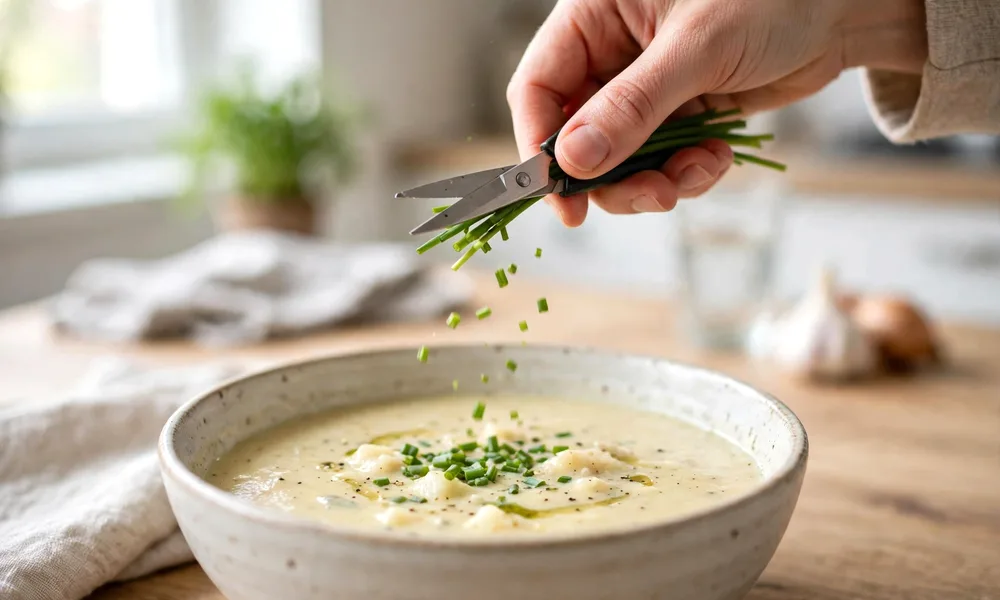
Fresh common chives are the best all-round choice, because they do the core job better than any other form. The stems are thin, hollow and bright green, with a mild onion flavour that suits almost any savoury dish. Snip them over eggs or soup, or stir them into sour cream for a baked potato. Buy a bunch that feels firm, with stems that stand up and leaves evenly green from base to tip, and avoid yellow tips or slimy cut ends.
2. Garlic chives: the best for a garlicky edge
Garlic chives are the best choice when you want chives with a little more character. Their leaves are flat rather than hollow, a deeper green, and their flavour carries a gentle garlic note alongside the onion. They are a staple in Asian cooking, where they go into dumplings, stir-fries and egg dishes, and they work just as well in Western kitchens for anyone who finds common chives too mild. Use them tossed through noodles, folded into an omelette, or mixed into a filling. Do not treat them as a straight swap in delicate dishes, where the garlic edge can push the balance off. Buy them the same way as common chives, firm and bright, and use them within a few days, since the flat leaves bruise and wilt faster than hollow stems.
3. Chive blossoms: the best garnish
Chive blossoms are the prettiest form of the herb, and the best garnish in this guide. The pale purple pom-pom flowers taste like mild onion with a faint floral sweetness, and they look striking scattered over a salad, a cheese board or a plate of grilled fish. Pull the flower head apart into small florets before using it. The season is short, usually a few weeks in late spring or early summer, so blossoms are a treat rather than a staple. They also make a pink infused vinegar for salad dressings. Buy or pick blossoms that are fully open but still fresh, with no brown edges, and use them the same day.
4. Freeze-dried chives: the best pantry backup
Freeze-dried chives are the best backup when fresh chives are not in the house. They are made by freezing fresh chives and removing the water, which keeps their green colour and much of their flavour while making them light and shelf-stable. They are not as bright as fresh, and they soften rather than snap, but stirred into a dip, a sauce or a soup they do a respectable job. They shine where fresh herbs are impractical, like a holiday cottage or a camping trip. Sprinkle them over a dish at the end of cooking and give them a minute to soften. Check the packet before buying: the pieces should be bright green, not brown or dusty, and the jar should seal well, because moisture is their enemy.
5. Frozen chopped chives: the best for cooking in
Frozen chopped chives are the best form for dishes where chives are cooked in rather than scattered on top. They are sold in small bags or as frozen cubes, already chopped, and they go straight from the freezer into a soup, a stew or a sauce. Their flavour is closer to fresh than dried chives, because freezing preserves the mild onion taste well, but their texture goes limp, so they never work as a garnish. Keep a bag in the freezer for weeknight soups and cheese sauces. There is no washing, chopping or waste. Do not thaw them first, because they turn soggy; add them frozen in the last few minutes of cooking so they keep as much colour and flavour as possible.
6. Dried chives: the last resort that still helps
Dried chives are the weakest form in this guide, and the honest advice is to treat them as a last resort. Drying takes away much of the fresh green flavour and leaves a mild, slightly hay-like onion note that only shows up in cooked dishes. They have one real advantage: they last for months in a jar, cost almost nothing, and are always there when the shops are shut. Add them early in cooking, and use a little more than you would fresh. They work best in long-cooked stews and sauces, where their subtlety does not matter. Never use dried chives as a garnish: they look dull, feel papery, and add nothing to the finished plate.

7. Potted chive plants: the best steady supply
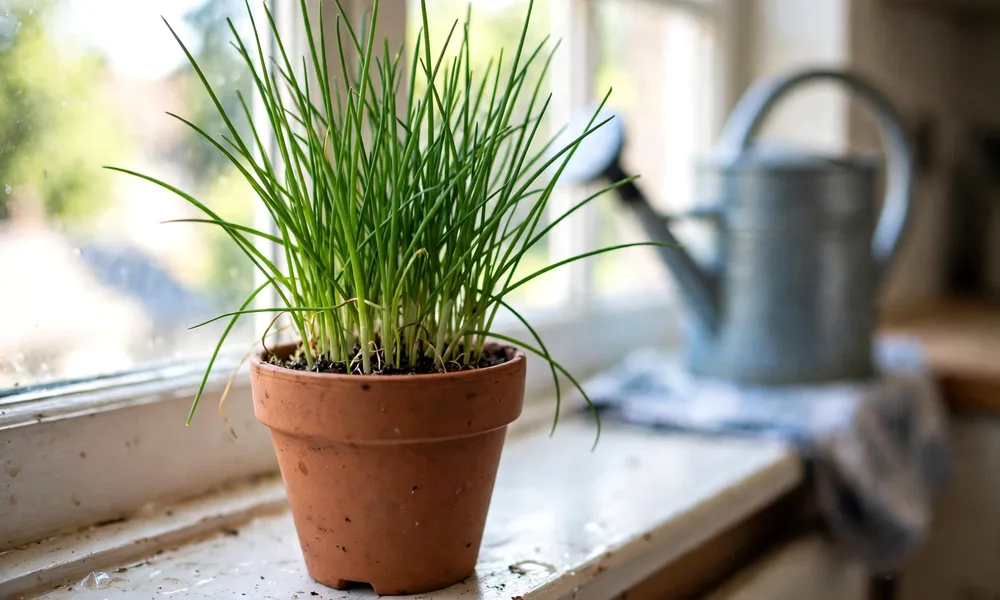
A potted chive plant is the best way to keep a steady supply of fresh chives without buying a bunch every week. The plant is hardy, grows back after cutting, and needs only a sunny windowsill, regular watering and a pot with drainage. Snip the outer stems first, about a third at a time, and it will regrow within weeks. A single pot usually gives enough chives for everyday cooking through spring, summer and autumn, and the plant can live for years if it is divided and repotted when it gets crowded. The flavour is as good as shop-bought, often better. The only real demand is light: a dark kitchen will give you thin, pale stems, so put the pot where it gets several hours of sun a day and it will repay you all season.
What to avoid when buying chives
The most common mistake with chives is buying a tired bunch and hoping it will recover. It will not. Yellow tips mean the stems are already ageing, slimy cut ends mean they have been sitting in water too long, and a limp bunch that will not stand up has lost the crispness that makes chives worth using. The second mistake is cutting them too early: snip them at the last moment, directly over the dish. The third is cooking them hard. Chives are a finishing herb, and a long simmer turns them dull and grey. Add them at the end, off the heat, and let the warmth of the dish do the work. Finally, do not confuse chives with spring onions, which are thicker, stronger and crunchier.
Checklist: buying and using chives
- Choose bunches that are bright green, firm and springy, with no yellow tips or slimy ends.
- Store cut chives upright in a little water in the fridge, or wrapped loosely in a damp cloth.
- Snip chives with scissors or a sharp knife at the last moment, directly over the finished dish.
- Add chives at the end of cooking, off the heat, so their colour and mild flavour survive.
- Use garlic chives only where a gentle garlic note is welcome, not as a straight swap.
- Keep a backup in the freezer or pantry, but use fresh chives whenever the dish is served raw or garnished.
Frequently asked questions
What is the difference between chives and green onions?
Chives are thin, hollow and mild, with a delicate onion flavour and a soft texture. Green onions, also called spring onions, are thicker, crunchier and stronger, with a white bulb at the base. Chives are best as a finishing garnish, while green onions can be cooked and eaten in larger amounts.
How long do fresh chives last in the fridge?
About a week if they are stored well. Stand the bunch upright in a jar with a little water, cover the leaves loosely, and change the water every two or three days. A good keeper for cut herbs works the same way and can stretch that to two weeks for some bunches.
Can you freeze fresh chives?
Yes, for cooking. Chop them, freeze them flat in a bag, and add them frozen to soups, sauces and stews. They go limp on thawing, so they are not suitable as a garnish.
Are chive flowers edible?
Yes. The pale purple blossoms taste like mild onion with a faint floral note. Pull them apart into florets and scatter them over salads, cheese boards or grilled fish. Use them the same day you pick them, while they are fresh and fully open.
Do chives need to be washed before use?
Yes, give them a quick rinse under cold water and shake them dry. Chives grow close to the ground, so grit can cling to the stems. Wash them just before snipping, not hours ahead, because wet chives wilt faster in the fridge.
What dishes do chives suit best?
Eggs, baked potatoes with sour cream, creamy soups, soft cheeses, salads and fish. They suit dishes where a mild onion lift is welcome but a strong onion would take over, and are at their best added at the end.
Bottom line
The best chives for fresh cooking in 2026 are fresh common chives: bright, firm and mild, snipped at the last moment over the finished dish. Garlic chives add a gentle garlic edge for stir-fries and dumplings, blossoms make the prettiest garnish, and a potted plant keeps the supply coming all season. Keep a frozen or freeze-dried backup for cooking, but reach for fresh whenever the dish is served raw or garnished, and your chives will taste like they should: green, mild and unmistakably fresh.