Best Cooking Oils for Every Heat in 2026
Choosing the best cooking oils is less about finding one perfect bottle and more about matching the oil to the heat. A bottle that makes a beautiful salad dressing can turn bitter and smoky in a hot frying pan, while a sturdy frying oil can taste flat and dull drizzled over tomatoes. Most kitchens only need three or four bottles to cover everything, yet the shelf in the supermarket suggests otherwise, with dozens of choices that all claim to be healthy, versatile and essential. The truth is simpler. Once you understand smoke point, flavour and how an oil is made, the choice at each heat level almost makes itself. This guide compares the main cooking oils side by side, explains which one suits low, medium and high heat, and shows how to store them so they stay fresh.
Key takeaways
- Match the oil to the heat first: a low smoke point oil belongs in dressings, a high smoke point oil belongs in the frying pan.
- Neutral oils such as canola and vegetable oil are the everyday workhorses, while olive oil earns its place for flavour at low and medium heat.
- Smoke point is a guide, not a guarantee: a tired, old or overheated oil smokes sooner than a fresh bottle of the same kind.
- Buy refined oils for high heat and save unrefined, flavoured oils for finishing, where their taste actually shows.
- Store every oil cool, dark and sealed, and use it within a few months of opening for the best flavour.
What a smoke point actually tells you
The smoke point is the temperature at which an oil starts to smoke steadily, and it is the single most useful number when you are choosing a cooking oil. Below it, the oil behaves; above it, it breaks down, tastes bitter and fills the kitchen with acrid smoke. Refined oils have higher smoke points than unrefined oils from the same plant, because refining removes the particles and compounds that burn first. That is why a refined oil is the safer choice for frying, while a cold-pressed, unrefined oil is better kept for dressings and finishing. An oil that has been open for a year, left beside the hob or used for frying three times already will smoke well below its published figure. Learning the rough order, from delicate oils at the bottom to robust frying oils at the top, is enough to choose well every time.
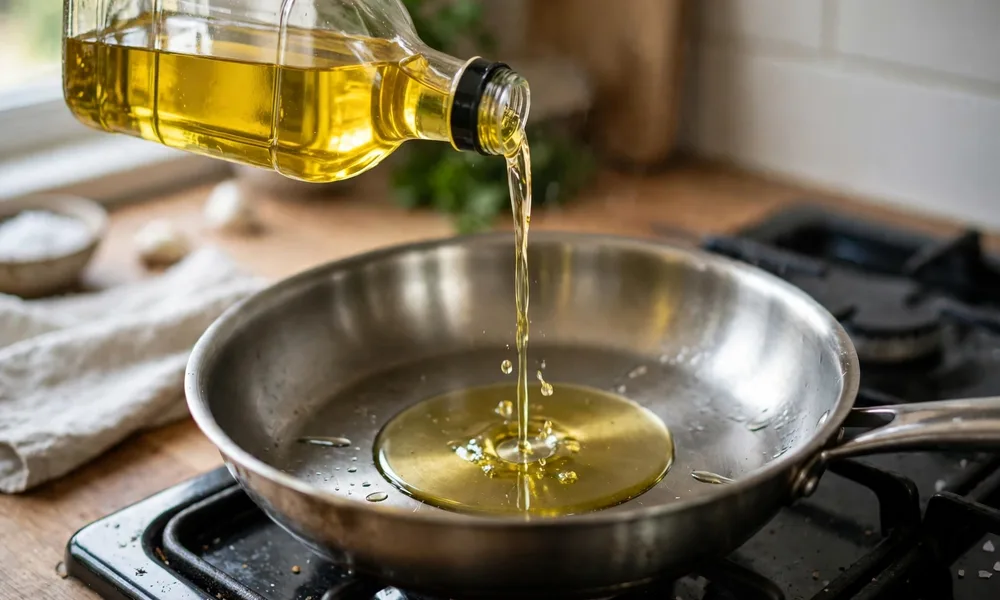
The oils, side by side
Here is how the main cooking oils compare on the three things that matter most: how hot they can go, how much flavour they bring, and what they cost to keep on the shelf. Use the table to narrow the choice, then read the heat sections below to match an oil to the job in front of you.
| Oil | Smoke point | Flavour | Best for |
|---|---|---|---|
| Extra virgin olive oil | About 190°C | Grassy, peppery | Dressings, low and medium heat |
| Canola oil | About 204°C | Neutral | Everyday frying, roasting, baking |
| Vegetable oil | About 220°C | Neutral | Shallow frying, baking, roasting |
| Sunflower oil | About 225°C | Light, mild | Frying, roasting, dressings |
| Peanut oil | About 230°C | Lightly nutty | High-heat frying, stir-fries |
| Avocado oil | About 270°C | Mild, buttery | Searing, roasting, grilling |
| Coconut oil | About 177°C | Distinctly coconut | Medium heat, baking, curries |
| Sesame oil | About 175°C | Strong, nutty | Finishing, dressings, stir-fry flavour |
The table shows why no single oil wins everywhere. Avocado oil tolerates the most heat but costs the most per litre, while vegetable oil is cheap and hot enough for most everyday frying but brings no flavour of its own.
Low heat and no heat: dressings and finishing
When there is no heat at all, flavour is everything, and this is where the best-tasting oils earn their keep. Extra virgin olive oil is the classic choice for dressings, with a grassy, peppery bite that makes a simple salad taste finished. A good bottle needs nothing more than lemon juice or vinegar, salt and a little mustard to become a dressing worth making. Toasted sesame oil is the other star of the no-heat shelf: a few drops give noodles, slaws and dipping sauces a deep nutty note, though it is far too strong to use by the spoonful. Keep these bottles away from the hob and treat them like a condiment rather than a cooking medium.
Medium heat: sautéing, roasting and baking
Medium heat is where most everyday cooking happens, and it is where a neutral oil proves its worth. Canola oil is the workhorse here: neutral enough to let the food taste of itself, with a smoke point around 204°C that covers sautéing onions, roasting vegetables and pan-frying chicken without complaint. It is also one of the cheapest oils per litre, which matters when you are using it every day. Olive oil works well at medium heat too, and its flavour suits Mediterranean cooking, roasted vegetables and anything with garlic and herbs, though you should keep the heat moderate and never let it smoke. The rule for medium heat is simple: if you can smell the oil, it is probably too hot or the wrong oil for the dish.
High heat: frying, searing and stir-fries
High heat is the hardest test an oil faces, and it is where the wrong choice shows up fastest, as smoke, bitterness and a kitchen that smells of burnt fat. Vegetable oil, a blend usually made from soybean, canola and sunflower oils, handles most everyday frying well, with a smoke point around 220°C and a price that makes deep frying affordable. Sunflower oil is a close rival, light in flavour and hot enough for shallow frying and roasting at high temperatures. For the fiercest heat, peanut oil is the cook’s favourite, with a smoke point around 230°C and a clean, lightly nutty taste that suits stir-fries and deep frying, though anyone with a nut allergy in the house should avoid it entirely.

Flavour: when the oil should disappear and when it should speak
Flavour is the part of the choice that a smoke point table cannot make for you. A neutral oil is the right call whenever the food itself should carry the dish: a delicate fish fillet, a sponge cake, a stir-fry where the sauce does the talking. In those dishes, an oil with a strong personality gets in the way, and a neutral bottle lets the ingredients shine. A flavoured oil is the right call when the oil is part of the flavour: a peppery olive oil over ripe tomatoes, toasted sesame oil in a noodle bowl, a spoonful of walnut oil in a bitter-leaf salad. The mistake is using a flavoured oil by habit rather than by choice, such as frying eggs in extra virgin olive oil at high heat, where its flavour turns bitter and its smoke point is exceeded. If you only buy one flavoured oil, make it a good extra virgin olive oil, because it covers dressings, finishing and medium-heat cooking in one bottle.
How to read the bottle before you buy
The front of the bottle is marketing; the back is information. Start with the ingredients list, especially on a bottle labelled simply vegetable oil, where the blend can change with the harvest and the price of each crop. Look for a harvest or best-before date rather than a vague promise of freshness, and choose a bottle you will finish within a few months, because oil starts to age the moment it is opened. Dark glass or a tin protects oil from light far better than a clear plastic bottle, so prefer it when the price is close. Words such as cold-pressed and extra virgin tell you how the oil was made and usually mean more flavour and a lower smoke point, while refined means the oil was processed for a higher smoke point and a neutral taste.
Storing oil so it stays fresh
Oil goes off quietly, and the signs are easy to miss until the food tastes wrong. Heat, light and air are the three enemies, so the worst place for a bottle is on the shelf beside the hob, in sunlight or with a loose cap. Keep oils in a cool, dark cupboard, away from the oven, with the cap screwed on tight. Most opened oils are at their best within three to six months, though a sealed bottle lasts much longer, so write the opening date on the label if you are the kind of cook who forgets. Sniff before you pour: fresh oil smells clean and faintly of its source, while stale oil smells waxy, crayon-like or like old paint, and it should be thrown out rather than used.
Checklist: choosing the right oil
- Decide the heat first, then pick the oil whose smoke point comfortably clears it.
- Keep one neutral workhorse, one flavour oil and, if you fry, one high-heat oil.
- Use refined oils for frying and save unrefined oils for dressings and finishing.
- Check the date and the ingredients list before the bottle goes in the basket.
- Store bottles cool, dark and sealed, away from the hob and the window.
- Sniff before pouring and throw out any oil that smells waxy or stale.
Frequently asked questions
What is the best all-round cooking oil?
Canola oil is the best all-rounder for most kitchens: neutral, affordable and hot enough for sautéing, roasting and baking. Pair it with a good extra virgin olive oil for dressings and finishing, and you have nearly every job covered.
Can I fry with olive oil?
You can fry at medium heat with olive oil, but it is not the best choice for high-heat or deep frying. Its smoke point is lower than refined frying oils, and its flavour turns bitter when overheated, so use a neutral high-heat oil for frying instead.
Which oil has the highest smoke point?
Refined avocado oil has one of the highest smoke points of any common cooking oil, around 270°C, which makes it excellent for searing. It is expensive, though, so most cooks save it for searing and use cheaper oils for everyday frying.
How long does cooking oil last once opened?
Most opened oils are at their best for three to six months if stored cool, dark and sealed. Nut oils and unrefined oils age faster, while a sealed bottle lasts much longer, so buy a size you will finish in a few months.
Is vegetable oil the same as canola oil?
No. Vegetable oil is a blend, usually of soybean, canola and sunflower oils, and the mix can vary by brand. Canola oil is pressed from a single plant, the canola seed, and has a more consistent flavour and fat profile.
Can I reuse frying oil?
You can reuse frying oil once or twice if you strain it through a fine sieve once it has cooled and store it sealed in a cool, dark place. Throw it out if it smells stale, looks dark or smokes at a lower temperature than it used to.
The bottom line
The best cooking oil is the one that suits the heat and the dish in front of you, and most kitchens only need three bottles to get there: a neutral workhorse such as canola or vegetable oil for everyday cooking, a high-heat oil such as peanut or sunflower oil for frying, and a flavoured oil such as extra virgin olive oil for dressings and finishing. Buy small, store cool and dark, and sniff before you pour, and the shelf will take care of itself.