Best Deck Boxes 2026
A good deck box is the difference between a patio that looks calm and one that looks like a storage yard. Cushions left out fade and soak up rain, pool towels end up draped over chairs, and garden tools migrate to wherever they were last dropped. Put a solid box by the back door and all of it has a home.
The best deck boxes of 2026 are not the biggest or the cheapest. They are the ones with a lid that seals properly, a base that keeps damp out, hinges that do not pinch fingers, and a size that matches what you actually own. This guide covers resin, wood, metal and rattan-effect boxes, how to size one, how to keep the contents dry, and how to lock it.
Key Takeaways
- Measure your cushions before you buy, because a box that is too small is useless and a box that is too big eats the whole patio.
- Resin suits most households: it does not rust, it does not rot, and it needs almost no maintenance beyond an occasional wash.
- A sealed lid and a raised base matter more than a waterproof label, since most damp gets in from below or through a warped lid.
- Check the lid supports before you buy, because a heavy lid that slams shut is a hazard for children and a nuisance for everyone else.
- A lockable lid is worth having even in a quiet street, since a box full of cushions is an easy target for an opportunist.
Deck Boxes 2026 at a Glance
| Best for | Box type | Typical size | Standout strength |
|---|---|---|---|
| Best overall | Resin deck box | 400 to 600 litres | Dry, tough, and almost no upkeep |
| Best looks | Wooden deck box | 300 to 500 litres | Warm, natural, and suits a traditional garden |
| Best for small spaces | Compact resin box | 150 to 270 litres | Fits a balcony or a narrow patio |
| Best for security | Lockable metal box | 300 to 500 litres | Strong lid, padlock hasp, and heavy build |
| Best for matching a set | Rattan-effect box | 350 to 550 litres | Looks like patio furniture, not storage |

How to Choose the Right Size
Start with what has to go inside. Lay your seat cushions, back cushions, throws and pool towels on the lawn and measure the pile. A set of four deep seat cushions with backs usually needs around 400 litres, while a two-seater set with a couple of throws fits in about 270 litres. If you also want to store garden tools, watering cans and children’s outdoor toys, add another 100 litres at least.
Resin Deck Boxes: The Practical Choice
Resin is the most popular deck box material for good reason. It does not rust, it does not rot, and it shrugs off rain, sun and frost with little more than an occasional wash with soapy water. A well-made resin box has a lid that overlaps the body like a roof tile, so rain runs off instead of pooling on the seal, and a base that lifts the contents a few centimetres off the ground.
The weakness of cheap resin is the lid. Thin lids warp in strong sun, and a warped lid leaves a gap that rain finds. Look for a lid with ribs or a double-wall construction, which stays flat, and for hinges that run the full width of the box rather than two small plastic pins. Gas struts or spring supports that hold the lid open are worth paying for, especially if children will be reaching inside.
Wooden Deck Boxes: Warmth and Weight
A wooden deck box looks like furniture rather than storage, which is why it suits traditional gardens and period houses. Cedar and teak weather gracefully and resist rot, while cheaper pine needs regular treatment to survive a wet winter. Whatever the timber, the box should be built with a slatted or raised base so water does not sit underneath it.
Metal and Rattan-Effect Boxes
Metal deck boxes are the toughest option and the best for security. A steel box with a hasp for a padlock is genuinely hard to break into, and it will not warp in the sun. The trade-off is condensation: metal sweats in cold weather, so cushions stored inside need to be fully dry, and a moisture absorber or a few ventilation gaps help a great deal.
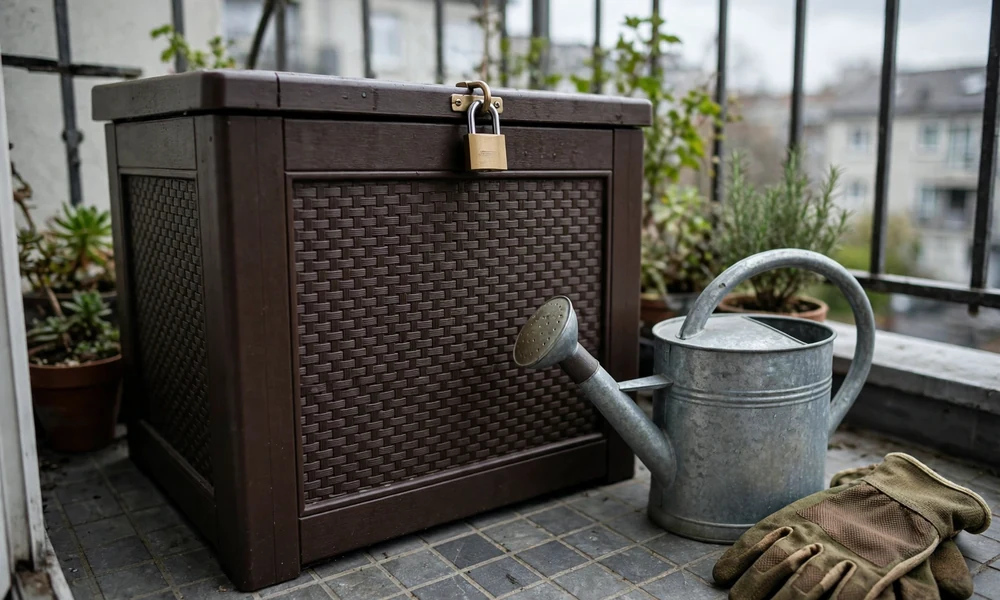
Rattan-effect boxes are usually resin underneath with a woven-look finish, and they exist to match a patio set rather than to stand out. They are a good choice when the box will sit beside matching chairs and a table, because the whole set reads as one piece of furniture. Check that the weave is part of the moulding rather than a stuck-on skin, which can peel after a summer in the sun.
Keeping Everything Dry
Dryness is the whole job of a deck box, and it depends on three things: the lid, the base, and the air inside. The lid should overlap the body and shed rain, not sit flush with a thin rubber strip as the only defence. The base should be raised or slatted so the contents never sit in a puddle. And the inside needs some air, because a perfectly sealed box with damp cushions inside will grow mould even when no rain has got in.
Ventilation gaps, opening the box on dry days, or a moisture absorber inside through winter all solve the condensation problem. Never put cushions away wet. Even the toughest outdoor fabric will develop mildew if it is shut in a dark box while damp, and once mildew takes hold it is very hard to remove. A quick shake and an hour in the sun before storing makes more difference than any waterproof rating.
Locks and Security
Most deck boxes come with a hasp for a padlock rather than a built-in lock, and that is usually enough. A padlock stops an opportunist and keeps children from opening a heavy lid unsupervised. If you store expensive items such as power tools or a pricey outdoor heater, choose a box with a metal hasp and a lid that cannot be prised up at the corners.
Do not rely on a lock alone. A light box can simply be carried away, lock and all, so a heavy box, or one fixed to a deck or a wall with a bracket, is far more secure. Position also helps: a box visible from the house and from the street is a worse target than one hidden behind a hedge at the far end of the garden.

Where to Put Your Deck Box
The best place for a deck box is close to where its contents are used. Cushion storage belongs beside the seating, pool towels belong by the pool, and garden tools belong near the beds. A box that is a long walk from its contents will not get used, and the cushions will end up back on the chairs in the rain.
A deck box can also do a second job. A sturdy closed box makes a low bench, a side table for drinks, or a plant stand. That is worth remembering when you choose the height: a box around 60 centimetres tall is comfortable to sit on, while a taller box is better for storage but less useful as furniture. Our guide to the best patio furniture in 2026 covers seating sets that pair well with a matching storage box.
What Fits Inside: A Capacity Guide
Capacity is easier to judge in cushions than in litres. A 150-litre box holds two seat cushions and a throw. A 270-litre box holds a two-seater set of cushions. A 400-litre box holds a four-seater set with backs, and a 600-litre box holds that set plus towels, toys and tools. Measure your own pile rather than trusting the label, and remember that thick, deep cushions take far more room than thin ones.
Do not overload the box. A lid that has to be forced shut will warp, and cushions squashed flat for months will lose their shape. If everything does not fit with the lid closing easily, you need a bigger box or a second one. Two medium boxes are often more practical than one huge one, because they can sit in different places and each lid is lighter to lift.
Care and Maintenance Through the Year
A deck box needs very little care, but a little goes a long way. Wash a resin box with warm soapy water in spring and autumn, and check the hinges and lid supports at the same time. Tighten any loose screws, oil metal hinges, and replace a cracked lid support before it fails and the lid comes down on someone’s fingers.
In winter, either empty the box and leave the lid ajar so air circulates, or keep it in use with a moisture absorber inside. A box left full, shut and forgotten from October to March is the one that greets you with mildew in spring. A monthly check through winter, even just lifting the lid on a dry day, keeps the contents fresh.
Mistakes to Avoid
The most common mistake is buying on price alone. A cheap box with a thin lid warps in the first summer, and the money saved is lost when the cushions inside are ruined. The second mistake is buying too small, which means half the cushions still live outside. The third is putting the box in the wrong place, usually against a wall with no room for the lid to open.
It is also worth thinking about the wider garden before you buy. A box that matches your seating and your storage needs will last longer in use than one bought in a hurry. Our guide to outdoor storage that keeps cushions dry compares boxes, benches and chests side by side, and our guide to the best garden bench for a small yard covers seating with built-in storage for tight spaces.
Frequently Asked Questions
Are deck boxes waterproof? Most good deck boxes are water-resistant rather than fully waterproof. A sealed lid and a raised base keep rain out in normal weather, but a box should not be expected to survive standing water or a jet wash aimed at the lid seal.
Can a deck box stay outside all winter? Yes, if it is well made and the contents are dry. Empty it or check it monthly through winter, leave the lid ajar on dry days or use a moisture absorber, and keep it off bare soil so the base stays dry.
Can I sit on a deck box? Most sturdy boxes can take the weight of an adult sitting on the closed lid, and many are designed as a bench. Check the weight rating first, and never stand on the lid, which is not built for that.
The Verdict
The best deck box is the one that fits your cushions, keeps them dry, and opens without a fight. For most households that means a mid-size resin box with a double-wall lid, gas struts and a lockable hasp. Wood wins on looks, metal wins on security, and a compact box wins on a balcony. Measure first, buy the lid as much as the box, and store everything dry, and a good deck box will quietly tidy your garden for years.