The best desk organizers for small desks in 2026 are the ones that give you back space instead of taking it. A small desk leaves no room for clutter to hide, so every pen, cable, notebook and charger needs a home that is easy to reach and easy to put back. When each item has a place, the desk stays clear, work starts faster, and the whole room feels calmer.
That matters because a small desk is unforgiving. A large desk can absorb a messy pile for a week before it becomes a problem. On a desk that is only 90 to 120 centimetres wide, the same pile covers the writing area and blocks the keyboard. The right organizer moves things up, down or into a drawer, so the surface you actually work on stays free.
We tested bamboo trays, drawer inserts, vertical file holders, monitor risers and cable boxes, judging them on footprint, capacity, build quality and fit on a real small desk. The nine picks below cover every budget, and each one earns its place by saving more space than it uses.
Key takeaways
- A tray or caddy with fixed compartments works best for pens, clips and other small items you use every day.
- Drawer inserts hide clutter completely and are the best choice when your desk has even one shallow drawer.
- Vertical file holders and monitor risers use height, not desk space, so they suit the smallest desks best.
- Measure your desk depth and drawer size before ordering, because a few centimetres can decide whether an organizer fits.
- Bamboo, metal mesh and sturdy plastic all work well, so choose the material that matches how hard you use your desk.

How We Chose the Best Desk Organizers for Small Desks
We started with size. A good organizer should occupy no more than a quarter of the surface and leave a clear area for a keyboard, a notebook and a cup. Anything wider than about 30 centimetres needs a strong reason to earn its place.
We then looked at how each organizer handles pens, paper, cables and personal items. Bamboo should feel smooth, metal mesh should be stiff and not bend when loaded, and plastic should be thick enough to hold its shape when full. We also checked stability, because a tall organizer that tips over is worse than no organizer at all.
The 9 Best Desk Organizers for Small Desks in 2026
1. Bamboo Desk Tray Set — Best Overall
This five-compartment bamboo tray is the best all-round choice for a small desk. It holds pens, scissors, clips, sticky notes and a phone in separate sections, so nothing slides into a single messy pile. At about 33 centimetres wide it fits most small desks with room to spare, and it wipes clean with a damp cloth. If you only buy one organizer, buy this one.
2. Mesh Desk Caddy — Best Budget Pick
The mesh desk caddy is the cheapest way to clear a small desk quickly. Its tall pen cups, shallow drawer and side slots hold the essentials in a footprint smaller than a sheet of A4 paper. The black metal mesh looks neat, you can see everything at a glance, and the small drawer is ideal for clips and USB sticks.
3. Drawer Organizer Insert — Best for Hidden Storage
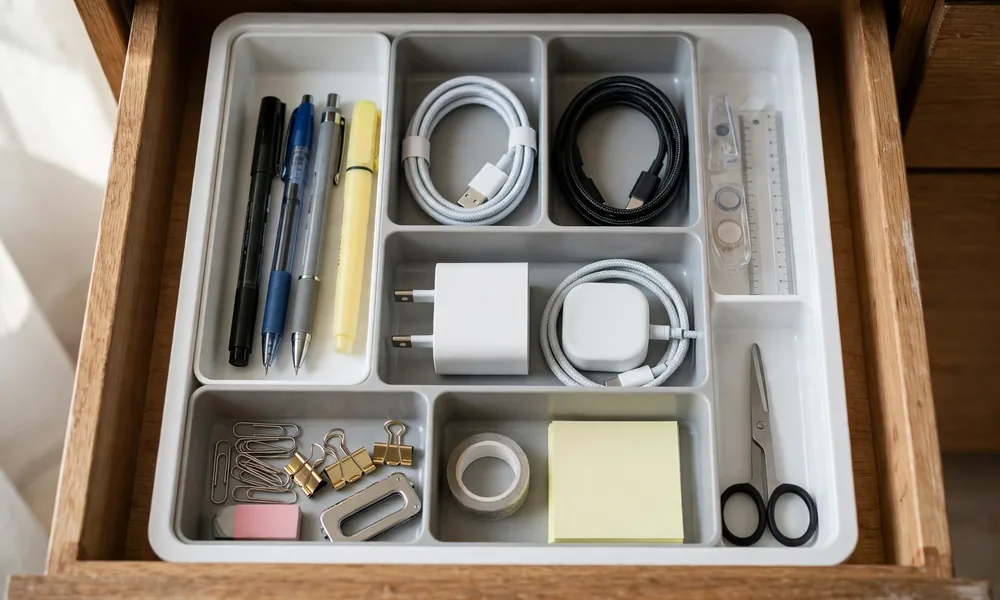
If your desk has a drawer, this insert is the most effective organizer you can buy. Its divided compartments sort pens, cables, chargers, tape and sticky notes into neat rows, so opening the drawer feels like opening a tidy toolbox rather than a junk drawer. Measure the inside of the drawer first, because a tight fit is what keeps the insert steady.
4. Vertical File Organizer — Best for Paper
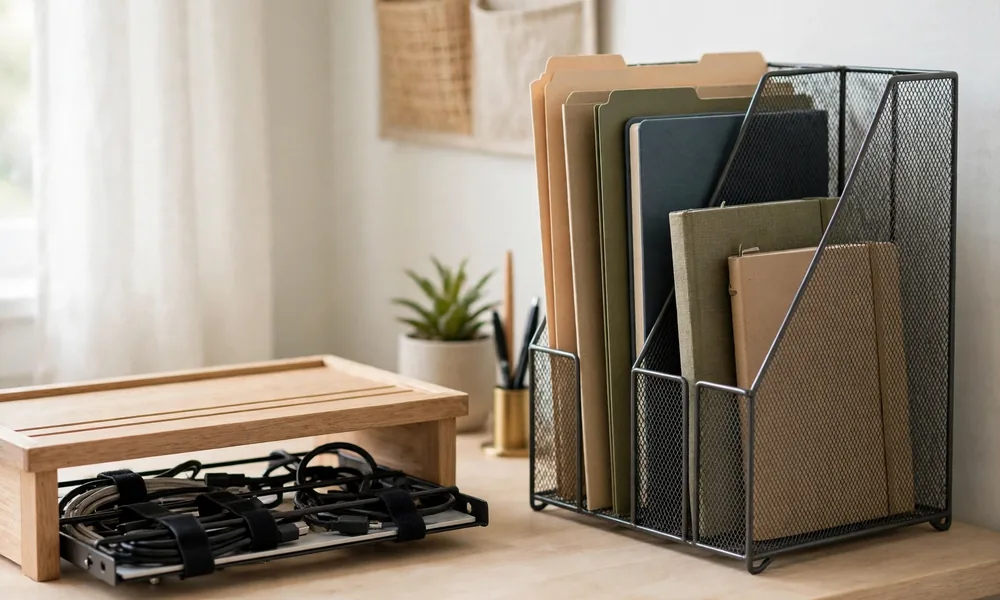
Paper is the hardest clutter to control on a small desk, because flat piles grow fast and spread wide. A vertical file organizer solves that by standing folders and notebooks upright in narrow slots, using height instead of surface area. The black mesh version we recommend holds five or six folders in about 25 centimetres, at the back or side of the desk.
5. Monitor Riser with Storage — Best for Raising Your Screen
A monitor riser does two jobs at once: it lifts the screen to a comfortable height and creates a storage shelf underneath. Notebooks, a keyboard or a small tray can slide under it when they are not in use, which frees a surprising amount of desk space. Check the weight limit and height first, because a riser that is too tall can strain your neck.
6. Cable Management Box — Best for Tidy Cables
Cables are the invisible clutter on a small desk. They tangle, collect dust and pull chargers off the desk when they snag. A cable management box hides a power strip and its plugs inside a lidded box, with slots at each end for the cables you actually need. Choose one large enough for your power strip plus two or three chargers, kept at the back of the desk.
7. Rotating Desk Organizer — Best for Shared Desks
A rotating organizer suits desks that two people share or that sit in a corner. A gentle spin brings pens, scissors, tape and small tools within reach without moving the whole unit, and the divided compartments stop items from mixing. The round shape fits neatly into a corner that a square tray would waste.
8. Wall-Mounted Pocket Organizer — Best for Zero Desk Space
When the desk itself is too small for any organizer, the wall is the answer. A wall-mounted pocket organizer hangs beside or above the desk and holds notebooks, letters, pens and chargers in fabric or woven pockets. It uses no desk space at all, keeps essentials at eye level, and suits folding desks and desks in alcoves best.
9. Small Desk Shelf Organizer — Best for Layered Storage
A small desk shelf adds a second level to a small desk, so you can stack rather than spread. The lower level holds a notebook or a keyboard, the upper level holds pens, a phone and a small plant, and the whole unit takes up no more space than a single tray. It also works well with a laptop stand for desks, because the stand lifts the laptop while the shelf holds the accessories underneath it.

Desk Organizers Compared
| Organizer | Best for | Footprint | Material | Price range |
|---|---|---|---|---|
| Bamboo Desk Tray Set | Everyday stationery | Medium | Bamboo | Mid-range |
| Mesh Desk Caddy | Budget desks | Small | Metal mesh | Budget |
| Drawer Organizer Insert | Hidden storage | Drawer only | Plastic | Budget |
| Vertical File Organizer | Paper and folders | Small | Metal mesh | Budget |
| Monitor Riser with Storage | Screen height | Medium | Wood | Mid-range |
| Cable Management Box | Cables and chargers | Small | Plastic | Budget |
| Rotating Desk Organizer | Shared desks | Medium | Plastic | Budget |
| Wall-Mounted Pocket Organizer | Very small desks | None on desk | Fabric | Budget |
| Small Desk Shelf Organizer | Layered storage | Medium | Wood | Mid-range |
The cheapest picks solve one problem very well, while the mid-range picks solve several at once and last longer. Start with the problem that bothers you most.
How to Measure Your Desk Before You Buy
Measure before you order, because a good fit makes the organizer feel like part of the desk. Start with the width and depth of the surface, then note where the keyboard, mouse and laptop sit. The free space that remains is the real size your organizer must fit into, not the size of the whole desk.
For drawer inserts, measure the inside of the drawer. For vertical organizers, check the height under any shelf above the desk. If the desk itself is the limiting factor, rethink the desk rather than the organizer. Our guide to the best standing desks for small spaces covers compact desks that give you more usable surface without taking over the room.
The Types That Work Best on a Small Desk
The organizers that work best share three traits. They are low or vertical, so they do not block your view. They have fixed compartments, so items stay where you put them. And they are easy to move, so you can clear the desk in seconds.
Trays suit pens and clips, drawer inserts suit anything you use less often, and vertical holders suit paper and folders. Risers and shelves create a second level, the cheapest way to double the usable area of a small desk. One well chosen organizer, used every day, beats three organizers competing for the same few centimetres.
Setting Up a Small Desk That Stays Tidy
Start with an empty desk. Take everything off and sort items into three groups: use daily, use weekly and rarely use. Daily items earn a place on the desk, weekly items belong in a drawer or a vertical holder, and rarely used items belong in a cupboard elsewhere.
Place the organizer before you put anything back: tray on the side of your non-writing hand, file holder at the back, cable box behind the monitor. Comfort matters too, so if your chair is uncomfortable, read our guide to the best desk chairs for home offices before you buy more storage.
Small Desk Organizer Checklist
- Measure the desk width, depth and drawer size before ordering anything.
- Choose one organizer for the clutter that bothers you most, not three at once.
- Keep daily items on the desk and weekly items in a drawer or file holder.
- Place tall organizers at the back or side so they do not block your view.
- Hide cables in a box or tray and check that chargers still have room to breathe.
- Clear the organizer once a week and return anything that has drifted out of place.
Frequently Asked Questions
What is the best desk organizer for a very small desk?
A drawer insert is best if your desk has a drawer, because it adds no footprint at all. If there is no drawer, choose a small mesh caddy or a wall-mounted pocket organizer.
How do I keep a small desk tidy long term?
Give every item a fixed home and return it after each use. Clear the desk at the end of each day, and do a deeper clear once a week. A tidy desk is a habit, not a purchase.
Are bamboo organizers better than plastic ones?
Bamboo looks warmer and feels sturdier, while plastic is lighter, easier to clean and often cheaper. Choose bamboo for a calm, natural look, and plastic for heavy use.
Do I need a monitor riser on a small desk?
A riser helps if your screen sits too low or if you need storage underneath it. It is not essential for a laptop, but it can still create a shelf for notebooks or a keyboard.
How do I organize cables on a small desk?
Use a cable box for the power strip and chargers, and small clips for daily cables. Keep the box at the back of the desk, leave enough slack to move the laptop, and label cables you often unplug.
Can one organizer be enough for a small desk?
Yes, for most people one good tray or caddy plus a drawer insert is enough. Add a vertical file holder only if you handle a lot of paper, and a cable box only if cables are a visible problem.
The Bottom Line
The best desk organizers for small desks save more space than they use. Start with a bamboo tray or a mesh caddy for daily items, add a drawer insert or a vertical file holder for the rest, and hide cables in a box. Measure first, choose one organizer for your biggest problem, and keep the surface clear.