Finding the best standing desks for small spaces is a different challenge from shopping for a regular desk. When every square foot counts, a desk that is too deep eats into your walkway and a bulky base makes a small room feel smaller. The right desk can turn an unused corner, a short wall, or the end of a sofa into a proper workspace.
A good small-space standing desk does three things at once: it gives you enough surface for a laptop, a monitor, and a few essentials; it adjusts smoothly between sitting and standing; and it disappears when you are done, by folding away, sliding into a corner, or taking up little floor space.
This guide rounds up the seven best standing desks for small spaces in 2026, from compact electric desks to folding models and converters, each judged on footprint, stability, and lift quality.
Key takeaways
- For most small rooms, a desktop 90 to 120 cm wide and 50 to 60 cm deep is the sweet spot.
- Electric desks adjust faster and hold steadier than manual cranks at standing height.
- Wall-mounted folding desks free up the most floor space, but they need a solid wall and a fixed working height.
- Corner desks use dead space well, yet they are the hardest to move once assembled.
- A desk converter is the cheapest way to test standing work with a table you already own.
How We Chose the Best Standing Desks for Small Spaces
Size came first. Every desk here is no wider than 120 cm and no deeper than 60 cm, unless its shape makes clever use of a corner. We also checked the frame footprint, because wide feet can trip you up in a narrow room.
Stability came second, so we favoured sturdy steel frames with a capacity of at least 50 kg. Lift quality came third: motors should move smoothly and quietly, ideally under 50 decibels. Finally, we considered how each desk behaves when you are not working: the best ones fold, tuck, or blend in. Readers comparing full-size options can also look at our guide to the best standing desks for home offices for larger rooms.
The 7 Best Standing Desks for Small Spaces in 2026
The seven desks below cover every small-room situation, from a studio flat to a bedroom corner. The table compares them at a glance, and the reviews explain who each suits best.
| Desk | Size | Lift | Capacity | Best for |
|---|---|---|---|---|
| Compact Electric Desk | 100 x 55 cm | Electric, dual | 70 kg | Best overall |
| Wall-Mounted Folding Desk | 90 x 45 cm | Fold-down | 25 kg | Tiniest rooms |
| Corner Standing Desk | 120 x 120 cm | Electric, single | 60 kg | Bedroom corners |
| Slim Budget Desk | 100 x 50 cm | Manual crank | 50 kg | Best value |
| Desk Converter | 80 x 40 cm | Gas spring | 15 kg | Existing tables |
| Narrow Bedroom Desk | 80 x 50 cm | Electric, single | 55 kg | Small bedrooms |
| Portable Standing Desk | 70 x 45 cm | Two heights | 10 kg | Moving around |
1. Best Overall: Compact Electric Desk
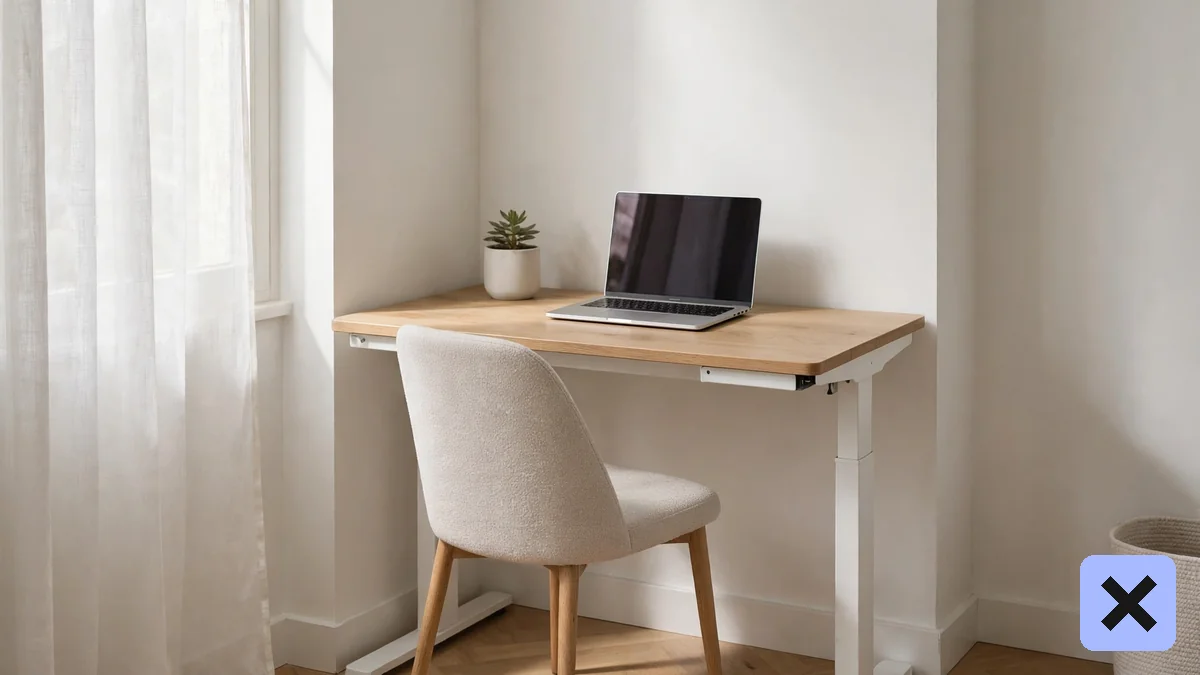
The compact electric desk is the best all-rounder for small spaces. Its 100 by 55 cm desktop fits a laptop, a monitor on an arm, and a keyboard, while the dual-motor frame lifts from 72 to 120 cm at the touch of a button. Memory presets store your sitting and standing heights, so switching takes seconds.
The short feet tuck under the desktop, so the desk slides close to a wall, with only a slight sway at full standing height. The trade-off is price and weight: it costs more than manual desks and needs a socket nearby.
2. Best for the Tiniest Rooms: Wall-Mounted Folding Desk
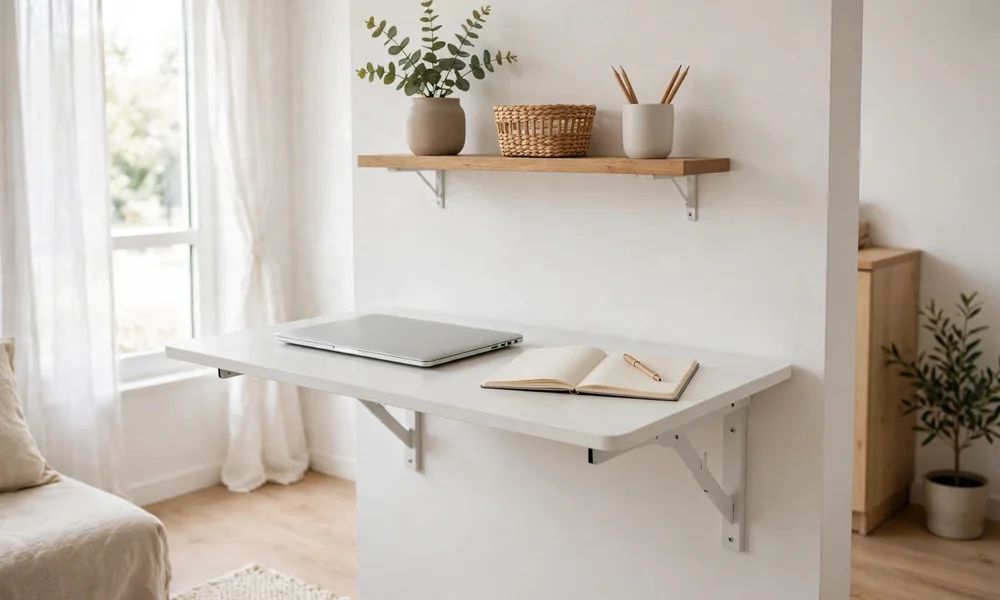
When floor space is scarcest, a wall-mounted folding desk is hard to beat. It bolts to the wall, folds down to work, and folds flat when you do not, freeing the floor completely. The 90 by 45 cm surface fits a laptop, a notebook, and a mug.
The catch is that the height is fixed, so you must mount it at the right level, usually around 105 to 110 cm, and use a tall stool to sit. It also needs a solid wall: plasterboard alone will not hold it, so fix into studs or masonry, and the 25 kg limit rules out heavy monitors.
3. Best Corner Desk: Corner Standing Desk
Corners are the most wasted space in a small room, and a corner standing desk turns one into a generous workstation. The L-shaped top fits two monitors or a monitor and a laptop, tight against two walls. The single-motor lift is slower than a dual-motor frame but far quicker than a crank.
The drawback is commitment: a corner desk is heavy, awkward to move, and hard to reposition, and the deep back corner suits a printer or plant but not things you grab often. If you have a genuinely empty corner, this gives you the most workspace per square metre.
4. Best Value: Slim Budget Desk
The slim budget desk proves you do not need to spend a fortune to stand while you work. Its manual crank raises the desktop in about thirty seconds, the steel frame is steady, and the 100 by 50 cm top fits a laptop and a monitor.
The compromise is convenience: cranking the desk several times a day gets old, so most owners adjust it once or twice a day. There are no memory presets, so you find your height by feel each time. For a spare room or a student flat, this desk is the smart buy.
5. Best Converter: Desk Converter
A desk converter sits on a table you already own and lifts your screen and keyboard to standing height. It is the smallest, cheapest, and least disruptive option here, and it is ideal if you rent. The gas-spring lift is smooth, the keyboard tray drops slightly for comfortable typing, and the unit folds flat for storage.
The limits are obvious: the surface is only 80 by 40 cm, so a large monitor and a laptop will not fit together, and the 15 kg capacity rules out heavy displays. Even so, it is the best choice for renters and for people who only stand for an hour a day.
6. Best for Small Bedrooms: Narrow Bedroom Desk
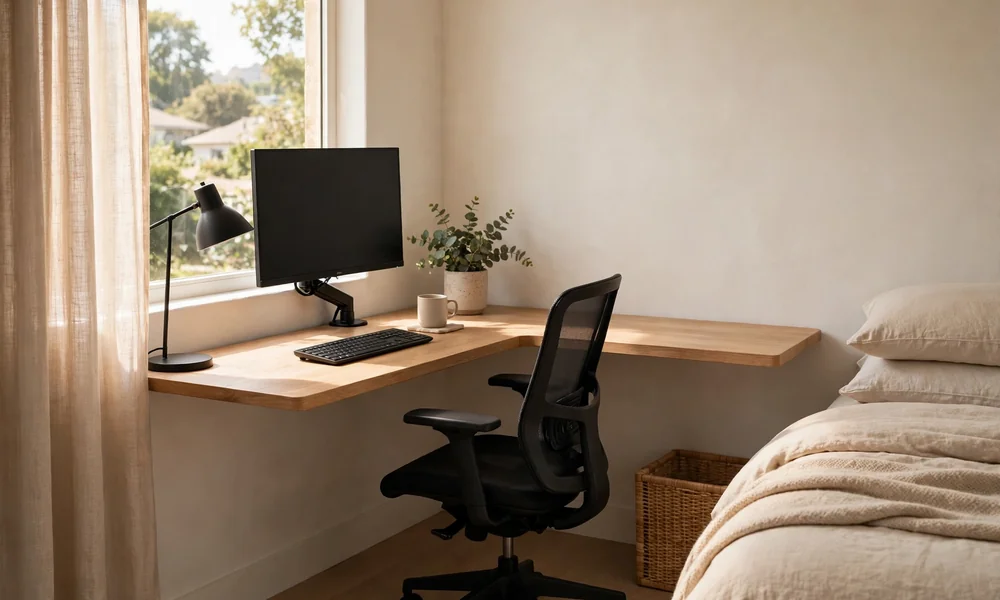
A small bedroom needs a desk that works beside a bed without blocking the wardrobe or the door, and the narrow bedroom desk is built for exactly that. At 80 by 50 cm, it slides into the gap between a bed and a wall, with a quiet single-motor lift.
The narrow width means you cannot spread out: two monitors are out, and a large keyboard will fill the surface. If your bedroom is your office, this is the desk to choose. It is quiet, compact, and unobtrusive.
7. Best Portable Option: Portable Standing Desk
The portable standing desk is less furniture and more a tool: a lightweight, two-height table you can carry room to room, set up on a balcony, or fold flat under a bed. At 70 by 45 cm it holds a laptop and a notebook, and it weighs little enough to move with one hand.
Portability comes with compromises: no powered lift, only two fixed heights, a 10 kg capacity that means a laptop only, and a light frame that can wobble if you lean on it. As a second desk, though, it is excellent for an hour of standing work or as a spare for guests.
What Size Standing Desk Fits a Small Space?
Start by measuring the space, not the desk. Mark the footprint on the floor with tape, then sit and stand in it. You need at least 60 cm clear behind the chair, and 30 cm on one side to get in and out.
For most people, a desktop 90 to 120 cm wide and 50 to 60 cm deep works best: wide enough for a laptop and a monitor, deep enough for a healthy screen distance. Height matters too: elbows should rest at roughly 90 degrees when typing, usually 70 to 75 cm sitting and 100 to 115 cm standing.
Electric vs Manual vs Fixed Height: Which Lift Is Best?
Electric desks are the most convenient: press a button and the desk glides to your preset height. They suit anyone who switches between sitting and standing three or more times a day. The downsides are price, weight, and the need for a power socket.
Manual crank desks are the value pick: they cost much less and need no power, but adjusting them is a chore, so most owners adjust once a day. Fixed-height desks only make sense for wall-mounted and very small portable desks. For everything else, buy adjustable.
Small-Space Setup Tips That Make a Big Difference
The desk is only half the story. A monitor arm lifts the screen off the desktop and frees the space underneath, which matters enormously on a 50 cm deep desk. Our guide to the best laptop stands for desks covers another cheap way to raise one.
Seating matters just as much: a chair that tucks fully under the desk when you stand keeps the floor clear. Our roundup of the best desk chairs for home offices includes several compact models that pair well with these desks. Storage should go up, not out: a small shelf above the desk holds books and chargers, and a cable tray stops cords trailing.
Checklist: Before You Buy
- Measure the space with tape, including 60 cm clear behind the chair.
- Check the wall type before ordering a wall-mounted desk, and confirm you can fix into studs or masonry.
- Confirm the height range covers your sitting and standing elbow heights.
- Count your power sockets, and check the cable reaches the desk without trailing across the floor.
- Add up the weight of your monitor, laptop, and accessories, and buy a desk rated above it.
- Check delivery size and assembly time, especially for corner desks in large flat packs.
Frequently Asked Questions
What is the best standing desk for a very small room?
A wall-mounted folding desk is best: it uses no floor space when folded away. If you need an adjustable desk with a larger surface, a compact electric desk around 100 cm wide is next best.
How much space do I need behind a standing desk?
Allow at least 60 cm behind your chair to pull it out and stand up. A chair that tucks fully under the desk helps, but you still need room to step back safely.
Are standing desks good for small apartments?
Yes, when they are compact. A desk 90 to 120 cm wide and 50 to 60 cm deep gives you a proper workspace, and folding models free the floor when not in use.
Can I put a standing desk in a bedroom?
Yes, a narrow electric desk around 80 cm wide fits most bedrooms, especially between bed and wall. Choose a quiet motor and a shelf above the desk for storage.
Is a manual crank desk worth it?
Yes, if you adjust height once a day or less and want to save money. If you switch several times a day, an electric desk is worth the extra cost because adjustment is instant.
How deep should a small standing desk be?
A depth of 50 to 60 cm is ideal: enough room for a keyboard and screen at a healthy distance, while keeping the desk slim enough for a wall or corner.
The Bottom Line
The best standing desk for a small space fits your room, your body, and the way you work. For most people, that is a compact electric desk around 100 cm wide, balancing surface area, stability, and easy adjustment. If floor space is truly scarce, a wall-mounted folding desk is the cleverest answer, and if you already own a good table, a converter lets you stand without new furniture. Measure first, buy the smallest desk that fits your gear, and pair it with a monitor arm and a tuck-away chair.