Not every dog is a natural swimmer, and even strong swimmers get tired, caught by a current, or startled by a wave. A dog life jacket is not a costume or a cute accessory for the boat. It is a piece of safety kit, and on open water it can be the difference between a scare and a tragedy. The best dog life jackets of 2026 keep a dog’s head above water, give you a solid handle to lift them back aboard, and stay comfortable enough that the dog forgets it is wearing one.

Why a Dog Needs a Life Jacket
Dogs do not all swim the same way. Breeds with short legs, heavy chests, short muzzles or dense coats tire quickly, and puppies, older dogs and dogs recovering from injury tire faster still. Even a confident swimmer can panic in cold water, in a strong current, or after falling from a boat. A life jacket adds buoyancy under the chest and belly, holding the dog level with its head held up. A dog swimming with its nose barely above the surface is working hard and swallowing water with every stroke.
A life jacket also makes a dog visible. Bright colours and reflective trim help you spot a dog in choppy water, in low evening light, or from the far side of a lake. And when a dog needs help, the handle on top of the jacket is the thing you will reach for. A good handle is wide, stitched through the body of the jacket, and strong enough to lift the dog’s full weight out of the water in one smooth pull. A flimsy handle, or one sewn only to the outer fabric, can tear when you need it most.
What Makes a Good Dog Life Jacket
Fit comes first, before colour, brand or price. A jacket that is too loose will slide sideways, ride up over the dog’s head, or twist in the water. A jacket that is too tight will rub under the front legs, restrict breathing, and make the dog hate wearing it. Measure the dog’s chest at its widest point, just behind the front legs, and measure the length from the base of the neck to the base of the tail. Then check those numbers against the maker’s size chart, not against the dog’s weight alone. Two dogs of the same weight can have very different chest sizes, and the chest measurement is the one that decides the fit.
Buoyancy is the second test. The foam panels should sit under the chest and belly, where they lift the dog level, rather than bunched up on the back. The best jackets spread the foam in panels that flex with the dog’s body, so the dog can still move its legs freely. Stiff, single-piece foam feels like a board, and a dog wearing one will paddle awkwardly and tire faster. Look for foam that is thick enough to feel firm when you press it, but flexible enough to bend around the dog’s ribs.
Straps and buckles decide whether the jacket stays put. At least two adjustable belly straps are essential, and three are better for larger dogs. The straps should adjust smoothly, hold their setting when wet, and sit flat against the dog without twisting. Quick-release buckles are worth having, because a jacket that is hard to take off in a hurry is a jacket that will be left on too long on dry land, where a wet dog in a warm jacket can overheat. Our guide to the best life jackets of 2026 covers the same buckle and strap standards for people, and the principles are identical: the fastenings are what keep a flotation device working when it matters.
Visibility is the part people skip, and it is the part that saves time in an emergency. Bright orange, yellow or pink stands out against blue and green water far better than navy, black or camouflage. Reflective strips on the sides and back catch a torch or a boat light after dark, and they cost nothing in comfort. If a jacket comes only in dark colours, it is a poor choice for open water, however well it fits.
How to Fit a Life Jacket Properly
Start on dry land, indoors, where the dog is calm. Slip the jacket on, fasten the straps snugly, and check that you can fit two fingers between the strap and the dog’s body, but not a whole hand. The jacket should sit with its front edge behind the dog’s throat, not pressing on the windpipe, and its back edge should end before the hips, so the dog can sit and lie down comfortably. Watch the dog walk around the room. If the jacket shifts sideways, pulls forward, or the dog keeps trying to bite at the straps, the fit is wrong.
Then test it in shallow water. Let the dog wade in, then swim a few strokes while you stay close. The jacket should keep the dog level, with the head clearly above the water and the back flat, not tipped nose-down or tail-down. The handle should stay on top, in the middle of the back, where you can grab it without fumbling. If the jacket rides up toward the ears, tighten the belly straps a little, or try a smaller size. If it still rides up, that jacket’s shape does not suit your dog, and no amount of tightening will fix it.
Jackets for Small Dogs
Small dogs need a lighter jacket, because heavy foam overwhelms a small frame. Look for thin, flexible panels, a slim handle, and straps that adjust down far enough to fit a narrow chest. A jacket made for a medium dog, shrunk down, rarely works: the proportions are wrong, the handle sits too far back, and the foam is too stiff. Small dogs also chill faster, so a jacket with a little extra coverage over the belly helps in cold water, but it must not restrict the legs. Test the fit by watching the dog climb out of the water onto a low bank or a step: if the jacket catches or the dog struggles, it is too bulky.
Jackets for Large and Strong Dogs
Large dogs need the opposite: thick foam, wide straps, and a handle built to lift real weight. A Labrador, a German Shepherd or a Golden Retriever can weigh thirty kilograms or more when wet, and lifting that weight by a handle takes a strong grip and a well-stitched jacket. Check that the handle is stitched through the full body of the jacket, not just tacked to the top layer, and that the belly straps are wide enough not to dig in. For large dogs, a third belly strap, or a strap under the chest, stops the jacket twisting when the dog turns sharply in the water. If you take a large dog out on the water, our guide to the best paddle boards of 2026 covers boards with the stability and deck space a dog needs.
Jackets for Puppies and Older Dogs
Puppies are still learning to swim, and they tire in minutes. A puppy jacket should be light, bright, and easy to put on and take off, because a puppy will not tolerate a fussy fitting. Keep the first swims very short, in warm, calm, shallow water, and stay within arm’s reach. The jacket is there to keep the puppy’s head up and to give you a handle, not to let the puppy swim further than it should.
Jackets for Boats, Kayaks and Paddle Boards
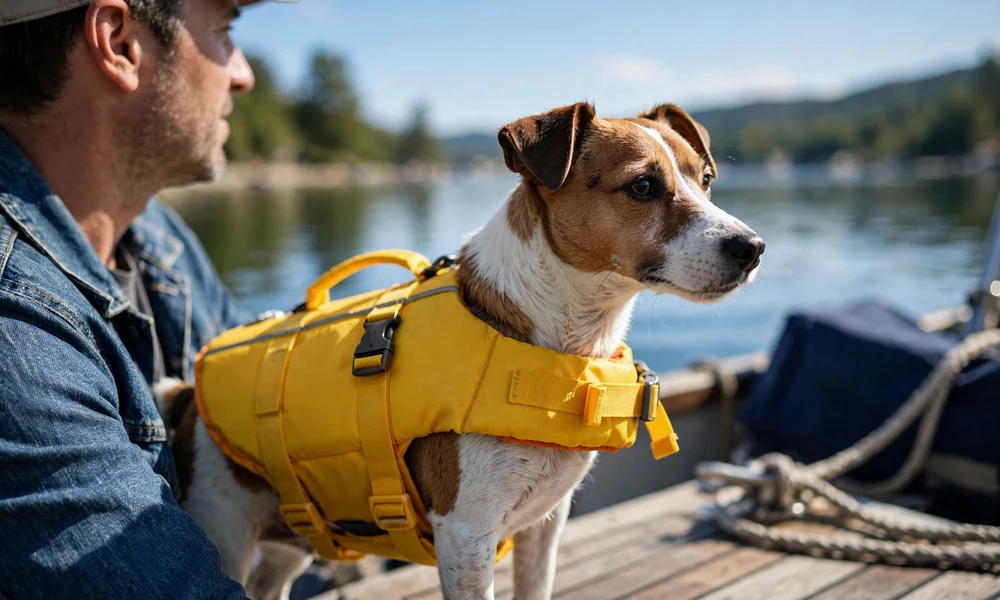
On a boat, a dog life jacket is essential, not optional. A dog can slip, be knocked overboard by a wave, or jump after a bird, and in open water there is no bank to swim to. The jacket should be on before the dog steps aboard, and it should stay on until the dog is safely back on land. Choose a jacket with a strong handle, because lifting a wet dog over the side of a boat is the hardest part of a rescue, and a D-ring on the back lets you clip on a lead so the dog cannot wander to the edge.
Kayaks and paddle boards are less stable than boats, so the jacket matters even more. A dog that shifts its weight suddenly can tip a kayak, and both dog and owner end up in the water. A jacket keeps the dog afloat while the owner sorts out the kayak, and the bright colour helps the owner find the dog quickly. For beginners, our guide to the best paddle boards for beginners in 2026 covers wide, stable boards that are far easier to share with a dog than a narrow racing board.
What to Avoid
Avoid jackets with no top handle. Without a handle, you have nothing safe to grab, and pulling a dog out by a collar or a leg risks injury. Avoid jackets that fasten with Velcro alone, because Velcro weakens when it is wet and clogged with sand or fur, and a jacket held only by Velcro can come undone in the water. Avoid jackets that are too long, reaching past the hips, because they restrict the back legs and make climbing out of the water hard. And avoid buying a size up to let the dog grow into it. A loose jacket is a dangerous jacket, and a puppy will need a new one as it grows, just as it needs a new collar.

Looking After a Dog Life Jacket
Rinse the jacket in fresh water after every swim, especially after salt water or a muddy river. Hang it up to dry, out of direct sunlight, and do not fold it tightly for storage, because creased foam loses its shape and buoyancy. Check the stitching around the handle and straps every few weeks, and replace the jacket if stitching frays, a buckle cracks, or the foam feels soft and compressed.
Mistakes to Avoid
The most common mistake is buying the wrong size, usually too big, because the dog looks comfortable in it on dry land. A jacket that feels fine in the shop can ride up badly in the water, so always test it in shallow water first. The second mistake is leaving the jacket on all day on land, where a wet dog in a warm jacket overheats quickly. The third is choosing a dark colour because it looks smart. On the water, smart is invisible, and bright is safe.
The Bottom Line
The best dog life jacket of 2026 is the one that fits your dog properly, keeps the head up, stays put in the water, and has a handle strong enough to lift the dog out. Fit matters more than brand, buoyancy matters more than colour, and a bright jacket with a solid handle beats a stylish dark one every time. Measure the chest, test the fit in shallow water, and choose a jacket the dog can move in, not just stand in.
Start with a short swim in calm, shallow water, watch how the jacket sits, and adjust the straps until the dog swims level and relaxed. That jacket, fitted and tested, is the right one for your dog. Keep it rinsed, keep it hung up to dry, and check the stitching before every trip. The water is where dogs are happiest, and a good life jacket is what lets them enjoy it safely, trip after trip.