A good drill is only as good as the bit in its chuck. The best drill bits of 2026 cut clean holes in wood, metal, masonry and tile, while a cheap or wrongly chosen bit wanders off the mark or leaves a ragged hole no sanding will fix. Most drilling frustration is not the drill’s fault: it is the bit.
This guide explains the bit types worth owning, the materials and coatings that matter, and how to match a bit to the job. There is no single best drill bit for everything, because wood, metal and masonry each need a different cutting edge, but a small, well-chosen set covers almost every job a home will ask for.
Key Takeaways
- Match the bit to the material: wood bits cut wood, metal bits cut metal, masonry bits cut brick and concrete — the wrong bit burns, wanders or snaps.
- High-speed steel suits most home drilling; cobalt bits handle hard metals, and carbide-tipped bits are the only sensible choice for masonry.
- A twist bit set, a brad-point set and a spade bit set cover nearly every wood job in a home.
- Sharp bits cut with light pressure; if you have to lean on the drill, the bit is blunt and needs sharpening or replacing.
- Store bits in their case, dry and separated — a loose bit loses its edge against other tools.

Drill Bit Types Worth Owning
Drill bits look similar at a glance, but the shape of the tip decides what the bit can do. A twist bit has a pointed tip and two spiral flutes that lift waste out of the hole as it turns. It is the general-purpose bit, the one that comes in every set, and it drills wood, plastic and thin metal well enough. Its weakness is starting cleanly: on a smooth surface it can skate, so a centre punch mark helps.
A brad-point bit is the woodworker’s bit. It has a sharp centre point that locates the hole exactly where you put it, and two spurs that score the wood fibres before the main cutting edges remove them. The result is a clean, flat-bottomed hole with almost no tear-out, which is why brad-point bits are the right choice for dowel joints, shelf holes and any hole that will be seen. They are not for metal or masonry, and they dull quickly on a hidden nail or screw.
Spade bits, also called paddle bits, cut wide, flat-bottomed holes fast. A spade bit has a flat blade with a pointed centre spur and two sharp cutting wings, and it chews through studs and joists far faster than a twist bit of the same diameter. The trade-off is roughness: the exit side often splinters, so spade bits suit hidden work — running cables, drilling joists, boring holes for pipework — rather than visible furniture work.
Forstner bits cut the cleanest large holes of all. They have a rim that shears the wood fibres in a circle before the cutters remove the waste, leaving a flat-bottomed hole with crisp edges, and they can drill overlapping holes and holes at an angle, which no other bit can do. They are slow, but for hinges and recessed fittings they have no rival.
Best Drill Bits by Material
Wood, metal and masonry ask different things of a bit, and the right choice starts with the material rather than the drill.
Best Drill Bits for Wood
For wood, a brad-point set from 3mm to 10mm handles most jobs: dowels, shelf pins, pilot holes and through-holes in boards up to 40mm thick. Add spade bits in 16mm, 20mm and 25mm for fast, rough holes through studs and joists, and one Forstner bit in the size of your most common hinge. Wood bits cut best at moderate speed with light pressure.
Best Drill Bits for Metal
Metal needs high-speed steel, and hard metal needs cobalt. A standard high-speed steel twist bit drills mild steel, aluminium and brass cleanly if you keep the speed low and use a drop of cutting oil. Cobalt bits, made from high-speed steel with around five percent cobalt, stay hard at higher temperatures and drill stainless steel that would blunt an ordinary bit in seconds. A centre punch mark is essential on metal: without it the bit walks and the hole ends up in the wrong place. Our guide to the best cordless drills of 2026 covers the speed and torque settings that suit metal drilling.
Best Drill Bits for Masonry
Masonry bits have a carbide tip brazed onto a steel shank, and they work by hammering rather than slicing: the drill’s hammer action chips the brick or concrete while the flutes clear the dust. Use them only with a hammer drill or a combi drill on hammer mode — in a standard drill they barely scratch brick — and never use one on wood or metal, because the carbide tip will shatter or blunt. For concrete, a bit with four cutting edges clears dust better and lasts longer. For heavy masonry, our guide to the best hammer drills of 2026 explains the hammer power that makes the difference.
Materials and Coatings Explained
High-speed steel is the standard bit material for home drilling. It holds an edge well, it can be resharpened, and a full set costs little. Cobalt bits cost more and are worth it only for hard metals. Carbide-tipped bits are for masonry, and they should never be resharpened at home — the tip chips easily if ground wrong.
Black oxide bits are high-speed steel with a dark oxide finish that resists rust and reduces friction slightly. They are a good middle choice for a home set: tougher than bright-finished bits, cheaper than titanium-coated ones, and adequate for wood and thin metal.
Shanks, Sizes and Sets
Most home bits have a round shank that fits any keyless chuck. Hex-shank bits have a six-sided shank that grips better and suits quick-change chucks and impact drivers, and they are worth choosing if you swap bits often. SDS shanks are for SDS rotary hammer drills only, and they will not fit a normal chuck at all. Check the shank before you buy, because the wrong shank simply does not fit.
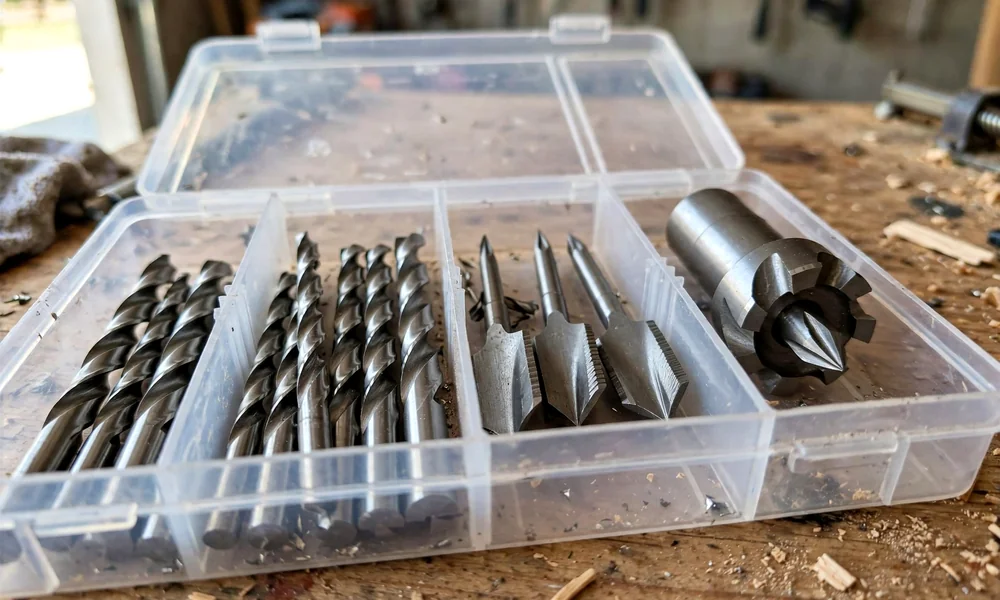
Bit sizes are sold in millimetres, and a set from 1.5mm to 10mm in one-millimetre steps covers almost every home job. The common sizes matter most: 3mm, 4mm and 5mm for pilot holes, 6mm and 8mm for wall plugs, 10mm for bolts. Buy a set rather than individual bits: it costs far less per bit. Keep the case, because a bit without its slot ends up blunt in a drawer.
How to Drill a Clean Hole
A clean hole starts before the drill does. Mark the spot with a pencil, then make a small dent with a centre punch or an awl so the bit has somewhere to start. On wood, a brad-point bit needs no punch. On metal, the punch mark is not optional: without it the bit wanders and the hole ends up in the wrong place.
Speed matters more than force. Wood drills best at moderate to high speed with light pressure; metal at low speed with steady pressure and cutting oil; masonry needs hammer mode and firm, even pressure. If the bit squeals, smokes or throws blue chips, stop: the bit is too hot, the speed is too high or the bit is blunt. Pushing harder only bends the bit.
For through-holes in wood, clamp a scrap board behind the workpiece. The bit exits into the scrap instead of tearing out the back face, and the difference is a clean exit against a splintered one. Pull the bit out regularly to clear waste: packed flutes overheat and jam.
Best Drill Bits of 2026 at a Glance
| Bit Type | Best For | Material | Watch Out For |
|---|---|---|---|
| Twist bit | General drilling, pilot holes | Wood, plastic, thin metal | Wanders without a punch mark |
| Brad-point bit | Clean visible holes, dowels | Wood only | Dulls fast on hidden nails |
| Spade bit | Fast wide holes in studs | Wood only | Rough exit, splinters the back |
| Forstner bit | Flat-bottomed hinge holes | Wood only | Slow, needs a firm grip |
| Cobalt twist bit | Stainless steel, hard metals | Metal | Costs more, brittle if forced |
| Masonry bit | Brick, concrete, block | Masonry only | Needs hammer mode to work |

Sharpening, Storage and Safety
A blunt bit is a dangerous bit. It needs more force, it overheats, and it is far more likely to snap or catch and spin the workpiece. Twist bits and brad-point bits can be resharpened with a bench grinder or a dedicated sharpener, keeping the original cutting angle and cooling the bit in water so the steel does not lose its temper. Masonry bits should not be sharpened at home; when they stop cutting, replace them.
Storage decides how long bits stay sharp. Keep them in their case with each bit in its own slot, somewhere dry. A bit loose in a toolbox loses its edge in days, and a damp garage rusts uncoated bits in a season. Wipe bits dry after use, and a light wipe with oil keeps rust away.
Safety is straightforward but not optional. Wear eye protection: drilling throws chips at speed, and metal swarf is sharp and hot. Clamp the workpiece rather than holding it by hand, because a bit that catches will spin a small piece faster than you can let go. Keep loose clothing, hair and gloves away from the chuck, and never change a bit with the drill switched on or the battery still fitted. Our comparison of the best vs worst drills of 2026 makes the same point about control under load.
Drill Bit Checklist
- Match the bit to the material before you start: wood, metal, masonry and tile each need a different bit.
- Centre-punch metal and smooth wood so the bit starts exactly where you marked it.
- Use the right speed: fast for wood, slow with oil for metal, hammer mode for masonry.
- Clamp a scrap board behind wood to stop tear-out on the exit side.
- Pull the bit out to clear waste and let it cool — packed flutes overheat and snap.
- Store bits in their case, dry and separated, and replace masonry bits when they stop cutting.
Frequently Asked Questions
What is the best drill bit for wood?
A brad-point bit gives the cleanest holes in wood, with almost no tear-out. For fast rough holes through studs, a spade bit is better.
Can I use a wood bit on metal?
Not well. Wood bits are ground to slice fibres, and on metal they skid, blunt quickly and can snap. Use a high-speed steel twist bit for metal, and a cobalt bit for stainless steel.
Why does my drill bit keep wandering?
Usually because there is no starting dent. A centre punch mark on metal, or a brad-point bit on wood, stops the tip skating.
How do I know when a drill bit is blunt?
It needs more pressure than it used to, it squeals or smokes, and the chips come out as dust instead of curls.
Do I need a hammer drill for masonry bits?
Yes, for anything harder than soft brick. A masonry bit in a standard drill barely scratches concrete. Hammer mode chips the masonry while the bit clears the dust.
How long do drill bits last?
A good high-speed steel bit used on the right material and kept sharp lasts years of home use. Bits die young from the wrong material, too much speed and bad storage — all avoidable.
The Bottom Line
The best drill bits of 2026 are not the most expensive ones: they are the right ones for the material in front of you. A brad-point set for clean woodwork, a high-speed steel set for metal, cobalt bits for hard steel and carbide-tipped bits for masonry cover every job a home will ask for. Buy the set, keep it sharp, store it properly, and the drill you already own will feel like a better tool.