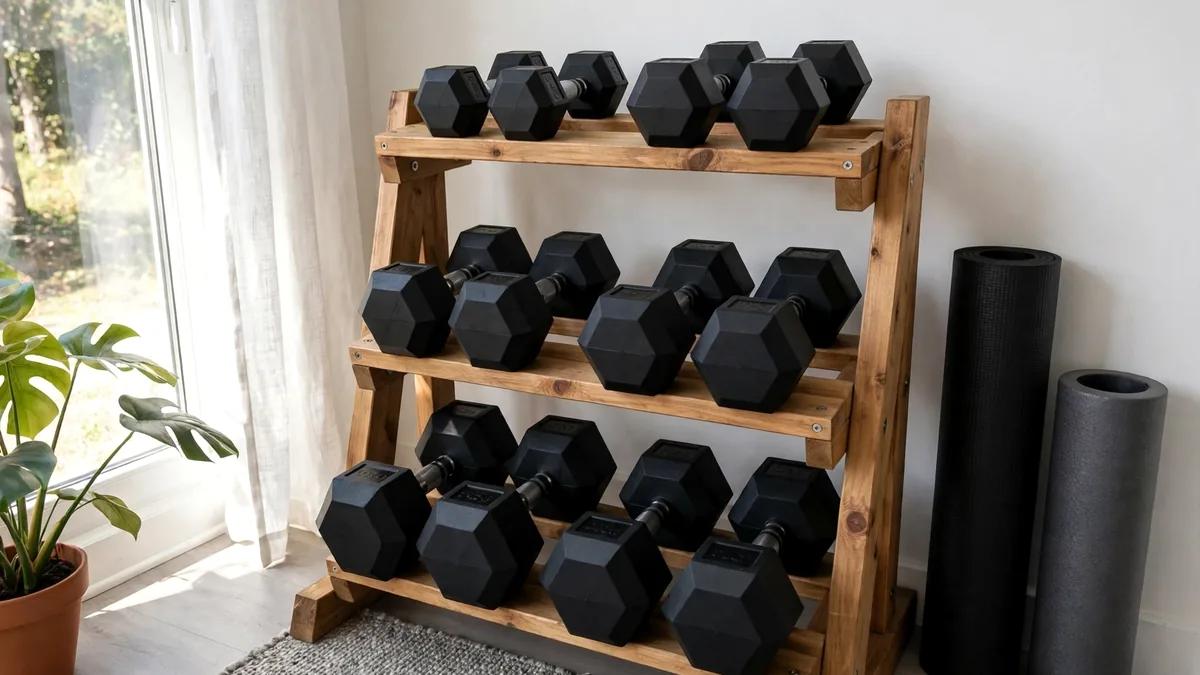
The best dumbbell racks in 2026 are the piece of home gym furniture nobody thinks about until the dumbbells start living on the floor. A rack does not build muscle, yet it decides whether your dumbbells are a pleasure to use or a trip hazard. The best dumbbell racks keep every pair visible, within reach and off the floor, so a workout starts with lifting, not hunting. This guide compares the best dumbbell racks of 2026 by type, size, build quality and value, and settles the question every home gym owner eventually asks: dumbbell racks vs weight benches, which one deserves your floor space first?
A dumbbell rack is storage with a job to do: it holds pairs at reachable heights, protects your flooring from dropped hex heads, and stops a growing set from spreading across the room. A weight bench is a training surface: you lie on it, sit on it and press from it. If your budget or floor space only stretches to one, the choice matters, so this guide works through both sides honestly.
Key Takeaways
- A two-tier rack is the best all-round choice for most home gyms, holding a full fixed set at waist height without needing a wall.
- Buy for the heaviest dumbbells you will ever own: a rack that sags under a 30 kg pair is one you will replace.
- Steel A-frame racks suit heavy sets and garage gyms; wooden racks suit light sets and living rooms where the rack is on show.
- Measure the footprint before you buy, including room to walk around it and load from the side.
- If you only have room for one, a rack plus the floor beats a bench with dumbbells scattered around it.
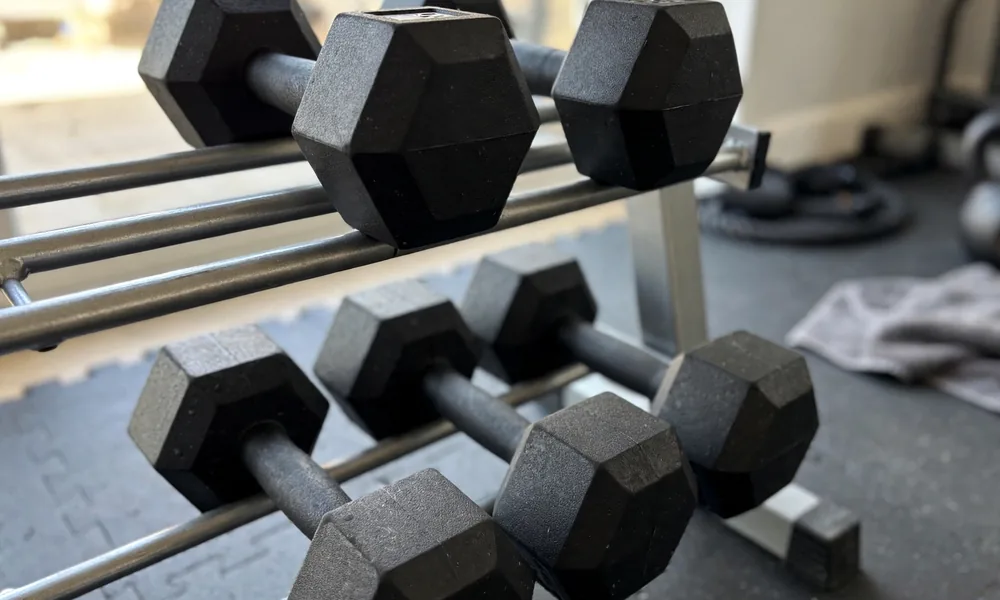
Dumbbell Racks vs Weight Benches: The Short Answer
Choose the rack first if you own more than two pairs, if your weights live on the floor, or if your training is mostly standing work such as curls, rows, lunges and presses. A rack earns its keep by putting the right pair in your hand in seconds and keeping the floor clear. Choose the bench first if you bench press, if you do most of your work lying or seated, or if you own only one adjustable pair and have nowhere to press from. A bench opens up exercises a rack never will, but it does nothing for the pile beside it. Most home gyms end up with both, usually rack first, bench second, because a tidy room trains better. Our guide to the best weight benches covers the bench side in full.
The Main Types of Dumbbell Rack
The right rack depends on how many pairs you own, how heavy they are, and where it will live: a rack for 40 kg hex dumbbells in a garage is a poor fit for 3 kg pairs in a living room corner.
Two-Tier Racks: The Home Gym Standard
The two-tier rack is the default for a reason. Two long shelves hold five to ten pairs in a footprint of roughly 100 cm wide by 45 cm deep. Heavy pairs go low, light pairs high, so nothing heavy is lifted from above your waist. Steel two-tier racks typically carry 150 to 300 kg, covering most fixed sets, and cost less than one good adjustable pair. The weakness is width: ten pairs means a metre of wall.
Three-Tier and A-Frame Racks: For Serious Sets
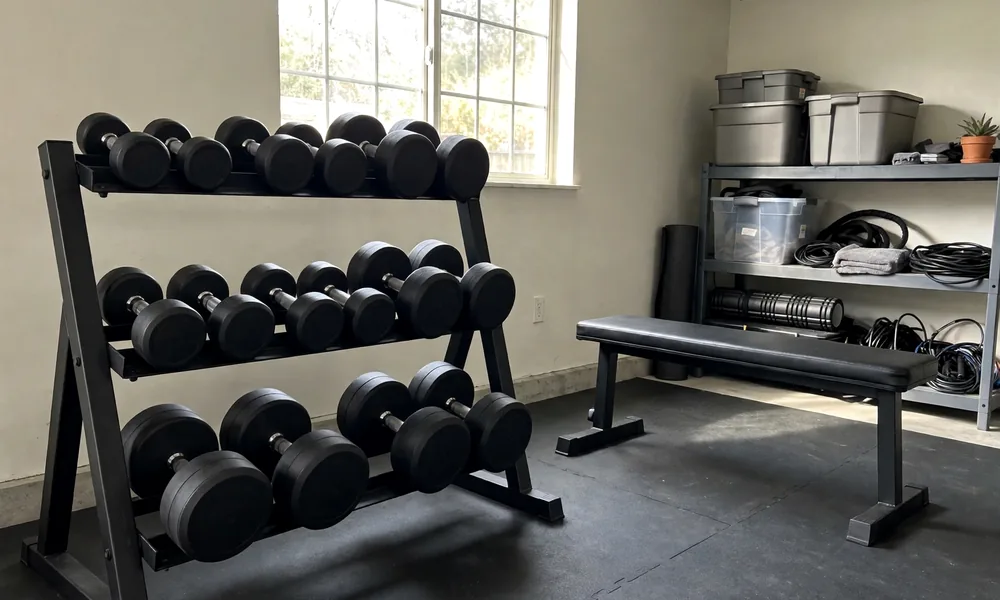
Three-tier and A-frame racks are the heavy lifters of the category. An A-frame holds dumbbells on both sloping sides, so a full set of twelve pairs fits into a footprint barely wider than a single tier, and the weight sits low and central for stability. Three-tier racks stack three stepped shelves, heaviest at the bottom. Both suit fixed hex and round dumbbells from 2 kg to 40 kg and beyond, and both are right once your set passes eight pairs. The trade-off is depth and height: an A-frame needs approach room on both sides, and a three-tier rack stands over a metre tall.
Vertical and Tower Racks: For Tight Corners
Vertical racks store dumbbells upright in a column, usually five or six pairs in a footprint of about 40 cm square. They suit a small flat, a spare bedroom or a living room corner, taking less floor than a chair. The compromise is access: pairs sit close together, so large hex heads crowd each other. They suit light to medium sets best, up to 10 or 12 kg per pair, and look tidier than a horizontal rack in a lived-in room.
Wooden Racks: For Rooms You Live In
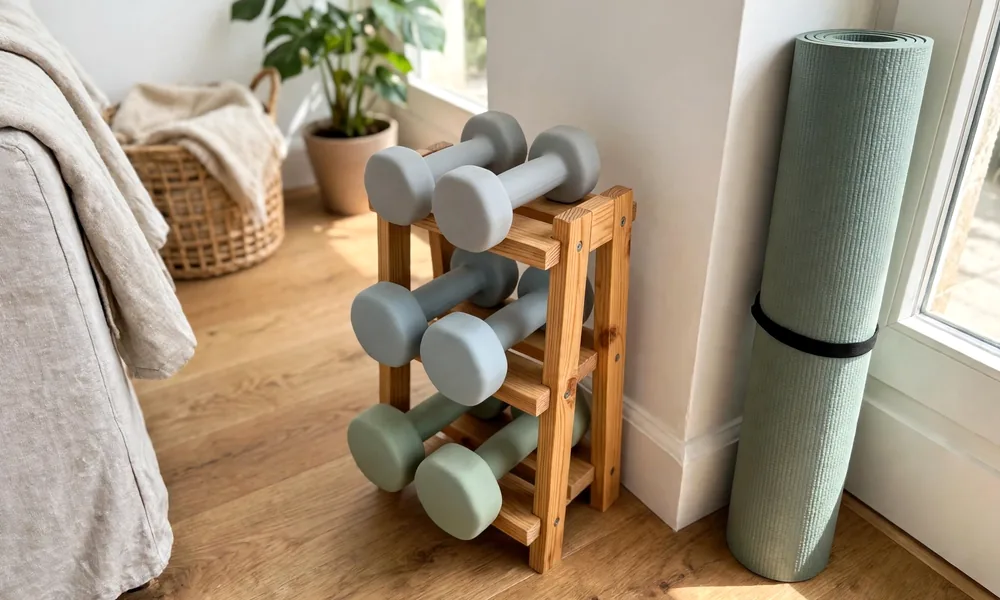
Wooden dumbbell racks are furniture first and gym equipment second. A pine or oak rack holding three or four light pairs looks at home beside a sofa in a way a black steel A-frame never will: the weights stay out, so they get used, and the room still looks like a living room. The limit is load: most wooden racks are rated for 30 to 60 kg, plenty for 2 to 8 kg pairs and nowhere near enough for a serious fixed set. Buy wood for light dumbbells in a shared room, steel once your pairs pass 10 kg.
Wall-Mounted and Compact Racks
Wall-mounted racks bolt to the wall and hold two or three pairs on short arms, freeing the floor entirely. They work for one adjustable pair plus a light fixed pair, or for a garage wall where floor space is precious. The catch is the wall: fixings must go into brick or solid studs, never plasterboard alone, and 20 kg pairs pull hard on their bolts. Compact horizontal racks are short two-tier units for three or four pairs, suiting beginners whose set is still growing. Check it can take heavier pairs later.
How to Choose the Right Size
Count your pairs, including ones you plan to buy next year, then add two. Measure the footprint on the floor, not the product page: a rack listed as 100 cm wide needs at least 130 cm of clear wall once handles are counted. Allow 60 cm of clear floor in front for stepping back with a pair in each hand, and check the height against shelves and radiators behind it. Weight capacity matters more than dimensions: add up the total weight of every pair, then buy a rack rated at least a third higher, because manufacturers test with weight spread evenly and real life piles heavy pairs on one side. Finally, match the rack to the dumbbells: hex pairs sit flat on any shelf, round pairs need a rail or lip, and adjustable pairs are usually too long for a standard tier. Our guide to the best dumbbells explains which shapes suit a rack and which suit a cradle.
Dumbbell Racks vs Weight Benches at a Glance
| Feature | Dumbbell Rack | Weight Bench |
|---|---|---|
| Main job | Stores dumbbells safely and visibly | Gives you a surface to press from |
| Typical footprint | 100 x 45 cm for a two-tier rack | 120 x 35 cm for a flat bench |
| Best for | Standing work, tidy storage | Pressing, seated and lying work |
| Typical cost | Lower than a bench | Higher, especially adjustable |
| Needs with it | The dumbbells themselves | Dumbbells stored somewhere |
| Buy first if | Weights are on the floor | You bench press every week |
What to Look for in Build Quality
A good rack is judged like any load-bearing furniture: by frame, joints and finish. Steel tube is the standard for anything heavy: box-section rather than round, at least 1.5 mm thick, with welded joints rather than bolt-only assembly, because bolts work loose under repeated loading. A rack that wobbles when you set a pair down will only loosen further, so check the feet: wide, flat, rubber-capped feet grip the floor and stop it walking. The shelves matter more than the frame: a raised lip keeps hex dumbbells from sliding, rubber lining protects the coating and stops the morning clatter, and a slight tilt lets you read the weight markings without bending down. Avoid bare painted shelves with no lip if you own round dumbbells, because they will roll. For wooden racks, check the joints: dowelled and screwed joints hold, glued-only joints creep. Treat weight ratings with scepticism and buy a third above your real total.
Where a Rack Beats a Bench, and Where It Does Not
A rack wins on safety and habit: dumbbells on the floor are a trip hazard, and every session that starts with moving weights out of the way starts with friction. A rack removes that friction: equipment you can see and reach gets used, equipment you have to dig out does not. A rack also wins on floor protection, because a dropped dumbbell lands on a rubber-lined shelf, and on space, because a stack takes less room than pairs spread across the floor. A bench wins wherever your body needs support: pressing, flyes, seated curls, step-ups and supported rows all need a stable surface at the right height. The two do different jobs. If you can only buy one this year, buy the one that fixes the problem you feel every session: the pile on the floor, or the missing surface. Our guide to the best home gyms shows how the two fit together in small, medium and large spaces.
Dumbbell Rack Buying Checklist
- Count every pair you own and plan to buy, then add two spare slots.
- Add up the total weight and buy a rack rated at least a third above it.
- Measure the wall, the depth and the 60 cm of clear floor in front.
- Match the shelf to your dumbbell shape: flat shelves for hex, a lip or rail for round.
- Check for welded joints, rubber-lined shelves and wide rubber-capped feet.
- Put the heaviest pairs on the lowest tier, light pairs on top.
Frequently Asked Questions
Do I need a dumbbell rack if I only own one pair?
No, not yet. One pair can live on the floor or a shelf, and a rack only earns its keep once you own three or more pairs. Spend the money on a second pair or a bench first.
Can a dumbbell rack hold adjustable dumbbells?
Usually not on a standard tier, because adjustable dumbbells are long and their cradles need a flat surface. Most adjustable pairs are better kept in their cradles on the floor or a low bench.
What weight capacity should I look for?
Add up the total weight of all the pairs, then buy a rack rated at least a third higher. A 100 kg set wants a rack rated to 135 kg or more, because real loading is never as even as the test.
Are wooden dumbbell racks strong enough?
For light pairs up to about 8 kg each, yes, if the joints are screwed as well as glued. For anything heavier, buy steel: a wooden rack holding 20 kg pairs will flex and eventually fail at the joints.
Where should a dumbbell rack go in a small room?
Against the longest clear wall, with 60 cm of open floor in front. A corner works for a vertical rack, but a horizontal rack in a corner wastes one end.
Is a rack or a bench the better first buy?
Buy the rack first if your dumbbells are on the floor and you train mostly standing. Buy the bench first if you bench press or do most of your work lying or seated. Most home gyms end up owning both.
Bottom Line
The best dumbbell racks in 2026 are the quiet foundation of a home gym that actually gets used. Buy a two-tier steel rack for a real fixed set, an A-frame for a large set, a vertical rack for tight space, and a wooden rack for light pairs in a room you also relax in. Size it for next year’s set, rate it a third above the weight it will carry, and put the heavy pairs low. A bench will make you stronger, but a rack will make you train.