
Why End Tables Deserve a Place at Both Ends of Your Sofa in 2026
Why do end tables matter so much when they are the smallest piece of furniture in the room? An end table is the little table that stands at the end of a sofa or beside an armchair, and it does more daily work than almost anything else you own. It holds the lamp you read by, the mug you reach for without looking, and the book you are halfway through. Without end tables, everything lands on the coffee table or the floor, and the room feels unfinished.
The best end tables of 2026 sit at exactly the right height beside your seat, stay steady when you lean on them, and hold what you actually keep within arm’s reach. Get the height wrong and the table becomes an obstacle you bump into every evening. Get it right and you stop noticing it entirely.
Key takeaways
- An end table belongs at the end of a sofa, usually bought as a matching pair, while a side table is any small movable accent table.
- Match the table height to your sofa arm within 5 centimetres.
- Measure the gap at the end of the sofa first: most rooms fit an end table 45 to 55 centimetres wide and no deeper than 45 centimetres.
- A drawer or a lower shelf doubles the table’s usefulness, but a heavy, stable base matters more.
- Buy the pair together when you want symmetry, and buy one at a time when the two ends of your sofa serve different jobs.
End tables vs side tables: what actually differs
People use the two names as if they mean the same thing, but there is a real distinction, and it decides what you should buy. An end table has a fixed job in a fixed place: it stands at the end of a sofa, anchoring that end of the seating. A side table is a looser idea: any small table beside a seat, which may be moved around the room as needed.
Position is the first difference
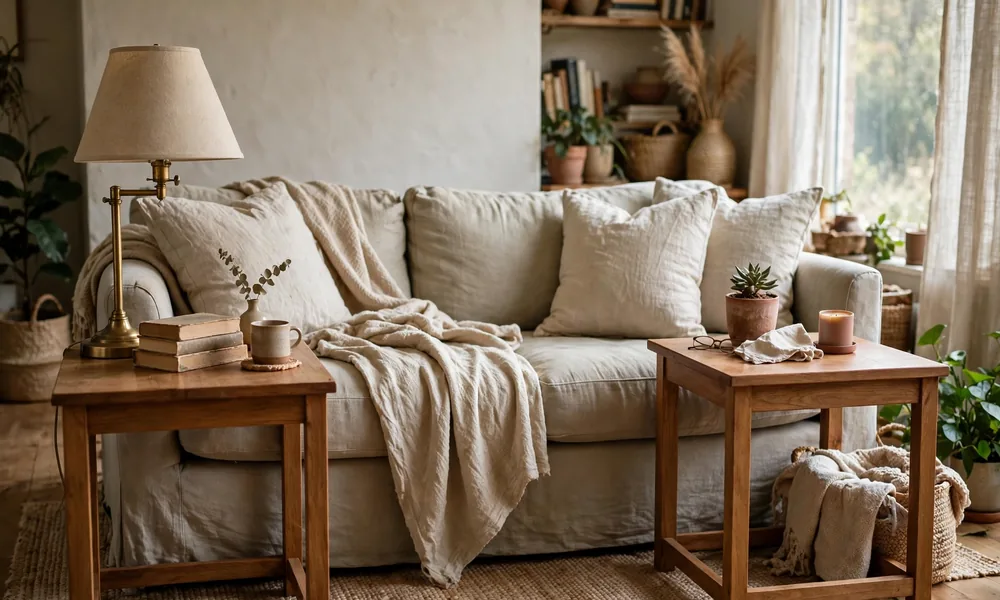
An end table earns its name from where it stands, usually one at each end of the sofa, framing the seating the way bookends frame a shelf. That fixed position is why symmetry matters with end tables and rarely matters with side tables.
Height is the second difference
Because an end table stands beside a sofa arm, its height is set by the sofa, not by fashion. Most sofa arms sit 55 to 65 centimetres from the floor, and the best end tables sit in that same range. A side table has no such rule: a C-shaped table can be low and slide under the seat. Much lower than your sofa arm, and you bend for every drink; much higher, and it becomes a wall. Our guide to the best side tables for a small living room covers those lighter, space-saving shapes in detail.
Storage is the third difference
End tables are expected to store things: a drawer for the remote and the glasses, a lower shelf for the books you are actually reading. Side tables often have no storage at all, which is why an end table usually costs more than a side table of the same size. Nightstands look similar but belong beside a bed, sized to the mattress, so they usually sit too low and too narrow beside a sofa.
Why the ends of the sofa matter
The ends of a sofa are where a living room is actually used: the lamp goes there, and the drink goes there, because the coffee table is a lean-and-reach away. A room with bare sofa ends feels unfinished, and the practical life of the room spills onto the coffee table. Two end tables fix both problems, framing the sofa and giving every seated person a surface of their own.
The main types of end tables, compared
End tables fall into a handful of shapes. A drawer table is the all-rounder. A shelf table is the honest one: everything on show, nothing hidden. An open-frame table suits small rooms because you can see through it. A round table softens a room full of straight lines and has no corners to catch a hip at night.
| Type | Best for | Storage | Watch out for |
|---|---|---|---|
| One-drawer table | Everyday living rooms | Drawer plus lower shelf | Cheap drawer runners jam |
| Open-shelf table | Books and baskets | One or two open shelves | Clutter stays visible |
| Open-frame table | Small rooms | Almost none | Too light to hold a heavy lamp |
| Round or drum table | Tight corners, softening a room | Hidden inside a drum | Less surface than a square table |
| Nesting pair | Guests and flexible seating | None on the small table | The small table wanders off |
| Tray-top table | Serving drinks and snacks | None | The tray slides if not seated properly |
The one-drawer table is the safest first buy. Choose the shape by the job, not by the photograph.
Measure first: height, width and depth
Every good end table decision starts with three numbers from your sofa, not the shop: the arm height, the gap at the end of the sofa at its narrowest point, and how far the table can stick out before it blocks the walkway.

Height first. The top of the table should sit level with the top of the sofa arm, or within 5 centimetres either way. A table 10 centimetres too low forces you to reach down for every drink; 10 centimetres too high and it turns into a barrier you cannot see over.
Width second. Most living rooms fit an end table 45 to 55 centimetres wide. Wider and the table dominates the seating; narrower than 40 centimetres and it will not hold a lamp and a mug at the same time. Leave a few centimetres of air between the table and the sofa arm. Depth third: deeper than about 45 centimetres and the table starts to push into the walkway.
Materials that survive daily use
An end table takes more daily punishment than most furniture: mugs leave rings, lamps get knocked, books get stacked. The material decides whether the table looks better or worse after a year of that.
Solid wood
Solid oak, walnut or ash is the most forgiving choice: it can be sanded and re-oiled when marked, it ages gracefully, and it has the weight that keeps a lamp steady. It is also the most expensive, so buy it when you want the table to last a decade.
Wood veneer on plywood
Good veneer on plywood is the sensible middle ground: it looks like solid wood, costs much less, and resists warping better than solid boards. The risk is the edge: cheap veneer chips at the corners and cannot be repaired invisibly, so check the edges in the shop.
Metal and glass
Metal frames with a glass top suit modern rooms, but glass shows every fingerprint. A metal base with a wooden top is often the best of both. Avoid thin tubular frames that wobble, and walk away from thin flat-pack board with plastic drawer runners: the drawer jams within months and the table is too light to hold a lamp safely.
Styling a pair without making it look matched
A matching pair is the classic choice, but it can also look like a furniture showroom. The trick is to match the tables and vary what sits on them: a different lamp on one side and a plant on the other, books on the left, a single vase on the right.
Keep the top of each table to three things at most: a lamp, a drink, and one personal item such as a book or a plant. The drawer and the shelf below exist so the top can stay clear. The lamp base should sit at least 10 centimetres from the edge. Our guide to the best table lamps for living rooms covers shade size and bulb warmth in detail.
Storage: drawer, shelf or open base
Storage is where end tables earn their keep. A drawer hides the small things: the remote, the charger, the reading glasses. A lower shelf holds what you want visible and reachable: the book you are reading, a basket. An open base holds nothing, but it keeps a small room feeling airy.
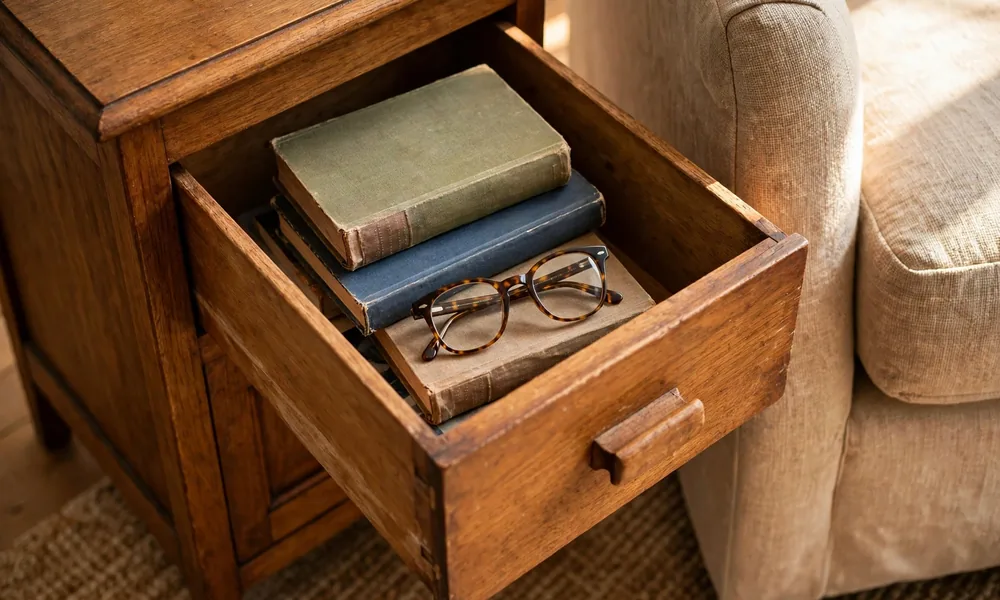
Test the drawer: it should open with one finger and close without a push. Full-extension runners are worth paying for, because a drawer you cannot reach into is a drawer you will not use. Do not fill the lower shelf to the edges: leave a third of it empty, and stack the books in one place.
Mistakes that make end tables annoying
The most common mistake is buying the table before measuring the sofa. The second is buying two tables of different heights because they were on sale separately. The third is choosing a table for its looks and discovering it cannot hold a lamp without wobbling. The fourth is putting the table so close to the sofa that the drawer cannot open. Do not treat the table as a dumping ground: clear the top every evening. Felt pads under the feet cost almost nothing and stop a heavy table scratching a hard floor. The best coffee tables for small living rooms face the same measuring problem from the other side of the room.
Checklist: before you buy
- Measure your sofa arm height and write it down before you shop.
- Measure the gap at each end of the sofa at its narrowest point.
- Check the walkway: the table must not stick out more than 45 centimetres.
- Push the table and lean on it; it must not wobble.
- Open and close the drawer three times; it should glide shut.
- Confirm the lamp base fits with 10 centimetres clear of the edge.
FAQs
What is the difference between an end table and a side table?
An end table stands at the end of a sofa, usually as part of a matching pair, sized to the sofa arm with a drawer or shelf. A side table is any small table beside a seat: lighter, often movable, often without storage. A light C-shaped side table rarely anchors the end of a sofa.
How tall should an end table be?
Level with the top of your sofa arm, or within 5 centimetres either way; most sofa arms sit 55 to 65 centimetres from the floor. Measure your own sofa, because a table 10 centimetres off feels wrong every time you reach for a drink.
Should end tables match?
Matching pairs look settled and symmetrical. The two tables do not have to be identical, but they should be the same height, and the same wood or finish helps. Vary what sits on top of each one.
Can I use a nightstand as an end table?
You can, but it is usually the wrong size: nightstands are sized to a mattress, lower and narrower than a sofa arm, so they sit too low beside a sofa. If the height matches your sofa arm, it will do; measure first.
How much should I spend on end tables?
Expect to pay more than for a side table of the same size, because you are paying for the drawer, the joinery and the weight. A solid wood or good veneer pair is a ten-year purchase; the cheapest flat-pack tables often need replacing within two years.
What should I keep on an end table?
Three things at most: a lamp, a drink, and one personal item. Everything else belongs in the drawer or on the lower shelf. A clear top is what makes the table look calm and expensive.
Bottom line
End tables are the smallest piece of furniture in the living room and the one you touch most. Buy them to fit your sofa, not the shop display: match the arm height, measure the gap, test the drawer, and choose a table heavy enough to hold a lamp. A pair that fits will disappear into your evenings.


