
The Best Nesting Tables for Small Living Rooms in 2026
Nesting tables are the small living room’s quiet trick: a set of two or three graduated tables that tuck under each other when you need one surface and pull apart when guests arrive. The best nesting tables of 2026 earn their place by doing two jobs at once. Nested, they take up the floor space of a single side table. Pulled apart, they give you a spare surface beside every seat, a landing spot for drinks, books and lamps that a single table never could. Most people shop for one small table and then discover they need two more. A nesting set solves that in one purchase, provided you buy the right sizes, the right heights and a frame that slides apart without catching.
Key Takeaways
- Buy the set, not the table: a nesting set is two or three graduated tables that slide under each other, and the smallest table decides whether the set actually nests.
- Match the largest table to your sofa arm within 5 centimetres, so you can set down a drink without reaching up or down.
- Wood sets suit warm, everyday rooms best, while metal and glass sets suit modern rooms and show dust sooner.
- Check the slide before you buy: the smaller tables must pull out smoothly and sit level, with no catching or rocking.
- A set of three beats a set of two when you entertain, because the third table is the one guests actually use.
What Makes a Nesting Table Set Work
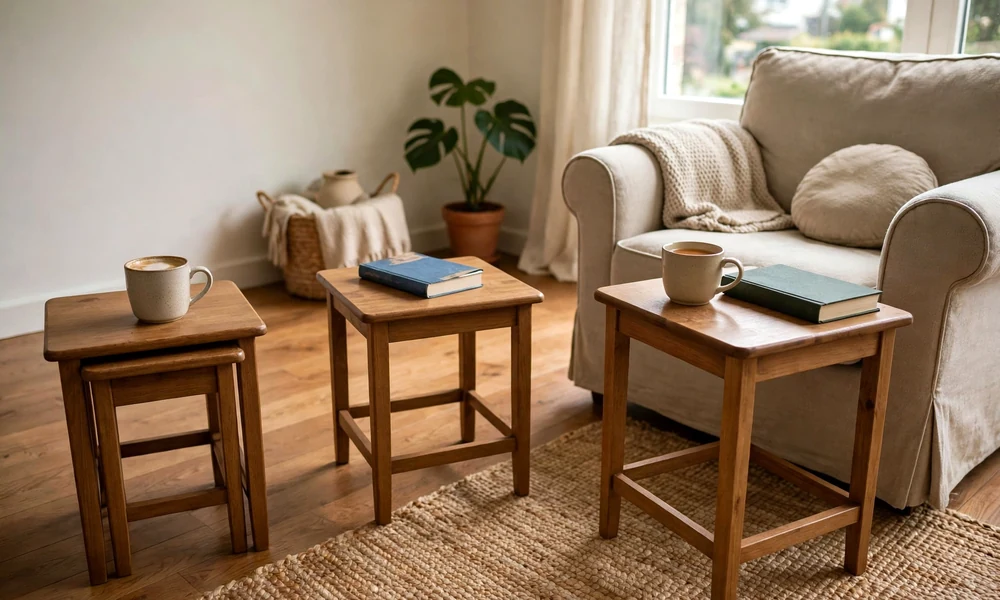
A nesting set works on one simple idea: graduated sizes. The largest table is a normal side table, usually 45 to 55 centimetres wide and 55 to 65 centimetres high. The middle table is a few centimetres smaller in every direction, and the smallest is smaller again, so each one slides under the next and the whole set parks in the footprint of the largest. The legs of the smaller tables must clear the legs of the larger one, the tops must not collide, and the smallest table must be low enough to slide under the middle one without scraping its top. A well-made set slides apart with one hand and nests again with a gentle push. A badly made set catches, rocks, or leaves the smallest table sticking out by a centimetre. That is why the slide is the first thing to test in the shop, before the wood, the finish or the price.
There is a useful distinction to draw here, because nesting tables are often confused with the single tables they resemble. A side table is any small movable table beside a seat, and our guide to the best side tables covers those lighter, single-surface shapes in detail, including nesting tables as one style among several. An end table, by contrast, has a fixed job in a fixed place at the end of a sofa, as our guide to the best end tables explains. A nesting set is neither: it is a set, bought as a set, whose whole point is that it becomes one table when you need one and three tables when you need three. Judge it as a set, not as three separate tables, and the buying decision gets much clearer.
The Main Types of Nesting Tables, Compared
Nesting sets come in four broad types, and the right one depends on the room and on how often the tables will be pulled apart. Solid wood sets are the classic: oak, walnut or pine tops on wooden legs, warm to look at and forgiving of everyday knocks. Metal-frame sets use steel legs with wood, glass or stone tops, and suit modern rooms where the frame is part of the look. Glass-top sets use a clear or smoked glass top on a metal or wood frame, so the set looks light even when it is fully nested. C-shaped nesting sets are the newest idea: each table has a base that slides under a sofa or armchair, so the top hovers over the seat, ideal when there is no floor space beside the sofa at all.
| Set type | Best for | Typical set | Watch out for |
|---|---|---|---|
| Solid wood | Warm, everyday rooms | Two or three tables | Heavy to move, scratches show |
| Metal frame | Modern rooms | Two or three tables | Cold to the touch, noisy |
| Glass top | Small, dark rooms | Two tables | Shows dust and fingerprints |
| C-shaped | No floor space beside sofa | Two tables | Tips if loaded on one side |
Best All-Rounder: The Three-Piece Solid Wood Set
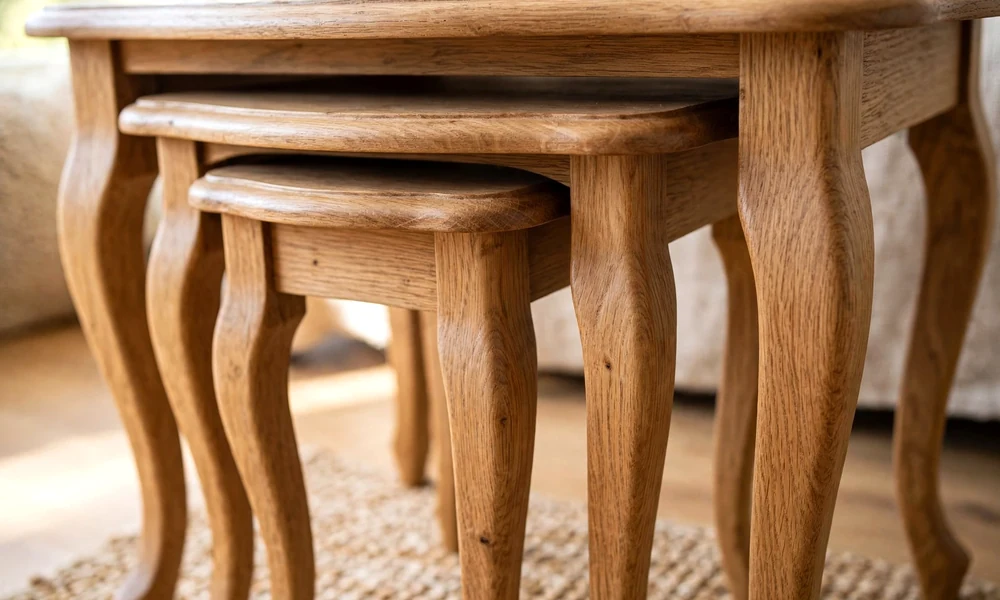
The three-piece solid wood set is the best nesting table set for most living rooms in 2026. Three oak or walnut tables, graduated by about 8 to 10 centimetres in width and 5 centimetres in height, give you a large table beside the sofa, a middle table for the armchair, and a small table that becomes the drinks table when guests arrive. Wood brings warmth that metal and glass cannot, and a solid top forgives a hot mug in a way glass never will. The grain makes even a sparsely styled set look finished, and a good hardwood top can be sanded and refinished if it picks up scratches over the years. Check the legs before you buy, because the leg is the set: the smaller tables’ legs must clear the larger tables’ legs with a centimetre to spare on each side, or the set will never nest cleanly. Four straight legs nest more reliably than splayed or curved legs, which look elegant but steal the clearance the set needs.
Metal-Frame Sets: Modern, Light, and Honest About Their Limits
Metal-frame sets are the modern option. A slim steel frame with wood, glass or stone tops looks light even in a small room, and the frame itself is the decoration, so the set needs no styling to look deliberate. They suit rooms where the furniture is already metal and glass, and they suit households that move the tables often, because a steel frame is lighter than a solid wood one of the same size. They fail when asked to feel warm. A metal frame is cold to the touch in winter, noisy when a mug is set down hard, and shows every fingerprint on a black powder-coated finish. The frame also decides the nesting: a frame with a crossbar under the top will block the smaller table sliding in, so check the clearance with the tables nested, not just apart. If you like the modern look but want warmth, choose a metal frame with a wood top and you get most of both.
Glass-Top Sets: Light, But Only for Careful Households
Glass-top sets are the lightest-looking option and the most demanding. A clear or smoked glass top on a slim frame lets light through, so a fully nested set barely registers in a small or dark room. That is also their weakness: glass shows dust, fingerprints and water rings within hours, so a glass set needs wiping far more often than wood, and a chipped corner is a safety problem rather than a cosmetic one. Tempered glass is the minimum: it is far stronger than ordinary glass and breaks into small, blunt pieces rather than sharp shards. Keep glass sets to two tables rather than three, and away from households with small children who climb.
Sizing: The Numbers That Matter
Three numbers decide whether a nesting set works, and all three are worth measuring before you buy anything. Height first: the largest table should sit within 5 centimetres of your sofa arm, usually 55 to 65 centimetres from the floor, so you can set down a drink without reaching up or down. The middle and smallest tables step down by about 5 centimetres each, which keeps the set looking graduated rather than accidental. Width second: the largest table should be 45 to 55 centimetres wide, and the set as a whole should fit the gap beside your sofa with a few centimetres of air on each side. Depth third: the smallest table must be shallow enough to slide fully under the middle one, so measure the clearance between the middle table’s legs and buy a smallest table at least 2 centimetres narrower. A set that nests with a centimetre sticking out is a set you will notice every day.

Where to Put Each Table When Guests Arrive
A nesting set earns its keep when guests arrive. Put the largest table beside the sofa where it always lives, the middle beside the armchair so the second seat has its own landing spot, and the smallest where drinks actually get set down: beside the guest with no armrest nearby, or in the middle of the room as a shared drinks table. When the evening ends, the tables nest again in seconds. That is also the test to run in the shop: pull all three apart, place them where your seats are, and nest them again. If any step feels awkward, the set is wrong for your room, however good it looks in the showroom.
Nesting Table Checklist
- Measure your sofa arm first and buy a largest table within 5 centimetres of that height.
- Test the slide in the shop: every table must pull out smoothly and sit level, with no catching or rocking.
- Check the nesting clearance: the smallest table must slide fully under the middle one, with air to spare.
- Choose three tables over two if you entertain, because the third table is the one guests use.
- Pick solid wood for everyday warmth, and tempered glass only if you will wipe it often.
- Leave a few centimetres of air around the nested set so you can pull a table out without moving the sofa.
Frequently Asked Questions
How many tables are in a nesting set?
Usually two or three. A set of two is a large table and a small one; a set of three adds a middle table and is the better choice if you entertain, because the third table is the one guests actually use.
What size nesting tables should I buy?
Match the largest table to your sofa arm within 5 centimetres, usually 55 to 65 centimetres high and 45 to 55 centimetres wide. The middle and smallest tables step down by about 5 centimetres in height and 8 to 10 centimetres in width.
Do nesting tables wobble?
A well-made set does not. Test the slide and the sit in the shop: every table must pull out smoothly and sit level with no rocking. Four straight legs nest more reliably than splayed or curved legs.
Are nesting tables the same as side tables?
No. A side table is a single table, while a nesting set is two or three graduated tables bought as a set. Our guide to the best side tables covers single tables in detail, and our guide to the best end tables covers the fixed tables that stand at the end of a sofa. For the bigger surface a nesting set sits beside, see our guide to the best coffee tables for small living rooms.
What is the best material for nesting tables?
Solid wood is the best all-rounder: warm, forgiving and long-lived. Metal frames suit modern rooms, and glass tops suit small, dark rooms but need frequent wiping and tempered glass as a minimum.
Where should I put nesting tables?
Keep the largest beside the sofa where it always lives, the middle beside the armchair, and the smallest where drinks get set down. When guests leave, nest them again and the room goes back to a single table.
The Bottom Line
The best nesting tables of 2026 are a three-piece solid wood set, sized to your sofa arm, that slides apart smoothly and nests again with air to spare. Buy the set, test the slide, and the small room gains three tables for the price of one footprint.


