
Hot Plates That Cook Anywhere in 2026: The Portable Burner Guide
Hot plates are the simplest cooking tool most kitchens ever own: a portable burner you plug in, set a pot or pan on, and cook with anywhere there is a socket. No hob, no gas line, no installation. For a student in a dorm, a renter with a tiny kitchen, an office worker who wants real lunch, or anyone who needs one extra burner at a family gathering, a hot plate turns a table into a stove.
This guide explains the four kinds of hot plate worth buying in 2026, what wattage and size actually mean in daily cooking, where a hot plate earns its keep, and the safety habits that keep a portable burner safe.
Key Takeaways
- A hot plate is a portable heat source you set a pot or pan on, not a cooking surface itself, which is what separates it from a griddle or a skillet.
- Coil hot plates are cheap and tough; solid plates are easy to clean; induction plates are the fastest and most precise; double burners cook a whole meal at once.
- Buy 1,000 to 1,500 watts per burner for real cooking, and check that your pan sits flat and stable on the plate before you commit.
- Match the plate to the pan: induction needs magnetic cookware, coil and solid plates take almost anything with a flat base.
- A hot plate is at its best as a second burner, a dorm or office cooker, or a travel stove, not as a replacement for a full hob.
What a Hot Plate Actually Is
A hot plate is a self-contained electric burner in a small box. Under the cooking surface sits a heating element, on top sits your pot or pan, and a dial or touch panel controls the temperature. Plug it into a wall socket and it works anywhere: a dorm desk, an office kitchenette, a campervan table, a garden shed, or a kitchen counter when the hob is already full. That portability is the whole point, and it is what separates a hot plate from every fixed cooker in the kitchen.
The confusion usually starts with the neighbours. A griddle is a wide, flat cooking surface that food touches directly: pancakes, burgers, and grilled sandwiches cook on the plate itself. A hot plate is different, because food never touches it; the plate heats your pot or pan, and the pan does the cooking. Our guide to the best griddles covers the flat-surface family in full. An electric skillet is different again: it is a deep-sided pan with its own heating element and lid, a self-heating pan rather than a burner you put a pan on. Our guide to the best electric skillets covers the one-pot cooker in full.
The Main Types of Hot Plate Compared
Hot plates fall into four main types, and the right one depends on what you cook, what pans you own, and how much you want to spend. The table below compares them on the points that decide most purchases.
| Type | Best for | Typical wattage | Pan needed | Watch out for |
|---|---|---|---|---|
| Coil | Budget cooking, heavy pots | 1,000–1,500 W | Any flat-based pan | Slow to cool, hard to clean |
| Solid plate | Everyday use, easy cleaning | 1,000–1,500 W | Any flat-based pan | Hot spots, slow heat changes |
| Induction | Fast, precise cooking | 1,300–2,000 W | Magnetic cookware only | Pan must be magnetic |
| Double burner | Full meals, hosting | 1,500–2,500 W total | Any flat-based pan | Weight, counter space |
Coil Hot Plates: The Cheap and Tough Choice
The coil hot plate is the classic: an exposed spiral element that glows red as it heats, usually on a small metal body with a dial on the front. It is the cheapest kind, often half the price of an induction plate, and it is also the toughest. A coil plate takes almost any pan with a flat base, holds a heavy stockpot without complaint,
The trade-offs are speed and cleaning. A coil heats slowly, cools slowly, and its temperature swings more than a solid plate or an induction plate, so delicate sauces and a gentle simmer take more attention. The coil itself is awkward to clean: spills bake onto the spiral, and the drip tray underneath needs emptying.
Solid-Plate Hot Plates: The Everyday Choice
A solid-plate hot plate replaces the exposed coil with a flat cast-iron or steel disc. The surface is easy to wipe clean once it has cooled, the plate looks tidier on a counter, and it spreads heat a little more evenly than a coil.
The weakness is responsiveness. A solid plate takes a few minutes to reach temperature, and it stays hot for a long time after you switch it off, so turning the heat down does not change the cooking temperature quickly. Hot spots are the other thing to watch: cheaper plates heat unevenly, so the centre of the pan runs hotter than the edges.
Induction Hot Plates: The Fast and Precise Choice
An induction hot plate heats the pan itself with a magnetic field, not the plate, so the surface stays relatively cool and the pan heats in seconds. It is the fastest kind of hot plate by a clear margin, the most precise, and the safest to touch after cooking. Most models have touch controls with exact temperature settings, a timer, and an automatic shut-off if you lift the pan away.
The catch is the pans. Induction only works with magnetic cookware: cast iron, carbon steel, and magnetic stainless steel all work, while aluminium, copper, and glass do not unless they have a magnetic base. Test your pans with a fridge magnet before you buy; if it sticks firmly to the base, the pan will work. Our guide to the best induction cooktops explains the same magnetic rule for built-in hobs.
Double-Burner Hot Plates: The Whole-Meal Choice
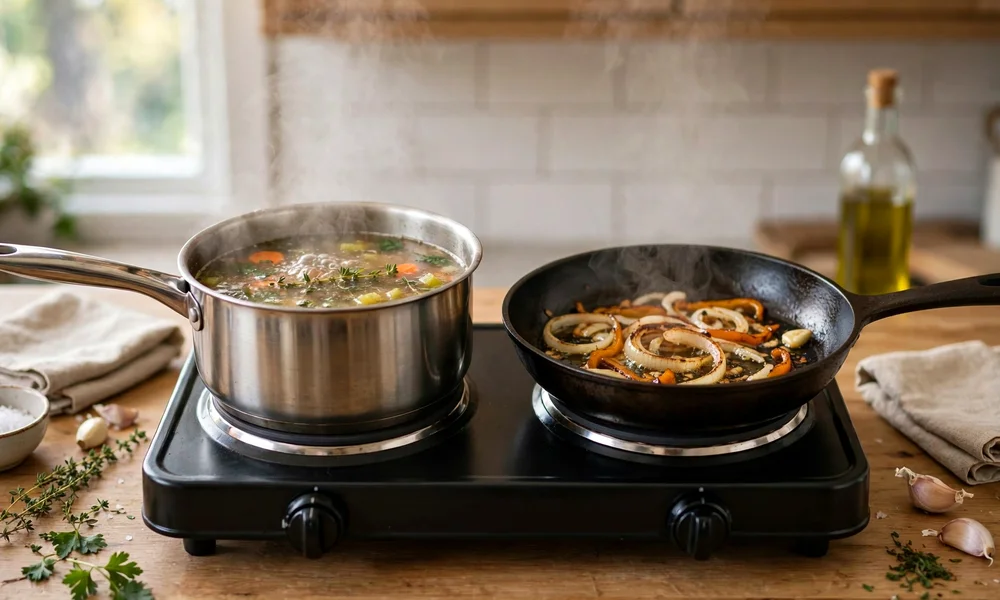
A double-burner hot plate puts two burners side by side in one unit, so you can simmer a pot on one and fry on the other, which is the difference between cooking a snack and cooking a meal. Most doubles have independent dials, so one burner can hold a gentle simmer while the other runs at full heat. Total wattage usually runs from 1,500 to 2,500 watts, and the two burners often differ in size, one large and one small, to suit different pans.
The price is size and weight. A double burner needs a good stretch of counter, weighs several kilos, and is not something you pack into a bag.
Wattage, Size and What They Can Cook
Wattage is the number that decides whether a hot plate cooks dinner or just warms it. A single burner of 1,000 to 1,500 watts will boil a litre of water in a few minutes, fry eggs, simmer a stew, and sear a steak in a hot pan. Below 1,000 watts, boiling takes noticeably longer and searing becomes difficult, because the plate cannot recover its temperature when cold food goes in.
Size matters in a different way: the plate must match the pan. A small plate under a wide pan heats only the middle, so food cooks unevenly and the edges stay cool. A large plate under a tiny pan wastes energy and heats the handle. As a rule, the pan base should cover the plate without overhanging it by more than a centimetre or two. Stability matters just as much: a hot plate should sit flat on the counter with non-slip feet, and a heavy pot should not make it rock.
Where a Hot Plate Earns Its Keep
A hot plate earns its keep in the places a fixed hob cannot reach. In a dorm room it is the whole kitchen: a kettle in the morning, noodles at lunch, a proper one-pot dinner in the evening, all from a single burner on a desk. In a small rented flat it is the second burner that lets you cook a sauce while the pasta boils on the hob. At a family gathering it is the extra burner for the gravy while the oven and hob are full.
It also earns its keep outdoors and on the move. Campers and caravan owners use a hot plate as a clean, quiet alternative to a gas stove, and it works on any campsite with a hook-up. During a kitchen renovation, a hot plate and a microwave keep a household fed for weeks.

Safety and Care
A hot plate is safe when it is used on a stable, heatproof surface with space around it, and dangerous when it is not. Always set it on a flat, level counter away from the edge, with at least a few centimetres of clear space on every side. Never use it on a bed, a carpet, or a plastic table, and never leave it running unattended.
The plate stays hot long after you switch it off, which is the cause of most hot-plate burns. Coil and solid-plate models hold their heat for ten minutes or more, so treat the surface as hot until you can hold your hand near it without feeling heat. Let it cool fully before you clean it, and wipe a solid plate with a damp cloth rather than running it under water.
Hot Plate Checklist: Before You Buy
- Choose the type for your cooking: coil for budget and heavy pots, solid plate for easy cleaning, induction for speed and precision, double burner for full meals.
- Buy 1,000 to 1,500 watts per burner, and check the socket can handle the load on its own circuit.
- Match the plate to your pans: test for magnetic bases if you are buying induction, and check pan diameter against plate size.
- Check stability: non-slip feet, a flat base, and no rocking with a full pot on top.
- Look for a hot-surface indicator light and an automatic shut-off or timer on induction models.
- Measure your counter space, including room for the cord, before you order a double burner.

Frequently Asked Questions
Can a hot plate replace a stove?
For one-pot cooking, boiling, and frying, yes, a hot plate can stand in for a stove. For a household that cooks full meals every day, no: a single or double burner is slower than a hob, offers fewer burners, and ties up counter space.
What pans work on a hot plate?
Coil and solid-plate hot plates take almost any pan with a flat base: stainless steel, aluminium, cast iron, and enamelled steel all work. Induction plates need magnetic cookware, so test your pans with a fridge magnet first.
How long does it take a hot plate to boil water?
A 1,000 to 1,500 watt hot plate boils a litre of water in roughly four to six minutes with a lid on, which is close to a standard hob burner.
Is it safe to use a hot plate in a dorm room?
Usually yes, but check your dorm rules first, because some halls ban open-coil plates or any cooking appliance in bedrooms.
Can I use a hot plate outdoors?
Yes, as long as it stays dry and is plugged into a weatherproof outdoor socket or a campsite hook-up.
Why does my hot plate heat unevenly?
Uneven heating usually comes from one of three things: a warped pan base that only touches the plate in the middle, a pan much wider than the plate, or a cheap plate with a thin element.
The Bottom Line
The best hot plate is the one that fits your pans and your space. A coil plate is the budget workhorse, a solid plate is the easy everyday choice, an induction plate is the fastest and most precise if your pans are magnetic, and a double burner is the one that cooks a whole meal. Buy 1,000 to 1,500 watts per burner, check stability with a full pot, and treat the surface as hot until it has cooled.


