
A fish tank is only as safe as the stand underneath it. Water is heavy — a single litre weighs a kilogram, and a modest 100-litre tank can weigh over 130 kilograms once you add glass, gravel, rocks and the water itself. Put that weight on a wobbly side table or a bookshelf that was never meant to carry it, and the result can be a slow bow, a cracked seam, or a sudden flood across the floor. The best fish tank stands of 2026 are built for that load from the ground up: a level top, a frame that does not flex, and a footprint that matches the tank it holds. They also give you somewhere to hide the filter, the heater cables and the fish food, so the tank looks like furniture instead of a science experiment.
How Much Weight Are We Talking About
The numbers surprise most first-time keepers. A standard 60-litre tank holds 60 kilograms of water, and the glass, substrate and decorations add another 15 to 20 kilograms, so the stand carries roughly 80 kilograms. A 120-litre tank pushes past 150 kilograms. A 200-litre tank weighs close to 250 kilograms when full — about the same as three adults standing on one spot. That is why a stand’s rated load matters more than its looks. A stand rated for 100 litres should never carry a 150-litre tank, even if the tank physically fits on top. When you shop, add up the full weight yourself: one litre of water is one kilogram, then add the glass, the gravel at roughly 1.5 kilograms per litre of substrate, rocks and driftwood, and a safety margin of at least 20 percent. If the stand’s rating is close to your total, size up. Stands do not get stronger with age; they get weaker as joints loosen and wood swells from the occasional splash.
The Four Main Types of Stand
Metal frame stands are the workhorses. Usually made from powder-coated steel, with four legs and cross-braces, they hold the most weight for the least money. Their open frame lets air circulate, which helps keep equipment dry, and many have an open shelf underneath for a canister filter or a bucket. Their weakness is looks: a bare steel frame can look industrial in a living room, and cheap ones can rust if water sits on the coating. They suit larger tanks and anyone who values strength over style.
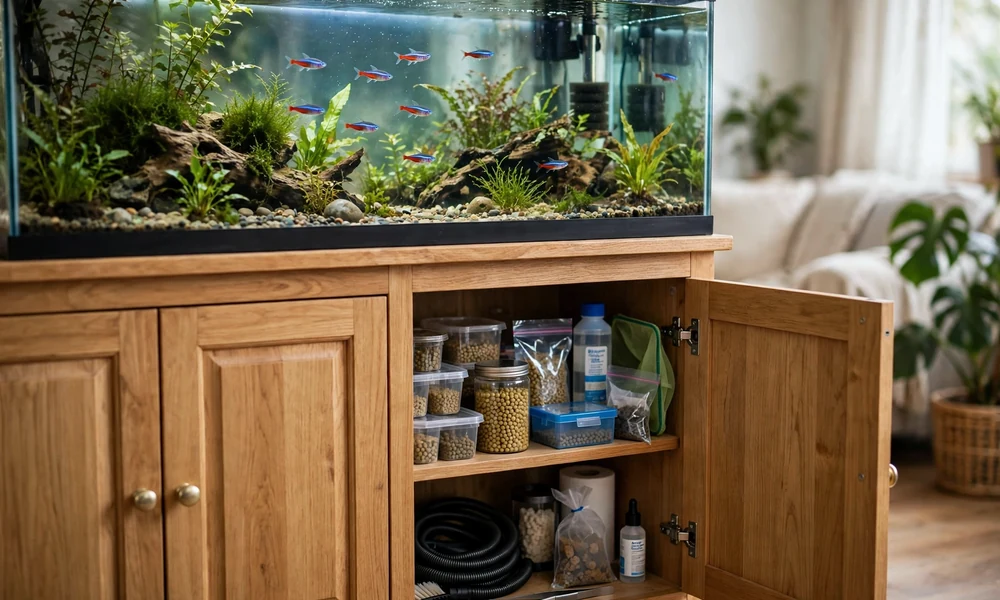
Cabinet stands are the living-room choice. They look like a low cupboard, with doors that hide the filter, the food, the test kits and the spare parts. A good cabinet stand is made from moisture-resistant board or solid wood, with a top thick enough not to bow and doors that close properly even after a few splashes. They cost more than a metal frame, but they turn the tank into a piece of furniture. Check that the back panel has cut-outs or holes for cables and hoses, or you will end up drilling them yourself.
Wooden open stands sit between the two. Usually solid wood or thick plywood, with a simple shelf or two and no doors, they look warmer than steel, cost less than a full cabinet, and give easy access to equipment. Their trade-off is storage: everything underneath is on show, so you need to be tidy, and untreated wood can stain or swell if water drips on it regularly. A quick coat of varnish on the top surface solves most of that.
Compact and desk stands are made for small tanks — betta tanks, nano aquariums and shrimp cubes up to about 40 litres. They are short, narrow and light, designed to sit on a desk or a sideboard rather than stand on the floor. The key check is the same as for a big stand: the top must be perfectly flat and the stand must be rated for the tank’s full weight. A desk stand that flexes under a 30-litre tank will crack the tank just as surely as a bad full-size stand will crack a big one.
What to Check Before You Buy
Start with the footprint. The stand’s top should be at least as large as the tank’s base, and ideally a few millimetres larger all round. A tank that overhangs the stand, even by a centimetre, puts its weight on the glass edge instead of the base, and that is how tanks crack. Measure the tank’s base, not the rim, and measure the stand’s top, not its overall width — some stands have decorative trim that sticks out further than the load-bearing surface. Next, check that the top is level, with a spirit level in the shop if you can, or at home before you fill the tank. A stand that rocks needs levelling feet or shims; never fill a tank on a rocking stand and hope the water settles it. Then look at the joints: on a metal stand the welds or bolts should be clean and tight, with no wobble when you push the frame sideways, and on a wooden stand the corners should be square and the screws should bite into solid material, not crumbling chipboard. Finally, think about the floor. A full 200-litre tank concentrates a quarter of a tonne on four small feet, so wide feet, or a thin board under the stand to spread the load, protect the floor and keep the stand level.
Matching the Stand to the Tank Size
For tanks up to 40 litres, a compact desk stand or a sturdy piece of furniture rated for the weight will do, as long as the top is flat and the stand does not flex. A betta tank on a desk stand is the classic starter setup. For tanks from 40 to 120 litres, a dedicated stand becomes worth the money. This is the size where a bookshelf starts to sag, and a cabinet or metal frame stand in this range is affordable and widely available. For tanks from 120 to 250 litres, buy the stand made for the tank, ideally from the same manufacturer. Matching sets are engineered together, so the top, the frame and the feet are all sized for that exact tank. For tanks above 250 litres, the stand is a structural decision, not a furniture choice. Check the floor’s load rating, keep the tank against a load-bearing wall, and consider a steel frame with adjustable feet so you can level it precisely.

Storage, Cables and Everyday Practicality
A stand earns its keep every day, not just on setup day. The best ones have room for the equipment you actually own: a canister filter underneath, a power strip, a net, a siphon hose and a tub of food. Cabinet stands hide all of this behind doors, which keeps the living room tidy and keeps small hands and pets away from the electrics. Open-frame stands need more discipline, but they make it easier to reach the filter for cleaning and to spot a drip before it becomes a problem. Cable management matters more than most people expect: a filter, a heater, a light and an air pump each need a socket, and the cables should run down the back of the stand, not dangle across the front. Look for stands with cable holes in the back panel. And think about water changes — you will be carrying buckets or a hose to this stand every week or two for years, so leave enough space around it to work. A stand crammed into a corner looks neat in a photo and is miserable to maintain in real life.
Assembly: What to Expect
Most stands arrive flat-packed, and assembly is usually a one-person job of thirty to sixty minutes — but there are traps. Read the instructions fully before you start, because some stands need a panel fitted before the frame is tightened, and undoing a half-built stand is frustrating. Most kits include an Allen key, but a proper screwdriver and a spirit level make the job far easier, and a second pair of hands helps when you are fitting a heavy top panel. Bolts should be snug, not forced; overtightening can strip the threads in a metal frame or split a wooden panel. Once it is built, test it before the tank goes on: put your weight on the top and push it from the side. It should not rock, creak or flex. Only when the stand is solid and level should the tank go on top — and only then should you start filling it, slowly, checking the level as the water rises.

The Worst Mistakes to Avoid
The worst mistake is using furniture that was never designed to hold a tank. A chest of drawers, a TV unit or a bookshelf may look strong, but their tops are often thin chipboard held up by a frame designed for clothes or books, not for a dead weight of water that never moves. They bow slowly, and the bow is invisible until the tank leaks. The second worst mistake is ignoring the overhang. A tank that sticks out past the stand’s top, even a little, concentrates its weight on the glass edge, and aquariums are not built for that. The third mistake is skipping the level check: a stand that leans by a few millimetres puts more water pressure on one side of the tank, and over months that uneven pressure works on the seams. The fourth mistake is buying a stand rated exactly at your tank’s weight with no margin — ratings assume a perfect, dry, level setup, and real life has splashes, uneven floors and the odd bump. A 20 percent margin costs little and buys a lot of peace of mind. The fifth mistake is forgetting the floor: a heavy tank on a soft floor can sink slightly on one side over time, so re-check the level a month after setup. Wipe up splashes when they happen, especially on wooden stands, because standing water swells wood and lifts veneer, and check the bolts on a metal stand once a year.
The Bottom Line
A fish tank stand is not the glamorous part of the hobby, but it is the part everything else depends on. The fish, the plants, the filter and the glass all sit on top of it, and a failure underneath them ruins all of it at once. The best fish tank stands of 2026 share the same qualities: a flat, level top that matches the tank’s footprint, a frame rated well above the tank’s full weight, joints that do not wobble, and enough storage to keep the equipment tidy. Whether you choose a steel frame for a big tank, a cabinet stand for the living room, or a compact desk stand for a betta, the checks are the same — measure the footprint, add up the weight, test the stability, and leave a safety margin. Get those right, and the stand disappears into the background, doing its job quietly for years while you enjoy the tank on top of it.
For a wider view of the hobby, see our guide to the best aquariums of 2026, and if you are setting up a new tank from scratch, our picks for the best aquarium heaters will help you keep the water at the right temperature. For a smaller-scale project that suits a desk or a shelf, the best terrariums of 2026 are a good place to start.


