
Flatware Sets That Feel Good in the Hand in 2026
A flatware set is the most-handled object in your kitchen, and the easiest to buy badly. You pick up a fork three times a day, every day, for years — yet most people choose a set in ninety seconds, guided by the shine on the box and the price on the shelf. The best flatware sets of 2026 reward a slower look: they feel balanced before they look beautiful and keep their finish through hundreds of dishwasher cycles. The worst look fine in the shop and disappoint within a month — hollow handles, tines that bend, a finish that clouds after a dozen washes.
Flatware sets are worth choosing carefully because the differences are small on the shelf and large at the table. A fork that weighs 45 grams feels solid and calm; one that weighs 28 grams feels like a toy and tires your fingers. A knife with a full tang — metal running the whole length of the handle — cuts cleanly and never wobbles, while a hollow-handled knife flexes at the joint and eventually loosens. And a set made from 18/10 stainless steel resists rust far longer than cheaper 18/0 steel, which has no nickel at all. None of this is visible in a product photo — but all of it is obvious the first week you use the set.
Key Takeaways
- Weight and balance matter more than shine: a fork around 40 to 50 grams, balanced at its middle, feels good for a whole meal.
- 18/10 stainless steel is the best everyday choice, because the nickel content resists rust and holds a bright finish through years of dishwasher cycles.
- A 20-piece set for four suits most households; a 45-piece set for eight suits anyone who entertains.
- Full-tang knives and solid, one-piece construction last far longer than hollow handles glued at the neck.
- Dishwasher-safe does not mean dishwasher-proof: rinse acidic food off promptly and skip the heated dry.
What Counts as a Flatware Set?
A flatware set is a matched group of forks, knives, and spoons sold by place setting. The most common sizes are 20 pieces for four and 45 pieces for eight, each setting typically including a dinner fork, a salad fork, a dinner knife, a teaspoon, and a soup spoon. Some sets add serving pieces, and some are sold as open stock, so you can buy extra forks or replacement spoons later — which matters, because spoons are the first pieces to go missing.
The pieces themselves deserve a closer look. A dinner fork needs evenly spaced, smoothly finished tines that spear food without bending. A dinner knife needs an edge that cuts cooked meat without sawing and a handle thick enough to grip without your knuckles brushing the plate. A soup spoon — rounder and deeper than a tablespoon — is the piece that separates a good set from a careless one. When you test a set, hold each piece the way you would at the table: the handle should sit comfortably across your palm and the balance point near the middle.

The Materials Compared
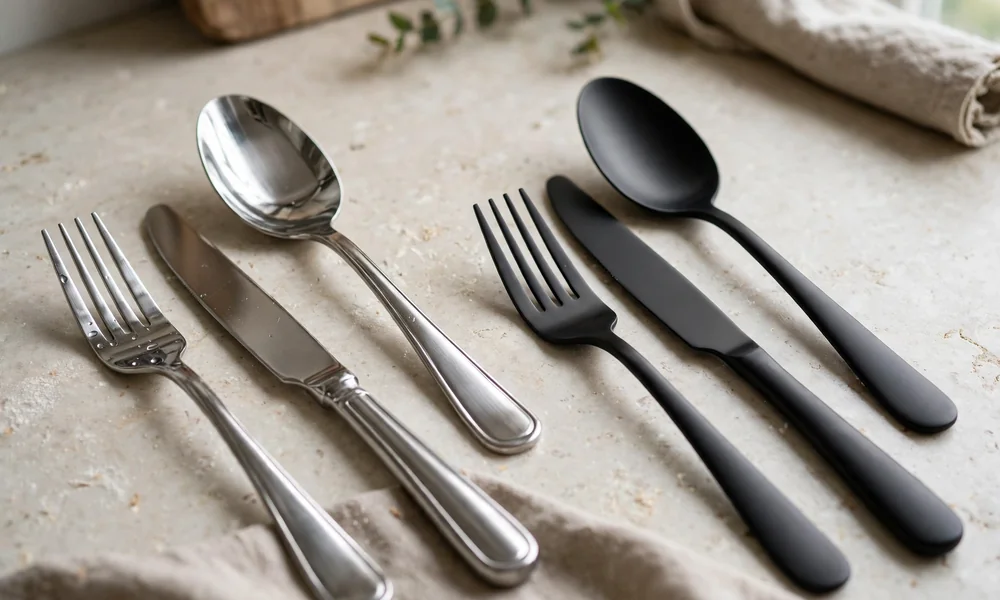
Material decides almost everything about how a set feels, lasts, and looks after a year of use. Stainless steel dominates: strong and rust-resistant when made well. The numbers on the box matter. 18/10 steel is the best everyday choice, bright and slow to show wear. 18/8 is close behind. 18/0 has no nickel, so it is cheaper but more prone to rust spots and quicker to lose its shine. Silver-plated flatware looks beautiful but tarnishes and needs polishing. Gold-toned and matte black finishes are fashionable in 2026, but they are coatings, not solid metal, so they scratch and wear at the edges — fine for a special-occasion set, risky for daily use.
| Material | Feel | Durability | Best for |
|---|---|---|---|
| 18/10 stainless steel | Solid, smooth, bright | Excellent, rust-resistant | Everyday use, long-term value |
| 18/8 stainless steel | Solid, bright | Very good | Good mid-priced sets |
| 18/0 stainless steel | Lighter, duller | Fair, can spot or rust | Budget sets, light use |
| Silver-plated | Soft, luxurious | Needs polishing, tarnishes | Formal occasions |
| Matte black / gold-toned | Modern, striking | Coating wears at edges | Style-led, occasional use |
Weight, Balance, and the Hand Test
Weight is the most underrated quality in flatware, and the first you notice at the table. A good dinner fork weighs roughly 40 to 50 grams; a good dinner knife roughly 60 to 75 grams. Below that range pieces feel flimsy and bend; far above it they feel clumsy and tire your wrist. But weight alone is not enough — balance is what makes weight feel good. Hold a fork horizontally on one finger at its middle: a well-balanced piece stays level, while a badly balanced one tips toward the handle or the head. The best sets balance near the centre, so the fork feels almost weightless in use even though it is solid in the hand.
Handle shape matters too: too thin digs into your palm, too thick feels like holding a marker pen. Check the neck — where the handle meets the head — because that is where cheap flatware fails: a thick, smoothly forged neck is strong, while a thin, pinched neck bends and is the first place a fork snaps.
The Best Flatware Sets of 2026
The best flatware sets of 2026 share one quality above all others: they feel the same on the fiftieth dinner as they did on the first — no rust spots, no clouding, no loose handles, no bent tines. The best everyday sets are usually 18/10 stainless steel with a mirror or satin finish, in a 20-piece size for four or a 45-piece size for eight, with solid one-piece construction and full-tang knives. They are not the flashiest sets on the shelf, and that is the point: a set you use three times a day should be calm, reliable, and quietly good-looking.
The best sets for entertaining earn their place too: a 65-piece set for twelve means nobody is washing forks between courses. What sets the best flatware apart is consistency — every fork weighs the same, and the set still looks matched after a year of daily use.
What to Avoid: The Worst Flatware Sets of 2026
The worst flatware sets of 2026 look fine in the box and disappoint within a month. The most common failure is hollow handles: light, tinny when tapped, usually made in two pieces glued or welded at the neck. The joint loosens with heat and water, the handle wobbles, and eventually it comes off in your hand. The second kind of bad set is made from thin 18/0 steel: it arrives shiny, then develops rust spots around the tines and along the knife edge, especially if you leave pieces damp or run a long, hot cycle. The box may promise dishwasher-safe, but the steel was never made to survive daily dishwashing.
The third failure is subtler: a set made well enough but designed badly, with tines too short to spear food and spoons so shallow they spill soup. These are often the cheapest sets on the shelf. Spend a little more than feels comfortable on the set you will use every day — replacing a bad set twice costs far more.
Set Sizes and Everyday Care
Choosing a size starts with counting heads. A household of two can live happily with a 20-piece set for four, leaving a clean set in the drawer while the other half is in the dishwasher. A family of four should start with a 45-piece set for eight, because four place settings disappear fast when breakfast, lunch, and dinner all use the same drawer. A household that entertains regularly should consider a 65-piece set for twelve. The mistake most people make is buying too small — the slightly larger set is almost always the better buy.
Flatware lasts longest when treated as the everyday tool it is. Rinse acidic food — tomato sauce, vinegar, citrus — off promptly, because acid left on steel is the fastest route to spots and pitting. Load the dishwasher with handles down for forks and spoons and handles up for knives, so pieces do not nest and trap water. Skip the heated dry, unload promptly, and never leave flatware soaking in the sink.

Flatware Sets at a Glance
| Set size | Pieces | Best for | Worth paying more? |
|---|---|---|---|
| 20-piece, 4 settings | 4 forks, 4 knives, 4 spoons, 4 teaspoons, 4 salad forks | Couples, small households | Yes — the daily set |
| 45-piece, 8 settings | 8 of each place piece plus serving pieces | Families, regular hosts | Yes — the most versatile size |
| 65-piece, 12 settings | 12 of each place piece plus serving set | Large families, frequent entertaining | Yes — if you host often |
A flatware set also has to live happily with the rest of your table. Read our guide to the dinnerware sets that make weeknights feel special before you buy — a heavy fork looks wrong beside a delicate plate. Our guide to wine glasses that make any bottle taste better covers the other half of the place setting, and our guide to soup bowls that hold the heat and look good is worth a read too.
Checklist: Before You Buy a Flatware Set
- Check the steel: look for 18/10 or 18/8 on the box; avoid 18/0 for a daily set.
- Hold every piece: the fork should weigh 40 to 50 grams and balance near its middle.
- Test the neck: it should be thick and smooth, with no pinch, burr, or visible joint.
- Count the place settings: buy one size larger than your household needs.
- Check for open stock: make sure you can buy replacement forks later.
- Read the care label: dishwasher-safe is a minimum; a set that forbids the dishwasher is for special occasions only.
Frequently Asked Questions
What is the best flatware material for everyday use?
18/10 stainless steel. Its nickel content resists rust, holds a bright finish through years of dishwasher cycles, and feels solid in the hand. 18/8 is a close second; 18/0 is cheaper but more prone to spots and rust.
How many pieces should a flatware set have?
A 20-piece set for four suits a couple, a 45-piece set for eight suits a family of four, and a 65-piece set for twelve suits large households and frequent hosts. Buying one size larger than you think you need is almost always right.
Why does my flatware get rust spots in the dishwasher?
Usually from cheap 18/0 steel, acidic food left on the pieces, or pieces nesting together and trapping water. Rinse promptly, keep pieces from touching, and skip the heated dry.
Are matte black and gold flatware sets durable?
They look striking, but the colour is a coating, not solid metal, so it wears at the edges over time. Good for a second set; plain stainless steel is safer for daily use.
What is the difference between a dinner fork and a salad fork?
A dinner fork is longer and broader, made for main courses, while a salad fork is shorter and narrower, made for lighter food. In most sets the salad fork gets used most at lunch, so check that it feels as good as the dinner fork.
Can I put flatware in the dishwasher?
Most stainless steel flatware is dishwasher-safe, but that is not the same as dishwasher-proof. Rinse acidic food off first, keep pieces from nesting, skip the heated dry, and never put silver-plated pieces in the dishwasher.
The Bottom Line
The best flatware sets of 2026 are the ones you stop noticing — not because they are dull, but because they do their job so well. Choose 18/10 stainless steel, buy a size larger than you think you need, hold every piece before you commit, and check the neck, the balance, and the weight. A good set costs a little more on the day you buy it and far less over the years you use it, three times a day, every day.


