Best Food Mills for Silky Sauces and Smooth Mash in 2026
The best food mills turn cooked tomatoes into smooth sauce, boiled potatoes into lump-free mash, and soft fruit into seedless purée, all without a plug, a blade, or a motor. A food mill is a hand-cranked bowl with a perforated disc in the base: you load in cooked food, turn the crank, and a paddle pushes the soft flesh through the holes while skins, seeds and strings stay behind. The result is silkier than anything a blender makes, because a mill presses food through holes instead of chopping it. This guide explains the disc sizes, the bowl sizes and the designs that decide whether a mill earns its cupboard space.
Key Takeaways
- A food mill presses cooked food through a perforated disc, giving a silky, lump-free purée while skins, seeds and strings stay behind.
- Three interchangeable discs, fine, medium and coarse, are the most useful feature: fine for sauces, medium for mash, coarse for soups.
- A 2 to 3 quart bowl suits most home cooks; buy larger only if you make big batches of sauce.
- Stainless steel is the safest all-round choice: it does not stain, it does not absorb smells, and it is dishwasher-safe.
- Use a mill for cooked food only, for tomatoes, potatoes, apples and berries; it is not a substitute for a food processor on raw food.
What a Food Mill Is, and What It Is Not
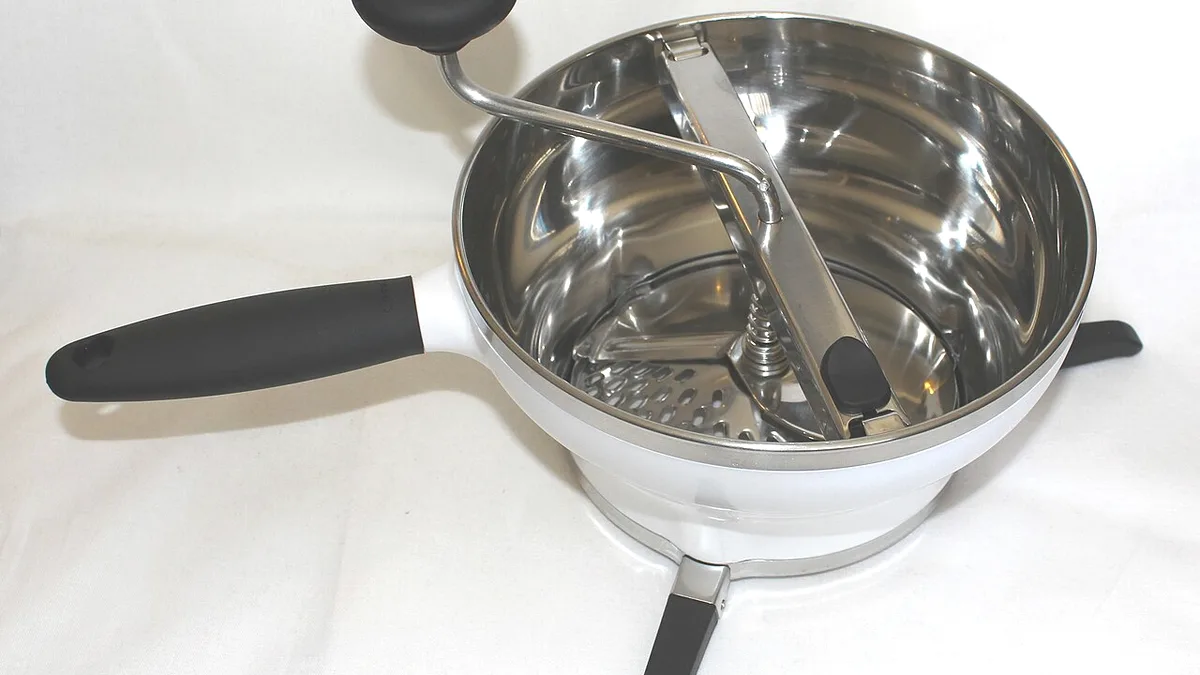
A food mill has three parts: a bowl with a perforated disc in the base, a crank on top, and a paddle under the crank that sweeps food across the disc. You put cooked food in the bowl, turn the crank, and the paddle presses the soft flesh through the holes into a bowl below, while skins, seeds, pips and strings stay in the mill. Because the food is pressed, not chopped, it stays smooth and light, and potatoes never turn gluey the way they do in a blender or a food processor. Our guide to the best food processors covers the electric machines for chopping and slicing raw food; a food mill is the hand tool for finishing cooked food into a silky purée.
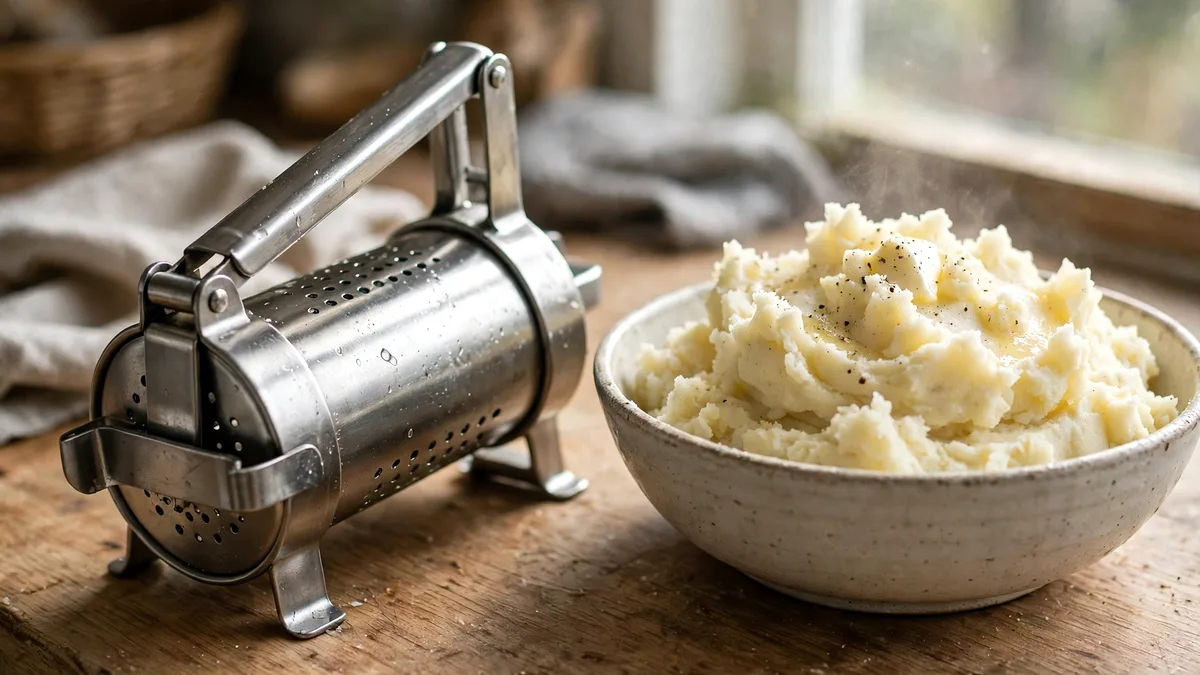
It is not a sieve, though it works a little like one: a sieve needs you to push food through with a spoon, which is slow and tiring, while a mill does the pushing for you with the crank. It is not a potato masher either: a masher crushes potatoes in the pot, while a mill presses them through holes into a fine, even texture. Our guide to the best potato mashers covers the faster tools for everyday mash; a mill is the tool for the finest mash of all. And it is not a blender: a blender chops everything together, skins and seeds included, while a mill separates the good flesh from the waste.
The Main Types of Food Mill
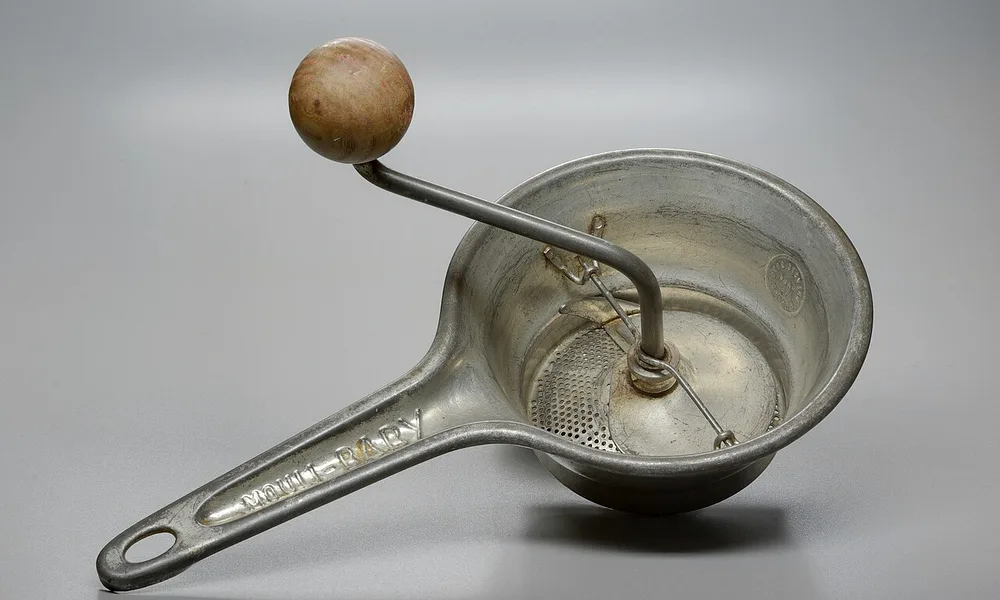
Almost every food mill falls into one of three designs, differing mainly in size, in how it sits over a bowl, and in whether the discs can be swapped. Pick the disc system first: the discs decide what the mill can do.
The Classic Crank Mill
The classic mill is a stainless steel bowl with a crank on top and a set of interchangeable discs, and it is the design most people should buy first. It sits over a bowl or a pot on legs, or on a rim that hooks over the edge, and you turn the crank with one hand while holding the bowl steady with the other. Look for a crank that turns smoothly, a paddle that sweeps close to the disc, and discs that swap easily without tools.
The Lever-Press Mill
A lever-press mill replaces the crank with a long lever that you push down to drive the paddle, and it is the best choice for large batches. The lever gives more force than a crank, so it handles firm food like cooked carrots and squash with less effort, and it is easier on wrists that tire from cranking. The trade-off is size: lever mills are bigger, heavier, and harder to store, and they usually cost more.
The Small Mill for Baby Food and Small Batches
A small mill is a one-quart bowl with a single disc, made for baby food, small batches of sauce, and cooks who mill rarely. It is cheap, light, and easy to store, and it does the same job as a full-size mill on a small scale. The limits are capacity and discs: one disc means one texture, and a small bowl means milling in batches.
Discs: Fine, Medium and Coarse
The disc is the heart of a food mill, and three discs cover almost every job. The fine disc, with holes around 1 millimetre, makes the silkiest sauces and purées: tomato sauce without a trace of skin, berry purée without a seed, and baby food smooth enough for a first spoonful. The medium disc, with holes around 2 millimetres, is the everyday disc: it makes mashed potato that is smooth without being gluey, apple sauce with a little body, and soups that are creamy without being thin. The coarse disc, with holes around 3 to 4 millimetres, is for rustic food that should keep some texture.
Buy a mill with three interchangeable discs if you can: a mill with one fixed disc is cheaper, but it can only make one texture. Check the discs are stainless steel, not plastic, and that they swap without tools.

Bowl Size and Materials
Bowl size decides how much you can mill at once, and a 2 to 3 quart bowl suits most home cooks: it holds a kilo of tomatoes or potatoes, enough for a family meal. A 1 quart bowl suits a baby or a single cook, and a 4 quart bowl suits anyone who makes big batches of sauce for freezing. Bigger is not always better: a large bowl full of food is heavy.
Stainless steel is the safest material: it does not stain from tomatoes or berries, it does not absorb smells, and it survives the dishwasher. Plastic mills are cheaper and lighter, but they stain, they absorb garlic and tomato smells, and they can warp in the dishwasher. Aluminium mills are light and cheap, but they react with acidic food like tomatoes and can leave a metallic taste. Check how the mill sits over a bowl: legs that hook over the rim are the most stable. A mill that sits over a pot as well as a bowl is worth having.
Food Mills Compared
| Type | Discs | Best for | Weakness |
|---|---|---|---|
| Classic crank mill | Three, interchangeable | Everyday sauces and mash | Tiring for very large batches |
| Lever-press mill | Two or three | Large batches, firm vegetables | Big, heavy, costs more |
| Small mill | One, fixed | Baby food, small batches | One texture, small capacity |
| Plastic mill | One or two | Occasional use, low price | Stains, absorbs smells |
How to Use a Food Mill, Step by Step
A food mill is simple to use, and the technique is mostly about preparing the food. Cook the food first, until it is soft all the way through: tomatoes until the skins split, potatoes until they break apart under a fork, apples until they are soft enough to squash. Do not peel, seed, or core anything first: the mill does that work for you. Cut large food into chunks, and load the bowl about two-thirds full, no more, or the crank will be hard to turn.
Set the mill over a bowl or a pot, choose the disc for the texture you want, and turn the crank steadily, not fast: a slow, even turn presses more food through and leaves less waste. When the crank gets hard to turn, the skins and seeds have built up under the paddle: lift the paddle, scrape the waste out, and carry on.
Care, Cleaning, and What to Avoid
A food mill needs almost no care, and the little it needs is about cleaning it promptly. Rinse the mill as soon as you finish, before food dries in the holes: dried tomato in a fine disc is hard to shift, and a brush is the only thing that clears it. Stainless steel mills can go in the dishwasher, though hand washing is quicker. Dry the discs at once, and store them in the bowl.
The most common mistakes are milling raw food, which the mill cannot press through the disc, and overfilling the bowl, which makes the crank hard to turn. Avoid mills with a fixed plastic disc, which cannot be swapped and will stain, and avoid very cheap mills where the crank wobbles or the paddle does not sweep close to the disc. Avoid milling very fibrous food like celery or raw ginger, which wraps around the paddle and jams it. And do not expect a mill to replace a food processor: a mill finishes cooked food, while a processor chops raw food.

Your Food Mill Checklist
- Choose a mill with three interchangeable stainless steel discs: fine for sauces, medium for mash, coarse for soups.
- Pick a 2 to 3 quart bowl for a family, 1 quart for a baby or a single cook, 4 quarts only for big batches.
- Check the crank turns smoothly, and the paddle sweeps close to the disc.
- Choose stainless steel over plastic or aluminium: it does not stain, it does not absorb smells, and it is dishwasher-safe.
- Make sure the mill sits stably over a bowl and a pot.
- Mill cooked food only, load the bowl two-thirds full, and rinse the mill as soon as you finish.
Frequently Asked Questions
What is a food mill used for?
A food mill presses cooked food through a perforated disc into a smooth purée, while skins, seeds and strings stay behind. It is used for tomato sauce, mashed potato, apple sauce, berry purée and baby food, where a silky texture matters.
Is a food mill better than a food processor?
For different jobs. A food mill gives a silkier purée and never overworks starch, so potatoes stay light and never turn gluey. A food processor is faster and better for chopping raw food, which a mill cannot do at all.
Do I need three discs, or is one enough?
Three discs are worth having: fine for silky sauces, medium for everyday mash, and coarse for rustic soups. A mill with one fixed disc can only make one texture, and you will soon want another.
Can I mill raw vegetables in a food mill?
No. A food mill only works on cooked food that is soft enough to press through the holes. Raw vegetables are too firm, and the crank will jam. Cook the food first, until it is soft all the way through.
How do I clean a food mill?
Rinse it as soon as you finish, before food dries in the holes, and brush the disc to clear it. Stainless steel mills can go in the dishwasher, though hand washing is quicker. Dry the discs at once, and store them in the bowl.
What size food mill should I buy?
A 2 to 3 quart bowl suits most home cooks: it holds a kilo of tomatoes or potatoes, enough for a family meal. A 1 quart bowl suits a baby or a single cook, and a 4 quart bowl suits big batches for freezing.
The Bottom Line
A food mill is a simple, old-fashioned tool, and it is the difference between a sauce that is silky and a sauce that is gritty, between mash that is light and mash that is gluey. Buy a classic crank mill in stainless steel, 2 to 3 quarts, with three interchangeable discs, and it will last for decades. Cook the food until it is soft, load the bowl two-thirds full, and turn the crank steadily. When you need the purée in a bowl, our guide to the best mixing bowls covers the bowls that suit the job.