Best Garden Arches 2026
A garden arch is the simplest way to give a garden a sense of arrival. It frames a path, marks the change from one part of the garden to another, and gives climbing plants somewhere to go. A well-chosen arch turns an ordinary walk across the lawn into a small moment, and it does it without needing a single brick laid.
Get the arch wrong, though, and it becomes a wobbly frame that leans after the first winter, or a narrow hoop that catches shoulders and snags sleeves. These are the best garden arches of 2026, chosen for size, strength, materials, and how well they carry the plants that make them beautiful.
Key Takeaways
- Buy the arch for the path it will frame, because an arch narrower than the path forces everyone to duck and brush against the plants.
- Height matters as much as width, since the top of the arch should clear the tallest person in the household by a comfortable margin.
- Metal arches suit heavy climbers such as roses and wisteria, while wooden arches suit cottage gardens and lighter plants.
- Anchor the feet properly, because an unanchored arch will lean or topple in the first strong wind of autumn.
- Match the plant to the arch, since a vigorous climber will overwhelm a light frame within two seasons.
Garden Arches 2026 at a Glance
| Best for | Arch type | Height | Standout strength |
|---|---|---|---|
| Best overall | Metal tube arch | 240 cm | Strong, light, and easy to anchor |
| Best for roses | Flat-top metal arch | 230 cm | Wide bars give canes plenty to tie to |
| Best for entrances | Wooden arch with gate | 220 cm | Frames a path and feels like a doorway |
| Best for small gardens | Narrow hoop arch | 210 cm | Fits a tight path without crowding it |
| Best for seating | Arbour arch with bench | 230 cm | Shade and a seat in one structure |
| Best for vegetables | Simple steel arch | 220 cm | Carries beans and squash over a bed |
What a Garden Arch Is Really For
A garden arch does three jobs at once. First, it marks a threshold, telling anyone walking the garden that they are passing from one space into another. Second, it supports climbing plants, lifting roses, clematis, and honeysuckle up into the light where they flower best. Third, it adds height to a flat garden, giving the eye something vertical to rest on.
It helps to know the difference between an arch and its close cousins. A trellis is a flat panel that a plant climbs against a wall or fence, and our guide to the best trellises of 2026 covers that style in detail. An arch is the freestanding structure you walk through, and the right choice depends on your path and your plants.
Getting the Size Right
Size is where most garden arch purchases go wrong. Measure the path, the tallest person who will walk under it, and the space on either side for planting, then buy the arch that fits those numbers. A path 90 centimetres wide calls for an arch at least 120 centimetres wide inside, so shoulders and sleeves clear the plants, and a path 120 centimetres wide needs an arch of 150 centimetres or more.

Height follows the same logic. The lowest point of the arch should sit at least 210 centimetres above the path, and 230 to 240 centimetres is better once a climber has grown over the top and hangs down. If the arch is also a doorway into the garden, allow extra height for the gate and its hinges. Measure in boots, not bare feet, and remember that a rose cane hanging down by 20 centimetres is a hazard, not a decoration.
The Main Types of Garden Arch
Garden arches fall into a handful of types, and each suits a different kind of garden. The right choice depends less on taste than on how wide your path is and how heavy your climber will grow.
The metal tube arch is the safest choice for most gardens: a simple curved frame of powder-coated steel that is light to carry, easy to anchor, and strong enough for roses. Its strength is versatility, so it suits almost any garden. Its weakness is looks, since a bare metal arch can seem plain until the plants cover it.
The wooden arch with a gate is the answer to a garden entrance. It frames the path like a doorway, and the gate keeps dogs and small children where they belong. Wooden arches are usually heavier than metal ones, so they suit gardens where the arch will stay put for years rather than move with the seasons.
The narrow hoop arch is the answer to a small garden. It fits a path of 60 to 90 centimetres, carries a single clematis or sweet pea, and adds height without eating the planting space. Hoop arches are usually the lightest type, so they need the most careful anchoring, especially in an exposed garden.
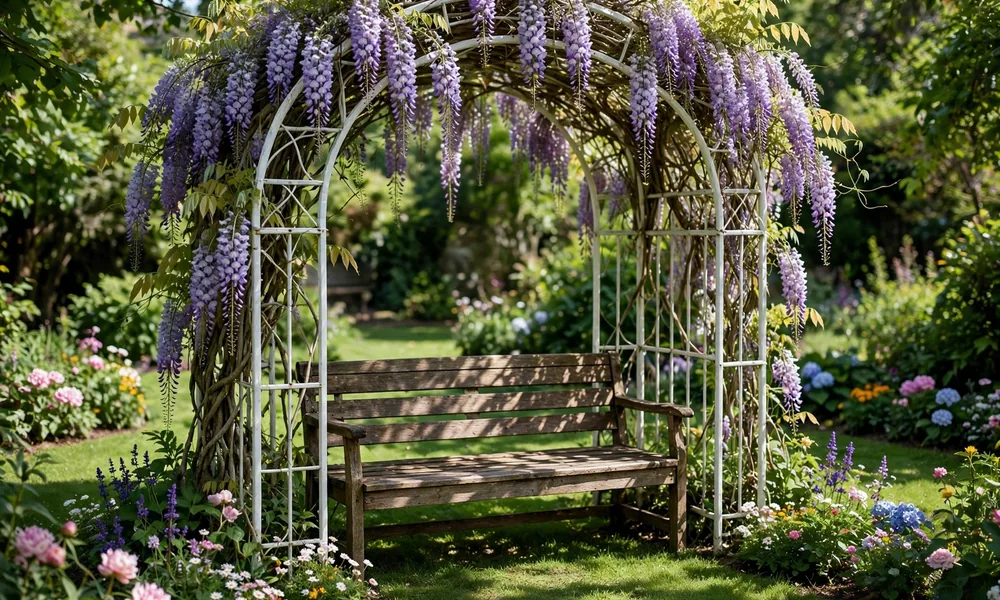
The arbour arch with a bench is the most generous option. A seat sits inside the arch, so you can sit in the shade of the climber on a hot afternoon. If the seat will be used often, our guide to the best garden benches of 2026 covers seat height, slats, and comfort, so you can match the bench to the arch.
Materials and Build Quality
Powder-coated steel is the classic choice, and it earns its price. It is strong for its weight, resists rust for years, and can carry a heavy rose without bending. Look for a thick tube, at least 20 millimetres across, and check that the joints are welded rather than bolted, since bolts loosen as the arch sways in the wind.
Wood is the warmest choice, and it suits cottage gardens better than any metal. Cedar and oak last longest outdoors, while treated pine is the sensible middle ground: it looks like hardwood and costs far less, but it needs re-oiling every year or two. Whatever the wood, check the thickness of the posts, since a thin post will twist as it dries and pull the whole arch out of square.
Plants and Climbers
An arch is only as good as the plant on it. Climbing roses are the classic choice, and they reward patience: a well-trained rose will cover an arch in three years and flower for decades. Tie the canes in horizontally where you can, since horizontal canes flower far more than vertical ones, and prune in late winter while the plant is still dormant.
Clematis suits a lighter arch, since it is less heavy than a rose and flowers in shades no rose can match. Wisteria is the most dramatic climber of all, but it is also the heaviest, and it will crush a light arch within a few years, so save it for the strongest steel or iron frame you can buy. Honeysuckle and jasmine suit a small arch near a seat, where their scent can be enjoyed in the evening.
Anchoring and Stability
A garden arch is tall, light, and covered in leaves, which makes it a sail in a strong wind. A wide, well-anchored arch is inherently stable, which matters in an exposed garden or one with heavy clay soil that softens in winter. A light hoop arch with a heavy rose on top is the opposite, and it should be anchored with ground spikes or set into concrete footings.
Matching the Arch to the Garden
An arch should suit the garden it lives in, not just the plant it carries. In a large garden, a wide metal arch frames a long path and balances a big lawn, while a small arch looks lost. In a small garden, an arch that is too wide eats the planting space, while a narrow hoop leaves room for the beds. A statue or ornament near the arch can complete the picture, and our guide to the best garden statues of 2026 covers stone, bronze, and resin figures that sit well beside a planted arch.

Common Mistakes to Avoid
The most common mistake is buying the arch before measuring the path: people remember the shape they liked and forget the width in centimetres, then discover the arch is too narrow to walk through comfortably. The second is choosing a light arch for a heavy climber, especially wisteria. The third is skipping the anchors, which costs an arch in the first gale. The fourth is planting the climber too close to the feet, where it competes with the grass for water. The fifth is forgetting to prune, so the arch becomes a solid green wall that blocks the light. Finally, do not buy an arch you cannot get into the garden: measure the side gate and the narrowest point of the path first.
Before You Buy: A Short Checklist
- Measure the path’s width, and buy an arch 30 centimetres wider inside than the path.
- Check the arch height against the tallest person in the house, allowing for hanging growth.
- Count the climbers you plan to grow, and match their weight to the frame.
- Check the tube or post thickness, and prefer welded joints over bolts.
- Look for ground spikes or footing options, and anchor the arch on day one.
- Test the arch for wobble before you plant, and level the feet on sloping ground.
- Measure the side gate and the path, and confirm whether the arch arrives assembled or flat-packed.
Frequently Asked Questions
How wide should a garden arch be for a 90-centimetre path? A 90-centimetre path calls for an arch at least 120 centimetres wide inside. A narrower arch forces everyone to brush against the plants, however pretty it looks in the catalogue.
Can a garden arch hold a wisteria as well as a rose? Only if the arch is built for it. Wisteria is far heavier than a rose, so it needs a strong steel or iron frame with deep anchors, and it should be pruned twice a year to keep its weight in check.
Do I really need to anchor a garden arch? Yes, especially in an exposed garden. The anchors are cheap, quick to fit, and they stop the arch toppling in the first autumn gale and crushing the plants it was bought to support.
The Bottom Line
The best garden arch of 2026 is the one that fits your path, your plants, and your garden, and then quietly disappears under the flowers. It is wider than the path, tall enough to walk under without ducking, strong enough for the climber you chose, and anchored well enough that you never think about it.
Start with the tape measure, not the catalogue. Measure the path, the tallest person in the house, and the ground where the feet will sit, choose the climber first, and then pick the type that fits: a metal tube arch for most gardens, a flat-top arch for roses, a wooden arch with a gate for an entrance, or an arbour with a bench if you want somewhere to sit in the shade.