
A Guide to Hallway Runners That Survive Foot Traffic in 2026
A hallway runner takes more punishment than any other rug in the house. Every trip to the kitchen, every school run, every muddy boot and every pet paw crosses the same narrow strip of floor, day after day. The best hallway runners in 2026 are built for that life: low pile that does not trip anyone, a tight weave that hides dirt between cleans, and a backing that keeps the rug flat on the floor instead of bunching at the corners. This guide covers the materials, sizes, and weaves that survive real foot traffic. It is about a flat floor runner for a hallway, not a stair tread: a stair tread is a short pad fixed to a single step, while a runner is one long piece that lies flat along the hallway floor.
Key Takeaways
- Low pile wins in hallways: under 10 millimetres, so doors clear it and feet do not catch.
- Wool and tough synthetics survive best; loose, shaggy, and silk blends do not belong in a hallway.
- Leave 10 to 15 centimetres of bare floor showing on each side.
- A rug pad underneath stops slipping, adds cushioning and protects the floor.
- Vacuum twice a week and treat spills the same day, or the traffic lane goes grey.
Why Hallways Destroy Ordinary Rugs
A hallway is the hardest place in a home for a rug to live. The traffic is funnelled down one narrow line, so the same strip of fibres takes every step. Dirt arrives with every pair of shoes, and the middle of the runner wears faster than the edges. A rug that would last a decade under a coffee table can look tired in a hallway within a year. That is why durability and cleanability matter more than softness here, and a flat, firm weave matters more than a pretty pattern.
The first thing to check is the pile. A high, soft pile feels lovely under bare feet, but in a hallway it crushes flat, traps grit deep where a vacuum cannot reach it, and catches on doors. A low pile, under 10 millimetres, releases dirt more easily and lets doors swing clear. The second thing is the weave: a tight, dense weave holds its shape under thousands of steps, while a loose weave stretches, ripples, and sheds. The third thing is the backing. A runner without a proper backing will creep, curl, and bunch, and a bunched runner in a hallway is a trip hazard.
The Main Types of Hallway Runner
Hallway runners fall into a few clear types, and each suits a different household.
| Type | Best For | Traffic | Cleaning |
|---|---|---|---|
| Wool flatweave | Most hallways | Heavy | Vacuum, blot spills |
| Synthetic low-pile | Pets and children | Very heavy | Hose or machine wash |
| Natural fibre | Dry, low-traffic halls | Light | Shake and brush |
| Washable runner | Muddy boots, pets | Heavy | Machine wash |
| Patterned vintage-style | Hiding dirt | Heavy | Vacuum, spot clean |
Best Overall: Wool Flatweave Runner
A wool flatweave runner is still the best all-round hallway runner for most homes, and the one to buy if you only buy one. Wool is naturally springy, so the fibres bounce back after footsteps instead of staying crushed, and the lanolin in the fibre resists stains and dust. A flatweave lies close to the floor, clears doors easily, and vacuums clean in a single pass. Wool costs more than synthetic, and spills need blotting rather than scrubbing.
Best for Pets and Children: Synthetic Low-Pile Runner
When the hallway sees muddy paws, spilled drinks, and small children, a synthetic low-pile runner is the practical choice. Polypropylene and nylon runners resist stains, dry quickly, and cope with a scrubbing brush. The best versions have a dense, short pile that releases dirt easily, and a rubber backing that holds the runner flat. They cost less than wool and come in the widest range of patterns. The trade-off is feel: synthetics feel flatter underfoot than wool, and a cheap one will crush and shine along the traffic lane within a year, so buy dense and heavy rather than thin and cheap.
Best for Dry Halls: Natural Fibre Runner
A natural fibre runner, in jute, sisal, or seagrass, suits a dry hallway that does not see muddy boots. The coarse, textured weave looks warm, hides dust well, and is one of the cheapest ways to fill a long hallway. It works best away from the front door, where shoes are already clean. The weakness is water: natural fibres stain when wet, dry slowly, and can smell musty if they stay damp. Never put one where wet boots land, and never use a wet cleaner on it. Shake it outside and brush it dry.
Best for Messy Entrances: Washable Runner
A washable runner is the best choice when the hallway is also the entrance, and mud is a daily fact of life. These runners have a thin, flexible pile on a rubber base, and they go straight into a washing machine. Instead of living with a slowly greying traffic lane, you can reset the runner to clean every few weeks. The trade-off is thinness: a washable runner feels light underfoot and needs a good pad underneath to stop it sliding, and the patterns are usually printed rather than woven, so they can fade after many washes. Buy two, and rotate them.
Best for Hiding Dirt: Patterned Vintage-Style Runner
A patterned vintage-style runner is the best choice when you want the hallway to look clean between vacuums. A busy, faded-looking pattern in mid-tones hides dust, crumbs, and pet hair far better than a plain runner, where every speck shows. The best versions have the pattern woven in, not printed on, so it does not wear away along the traffic lane. The trade-off is that a very busy pattern can clash with patterned wallpaper or tiled floors, so keep the rest of the hallway plain and let the runner do the talking.

Sizing a Hallway Runner
Sizing a runner is simple once you measure the hallway properly. Measure the length, then subtract about 30 centimetres at each end, so the runner stops short of the doorways. Measure the width, then leave 10 to 15 centimetres of bare floor showing on each side. A runner that is too wide will buckle, and one that is too narrow looks lost in the middle of the floor. Standard widths are 60, 80, and 100 centimetres; most hallways suit 80, with 60 for narrow flats and 100 for wide entrance halls.
Check the doors before you buy. Open every door that crosses the runner and check the clearance underneath: a runner plus a pad needs at least 15 millimetres of gap, and older doors often have less. If a door catches, choose a thinner runner or skip the pad under that stretch. Also check the transitions where the hallway meets other rooms: a runner that ends in a lump at a doorway is a trip hazard, so use a flat edge or a thin transition strip where it meets tile or carpet. If you are also choosing rugs for the rooms off the hallway, our guide to area rug sizes covers the living-room rules that keep the whole home consistent.
Keeping a Runner Flat and Safe
A runner that moves is worse than no runner at all, because it bunches, curls, and trips people. The fix is a proper rug pad underneath, cut slightly smaller than the runner so it does not peek out at the edges. A felt-and-rubber pad is the best choice on hard floors: the felt adds cushioning, the rubber grips the floor, and together they stop the runner creeping with every step. Replace the pad when it goes flat or crumbly, and check the corners monthly for curling.
Doors and furniture also matter. A runner under a console table or shoe bench wears faster where the legs press on it, so keep heavy furniture off the runner where you can. A runner past a radiator dries out and fades on the warm side, so leave a gap. And a runner near a pet flap or back door takes the worst of the mud, so put a small scraper mat at the door itself.

Cleaning a Hallway Runner
Vacuum twice a week along the traffic lane, and once a week across it, so the suction lifts grit from the base of the fibres. Vacuum the back once a month. Treat spills the same day: blot, never scrub, with a clean cloth and cold water, working from the outside of the stain inwards.
For a deeper clean, match the method to the fibre. Wool needs a gentle, wool-safe cleaner and as little water as possible, drying flat with air moving over it. Synthetic runners cope with a portable extractor, the machine our guide to rug cleaners recommends for high-traffic rugs. Natural fibre runners should never be wet-cleaned: shake them outside and brush them dry. Washable runners go in the machine on a gentle cycle. Never hang a wet runner over a line to dry, or it will stretch; lay it flat, out of direct sun.
Mistakes That Ruin a Hallway Runner
The most common mistake is buying a high-pile or shaggy runner: it crushes flat along the traffic lane within weeks, traps grit where no vacuum can reach it, and catches on doors and shoes. The second is skipping the pad, which guarantees a runner that creeps, curls, and bunches. The third is buying the wrong size: too long, so it buckles, or too wide, so it ripples against the skirting boards. The fourth is a plain pale runner for a muddy entrance, where every footprint shows. And the fifth is neglecting the cleaning routine: a runner vacuumed once a month will go grey along the traffic lane.
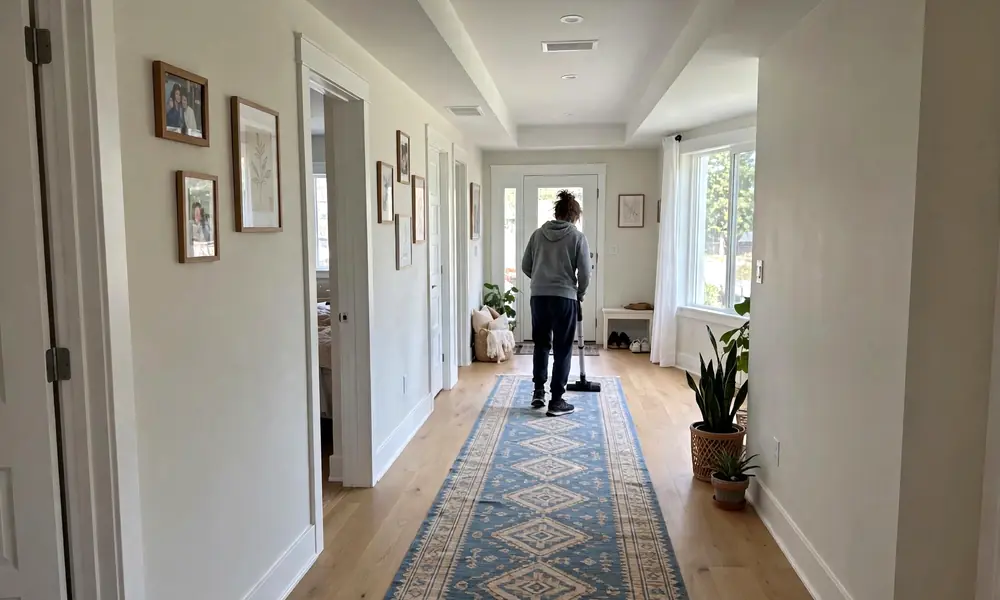
Hallway Runner Checklist
- Pile under 10 millimetres, so doors clear it.
- Tight, dense weave that springs back when pressed.
- Width leaves 10 to 15 centimetres of bare floor on each side.
- Length stops about 30 centimetres short of the doorways at each end.
- Proper rug pad underneath, cut slightly smaller than the runner.
- Mid-tone pattern if the hallway sees mud, pets, or children.
Frequently Asked Questions
How wide should a hallway runner be?
Most hallways suit 80 centimetres, with 60 for narrow flats and 100 for wide entrance halls. Leave 10 to 15 centimetres of bare floor showing on each side.
What is the best material for a hallway runner?
Wool flatweave is best all-round. For pets, children, and muddy boots, a dense synthetic low-pile runner is more practical, because it resists stains and can be scrubbed or machine washed.
Do hallway runners need a rug pad?
Yes. A pad stops the runner slipping, bunching, and curling, adds cushioning, and protects the floor. Use felt-and-rubber on hard floors and carpet-grip on carpet, cut slightly smaller than the runner.
How is a hallway runner different from a stair tread?
A hallway runner is one long, flat piece that lies along the hallway floor. A stair tread is a short, shaped pad fixed to a single step to give grip there. They are different products for different jobs.
How often should I vacuum a hallway runner?
Twice a week along the traffic lane, once a week across it, with a monthly vacuum of the back. Treat spills the same day by blotting with cold water.
Can I put a hallway runner on carpet?
Yes, with a pad designed for carpet. Choose a low, firm runner rather than a thick one, or the layers will feel unstable underfoot.
The Bottom Line
The best hallway runners in 2026 are low, tight, and honest about the traffic they face. A wool flatweave is the best all-round choice, a dense synthetic is best for pets and children, and a washable runner is best for muddy entrances. Size it with bare floor showing on each side, put a proper pad underneath, and vacuum it twice a week.


