
Honey is the one food that refuses to behave. It pours too slowly from the jar, it drips down the side, it sticks to the spoon, and by the time it reaches the toast, half of it is on the table. A good honey dispenser fixes all of that with a simple idea: a container that pours cleanly, seals tightly, and gives the cook control over exactly how much honey comes out. The best honey dispensers of 2026 are not the fanciest ones. They are the dispensers that do not drip, do not stick, and do not turn the kitchen into a sticky mess.

What Makes a Honey Dispenser Good
The first thing to judge is the drip. A dispenser that drips after every pour will coat the counter, the handle and the user’s fingers in honey, and the whole point of a dispenser is to prevent exactly that. The best dispensers use a sealed valve, a weighted lid or a dipper that rests inside the jar, so the honey stops the moment the pour stops. If it is clean, the dispenser works. If there is a sticky trail, it does not.
The second thing is the seal. Honey absorbs moisture from the air, and a dispenser that does not seal properly will let the honey thin out, crystallise or pick up smells from the kitchen. The best dispensers have a tight-fitting lid or a silicone seal that keeps the air out, and the honey stays thick and golden for months. A good seal is not a detail, it is the whole point of the jar.
The Main Types of Honey Dispenser
Glass jar dispensers are the classic choice. They are a glass jar with a lid and a dipper, usually wood, that rests inside the honey and lifts out to drizzle it over toast or tea. They look good on a table, they are easy to fill, and glass does not hold smells or stains. The trade-off is the dipper: it drips, it needs a rest, and it has to be washed after every use, which is why many people leave it in the jar and accept the stickiness.
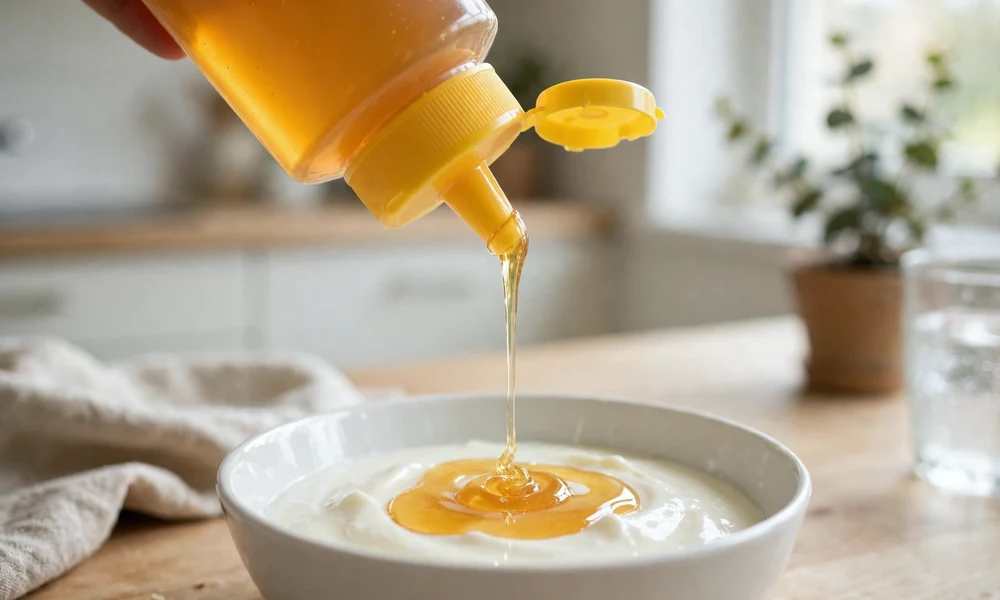
Squeeze bottles are the practical choice. They are a soft plastic bottle with a narrow nozzle that lets the cook squeeze out exactly as much honey as needed, in a thin line, with no dipper and no spoon. They are the best choice for a busy kitchen, for children, and for anyone who uses honey in cooking rather than at the table. For everyday use, though, a squeeze bottle is the cleanest and fastest option.
Pump dispensers are the cleanest option. They work like a soap pump: one press delivers a measured amount of honey, with no drips and no contact between hands and honey. They are the best choice for a household with children, for a cafe, or for anyone who hates sticky fingers. The pump needs to be strong enough for thick honey, and it needs to be easy to take apart and wash, because a clogged pump is useless.
Ceramic dispensers are the beautiful option. They are a glazed ceramic pot, often with a matching dipper and a lid, that looks like it belongs on a farmhouse table. Ceramic keeps honey cool and dark, it does not react with the honey, and it is easy to wipe clean. The trade-off is weight and breakage: a ceramic dispenser is heavy, and it will chip or crack if it is knocked off a table.
Stainless steel dispensers are the durable option. They are a steel pot with a tight lid and a dipper or a spout, and they will not crack, stain or absorb smells. Steel is the best choice for a kitchen where things get knocked around, for a camper or a picnic, or for anyone who wants a dispenser that will last for decades. For toughness above all, steel is the answer.
How to Choose the Right Dispenser
Start with how the honey is used, not with how the dispenser looks. A household that drizzles honey over toast and tea every morning needs a squeeze bottle or a pump, because speed and cleanliness matter more than looks. A household that serves honey at the table, for guests or for a slow weekend breakfast, will be happier with a glass jar or a ceramic pot. A cook who uses honey in baking needs a wide opening that can be filled easily and a dispenser that can be measured from. Buying the prettiest dispenser and hoping it suits a busy kitchen is the fastest way to end up with a sticky mess.
Then check the size. A dispenser that holds a whole jar of honey is convenient, but it is heavy and the honey at the bottom will crystallise before it is used. A small dispenser that holds a few weeks of honey is easier to handle, easier to clean, and the honey stays fresh. Most homes need a dispenser that holds between two hundred and five hundred grams, and anything bigger is better kept as a storage jar in the cupboard. Check the opening too: a narrow neck makes filling a chore, and a dispenser that is hard to fill will be left empty.
The Best Honey Dispensers of 2026
The best glass jar dispenser for most homes this year is a thick glass jar with a wooden dipper and a lid that rests on top without sealing the dipper in, so the honey can be drizzled without a sticky spoon. It holds a standard jar of honey, it looks good on any table, and the glass is thick enough to survive a knock. It is the dispenser for a slow breakfast, for guests, and for anyone who likes the ritual of honey. For the table, this is the one to buy.
The best squeeze bottle of 2026 is a soft, food-safe plastic bottle with a narrow, self-sealing nozzle that stops the honey the moment the squeeze stops. It pours a thin, even line, it does not drip, and the bottle is soft enough to squeeze with one hand. It is the dispenser for a busy kitchen, for children, and for anyone who uses honey in cooking. It is not pretty, but it is the cleanest and fastest way to get honey out of a bottle and onto food.
The best pump dispenser is a glass and steel pump that delivers a measured spoonful with one press, with no drips and no sticky fingers. The pump is strong enough for thick honey, it comes apart for washing, and the glass body shows how much honey is left. It is the dispenser for a household with children, for a cafe, or for anyone who hates cleaning honey off a counter. It costs more than a jar, but it is the most hygienic option in this guide.
The best ceramic dispenser of 2026 is a glazed stoneware pot with a matching wooden dipper and a lid that seals tightly enough to keep ants out and moisture in check. It keeps honey cool and dark, it looks like it belongs on a farmhouse table, and it is heavy enough to stay put when the dipper is lifted. It is the dispenser for a home where looks matter and the dispenser never leaves the table. For beauty and tradition, this is the pick.
The best budget dispenser is a simple plastic squeeze bottle that costs less than a jar of honey and does the job properly. The nozzle seals well, the bottle is easy to fill, and it pours cleanly without dripping. It will not win any beauty contests, and it needs replacing once the plastic starts to wear, but as a first dispenser it is the best way to find out whether a dispenser suits the household at all. Cheap does not have to mean sticky, and this bottle proves it.

What Else You Need
A dispenser works best with a little help. A honey dipper, if the dispenser does not include one, should be wood, because wood holds honey in its grooves and releases it slowly, while metal lets it slide off too fast. A small tray or saucer under the dispenser catches the odd drip and keeps the table clean, and a clean, dry spoon is the backup for the days when the dispenser is being washed. Raw honey crystallises over time, and a jar of crystallised honey can be warmed gently in a bowl of warm water until it flows again. None of this costs much, and all of it keeps breakfast clean.
Common Mistakes to Avoid
The biggest mistake is storing honey in the fridge. Cold honey thickens, crystallises and becomes almost impossible to pour, and a dispenser full of cold honey is useless. Keep honey at room temperature, in a cupboard or on a table, and it will stay liquid for months. The second mistake is leaving the dispenser open: an open dispenser absorbs moisture, thins the honey and invites ants. Close the lid every time, even if the next pour is only minutes away.
Another common mistake is buying a dispenser that cannot be cleaned. A dispenser with a narrow neck, a fixed pump or a lid that does not come off will trap old honey inside, and old honey ferments. Buy a dispenser that comes apart, wash it every time it is refilled, and let it dry fully before filling. And do not microwave honey to warm it: a microwave heats unevenly and can destroy the flavour, while a bowl of warm water does the job gently and safely.
How a Honey Dispenser Fits Breakfast
A good dispenser changes breakfast in a small but real way. The toast gets honey without a sticky spoon, the tea gets honey without a drip, and the table stays clean. That ease is the whole point, and it is why people who try a good dispenser rarely go back to a jar and a knife. The same care that goes into serving honey goes into the rest of breakfast, and readers who love honey will find the best honey guide useful for choosing between raw, wildflower, manuka and the many other kinds on the shelf.
Breakfast is a team effort, and a dispenser is only one part of it. A good blender makes the smoothies, a good coffee maker makes the coffee, and the honey ties it all together. The best blenders guide covers the machines that turn fruit and yoghurt into breakfast, and the best coffee makers guide covers the other half of the morning. Honey, coffee and a clean table: the three things a good breakfast asks for.
The Verdict
The best honey dispenser of 2026 is the one that does not drip. For most homes that means a glass jar with a dipper for the table, or a squeeze bottle for a busy kitchen. For the cleanest option, a pump dispenser is the better tool. For beauty, a ceramic pot is the most rewarding choice. Whatever the choice, keep the honey at room temperature, close the lid every time, and wash the dispenser when it is refilled. A dispenser chosen this way will not just serve honey cleanly on the first morning; it will still be serving it cleanly years from now, without a drip on the table.


