
The best journaling essentials in 2026 are the tools that make writing by hand feel effortless, inviting and worth returning to every day. A good journal, a pen that glides instead of scratching, and a few thoughtful extras can turn a blank page from an obligation into the best ten minutes of your morning. The difference between a journaling habit that sticks and one that fades by February is rarely willpower. It is the quality of the tools in front of you.
Journaling has quietly become one of the most popular daily rituals of the decade, and the market has followed. Notebooks now come in every paper weight, binding and size, pens are engineered for specific inks and hand sizes, and accessories from washi tape to habit trackers promise to make the practice prettier and more productive. Choice is wonderful, but it also makes it easy to buy the wrong things: paper that bleeds, pens that smudge, and journals that fall apart after a month.
This guide cuts through that noise. We tested and compared the journaling essentials that matter most, ranked them on paper quality, comfort, durability and value, and organised them into a simple kit you can build at any budget. Whether you write morning pages, keep a bullet journal, or simply want a beautiful place to think, these are the best journaling essentials of 2026.
Key Takeaways
- The best journaling essentials start with paper: thick, smooth, bleed-resistant pages matter more than any cover or brand name.
- A single reliable pen beats a drawer full of mediocre ones, so spend your money on one pen you love to hold.
- Dot-grid notebooks are the most versatile format, working equally well for writing, lists, sketches and trackers.
- Accessories should earn their place: washi tape, stencils and stickers are fun, but only if they help you write more.
- Build your kit gradually, starting with a journal, a pen and a quiet spot, then add one item at a time.
What Makes a Great Journaling Kit
A great journaling kit is not the most expensive one. It is the one you actually reach for. The best kits share a few qualities: the notebook opens flat, the pen feels comfortable after twenty minutes, and everything fits together in a pouch or on a small shelf. If any part of the kit annoys you, the habit quietly dies.
The 7 Best Journaling Essentials of 2026
1. A Dot-Grid Hardcover Journal
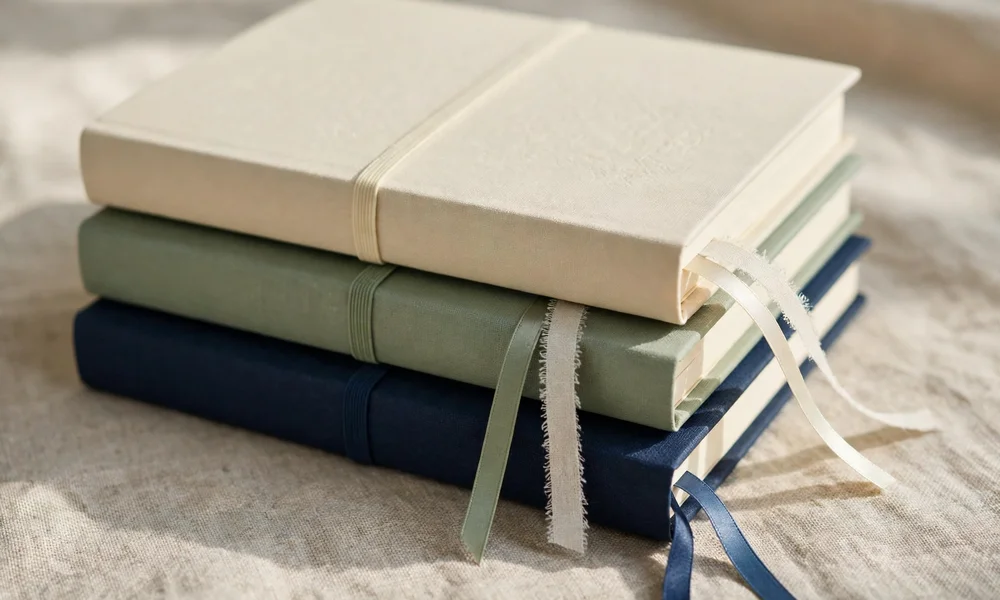
The journal is the heart of the kit, and a dot-grid hardcover is the most versatile choice you can make. The faint dots guide your handwriting without boxing it in, so the same notebook works for long-form writing, bullet journaling, habit trackers, tables and quick sketches. A hardcover protects the pages in a bag and gives you a firm surface when you write on a sofa or in bed.
Look for paper around 100 to 120 gsm with a smooth, coated finish. Thick paper stops ink from showing through, which matters when you write on both sides of every page. A lay-flat binding, two ribbon markers and a back pocket for loose notes are the details that separate a good journal from a great one. A5 is the sweet spot for most people: large enough to write comfortably, small enough to carry everywhere.
2. A Smooth Gel Pen
Your pen is the tool you touch most, so it deserves the most care. A smooth gel pen with a 0.5 mm tip is the best starting point for most journalers: the ink flows easily, dries quickly and produces clean, dark lines on almost any paper. It requires almost no pressure, which keeps your hand relaxed during long sessions.
3. A Fountain Pen for Slow Writing
A fountain pen is not a necessity, but it is the single upgrade that changes how journaling feels. The nib glides across the page with almost no pressure, and the slower pace encourages clearer thinking. Many journalers keep a gel pen for quick notes and a fountain pen for their morning pages or evening reflections.
4. Highlighters and Fineliners
Highlighters and fineliners are the tools that turn a wall of text into a page you can scan at a glance. Use a pale highlighter to mark key ideas, quotes and decisions, and a fineliner to draw headers, boxes and small illustrations. A limited palette of three or four colours keeps pages calm and readable; a rainbow of twenty colours usually ends up as visual noise.
5. Washi Tape and Sticky Tabs
Washi tape and sticky tabs are the most enjoyable extras in the kit, and they are genuinely useful. Washi tape marks sections, seals envelopes, repairs torn pages and adds a strip of colour to a plain spread. Sticky tabs mark important entries so you can find them months later without flipping through the whole journal.
6. A Pencil and Eraser for Planning
Every journaler needs a pencil, even if they rarely use one. Pencils are ideal for drafting layouts, sketching weekly spreads and trying out ideas you are not ready to commit to ink. A mechanical pencil with a 0.5 mm lead is the most practical choice: it never needs sharpening, the line stays consistent, and it fits in a pen loop.
7. A Journal Pouch or Desk Tray
The final essential is not something you write with, but something that keeps everything together. A slim journal pouch holds your notebook, pens and tape in one place, so the kit is ready the moment you sit down. For home journalers, a small desk tray does the same job and doubles as a visual reminder to write.
Choose a pouch with a pen loop, a zip pocket for small items and a size that fits your journal snugly without crushing it. Leather and waxed canvas age beautifully and protect the contents, while a simple fabric pouch is lighter and easier to wash. Whatever you choose, the rule is the same: if the kit is packed and waiting, you will use it far more often than if it is scattered across a drawer. A tidy desk helps too, and the best desk organizers for small desks keep your journaling corner calm and ready.
Journaling Essentials Compared
| Essential | Best For | Price Range | Key Feature | Beginner Friendly |
|---|---|---|---|---|
| Dot-grid hardcover journal | Daily writing and bullet journaling | $20–$40 | Thick, bleed-resistant paper | Yes |
| Smooth gel pen | Everyday writing | $3–$10 | Quick-drying, low-pressure ink | Yes |
| Fountain pen | Slow, reflective writing | $25–$80 | Effortless glide, bottled ink | Moderate |
| Highlighters and fineliners | Marking and decorating pages | $8–$20 | Muted colours, archival ink | Yes |
| Washi tape and sticky tabs | Sectioning and marking entries | $5–$15 | Clean removal, no tearing | Yes |
| Pencil and eraser | Drafting layouts and sketches | $5–$12 | Consistent line, clean erasing | Yes |
| Journal pouch or desk tray | Keeping the kit together | $15–$45 | Pen loop and zip pocket | Yes |
How to Choose the Right Journal
Choosing a journal comes down to four decisions: size, paper, binding and layout. Size is the easiest: A5 suits most people, B5 suits those who write large or sketch, and pocket size suits travellers. Paper weight is the most important: anything under 80 gsm will show ink through, while 100 gsm and above handles gel pens, fineliners and light highlighting without complaint.
Finally, consider the cover. A hardcover protects pages and gives you a writing surface anywhere. A softcover is lighter and more flexible, and it slips easily into a coat pocket. Neither is better in general; the right one is the one that fits how and where you actually write. Writers who work at a keyboard all day often pair their journal with the best mechanical keyboards for writers, keeping analogue and digital writing in balance.

Building a Daily Journaling Habit
The best kit in the world is useless without a habit, and habits are built on small, repeatable steps. Start with five minutes a day at the same time and in the same place. Morning works best for most people, because the day has not yet filled up with demands, but an evening wind-down works just as well if mornings are chaotic.
Keep your kit visible and ready. A journal on the bedside table gets used; a journal at the back of a drawer does not. Pair the habit with something you already enjoy, like your morning coffee or your evening tea, so the cue is built into your day. After a few weeks, you will find yourself reaching for the journal without thinking about it, which is exactly when the habit has taken hold.
Journaling Essentials Checklist
- A dot-grid hardcover journal in A5 with paper of at least 100 gsm.
- One smooth gel pen with a 0.5 mm tip that dries quickly on your paper.
- A fountain pen with a fine or medium nib for slower, reflective writing.
- Three or four muted highlighters and a set of archival fineliners.
- Two or three rolls of washi tape and a pack of transparent sticky tabs.
- A mechanical pencil, a soft eraser and a pouch or tray to hold it all.

Frequently Asked Questions
What are the best journaling essentials for beginners?
Beginners need just three things: a dot-grid journal with thick paper, one smooth gel pen, and a quiet ten minutes a day. Start there and add highlighters, washi tape and a fountain pen only after the habit is established. Buying everything at once usually leads to a drawer of unused supplies.
How much should I spend on journaling supplies?
A solid starter kit costs between forty and seventy dollars: twenty to forty for the journal, five to ten for a pen, and the rest on small accessories. You can spend more on a fountain pen or a leather pouch, but the writing experience barely changes above that range. Spend on paper quality first, because it affects every page you write.
Is a fountain pen worth it for journaling?
For many journalers, yes. A fountain pen reduces hand fatigue, slows your thinking in a useful way, and makes the act of writing feel special enough to look forward to. It is not essential, though, and a good gel pen covers ninety percent of daily writing. Try a fountain pen once your habit is steady, not before.
What paper weight is best for journaling?
Paper of 100 to 120 gsm is the sweet spot for most journalers. It resists bleed-through from gel pens and fineliners, handles light highlighting, and still feels flexible enough to write on comfortably. Paper under 80 gsm will show ink on the reverse side, while paper above 160 gsm is excellent for art but heavy and expensive for daily writing.
How do I stop my journaling habit from fading?
Keep the habit tiny, keep the kit visible, and attach writing to an existing routine like morning coffee. Miss a day without guilt and simply return the next day, because a broken streak is only a problem if you let it become a reason to quit. Most habits fade because the kit is inconvenient, so fix the setup before blaming your discipline.
Can I journal on a tablet instead of paper?
You can, and many people do, especially when they travel. A tablet with a stylus keeps every entry searchable and backed up, and it removes the cost of paper entirely. Paper still wins on focus and feel: no notifications, no battery, and a slower pace that helps you think. Some journalers keep both, using paper at home and a tablet on the road, and reading remains part of the ritual too, which is why the best Kindles for readers pair so well with a paper journal.
The Bottom Line
The best journaling essentials of 2026 are simple: a sturdy dot-grid journal with thick paper, a pen that glides, a few colours for marking what matters, and a pouch that keeps it all together. Buy for your hand and your habits, start small, and let the kit grow with the practice. The pages will take care of the rest.


