
How to use julep strainers well is a small skill with an outsized payoff: the difference between a Martini that arrives crystal clear and one that arrives with ice chips in it. A julep strainer is the shallow, perforated bowl on a short handle that sits inside the rim of a mixing glass and holds the ice back while the chilled drink pours through. The angle of the bowl, the speed of the pour and the fit against the glass decide whether the drink lands clean or messy. This guide explains how to hold a julep strainer, how to pour with it, which type suits your bar, and when to reach for a different strainer instead.
Stirred drinks are where the julep strainer earns its place in the bar. A Martini, a Manhattan and a Negroni are stirred, not shaken, and served without ice, so the strainer is the last thing between the mixing glass and the coupe. Shaken drinks use a different tool: the spring-loaded Hawthorne strainer that grips the shaker tin. Knowing which strainer belongs to which job is half the craft: get it right and the pour is smooth and controlled; get it wrong and the drink splashes, the ice escapes, or the pour stalls.
Key Takeaways
- A julep strainer is a perforated bowl on a short handle, built for stirred drinks poured from a mixing glass.
- Hold it with your index finger on top of the handle and the bowl pressed against the rim of the glass.
- Pour slowly and steadily: a fast pour pushes ice chips through the holes and clouds the drink.
- Use a Hawthorne strainer for shaken drinks and a julep strainer for stirred drinks; the two are not interchangeable.
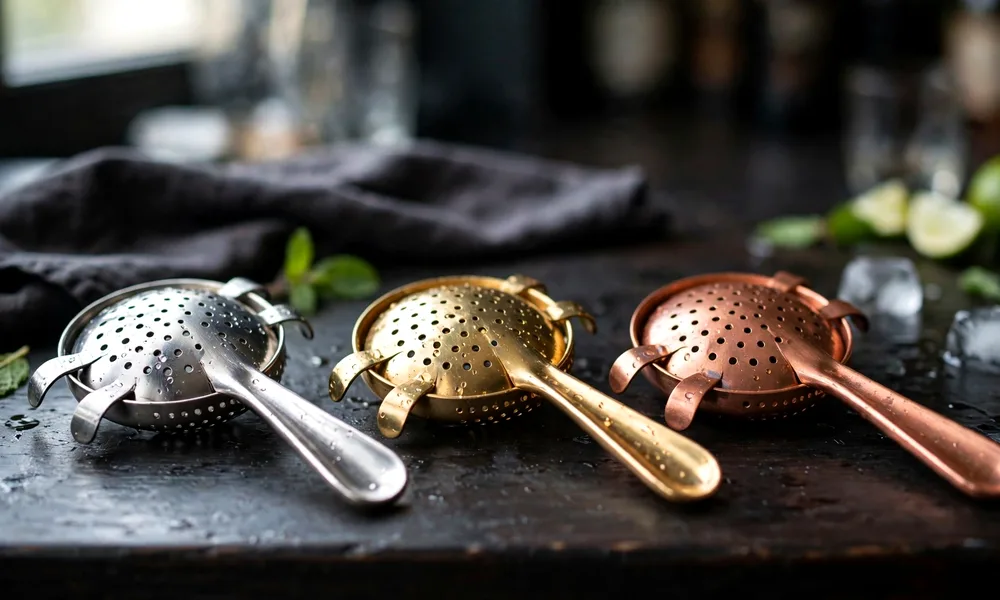
- Buy solid stainless steel first; plated gold and copper finishes look good but chip and tarnish faster.
What a Julep Strainer Is
A julep strainer is a round, slightly domed metal bowl, roughly the width of a mixing glass, pierced with small holes and fitted with a short flat handle. The bowl sits inside the top of the mixing glass, the handle rests against your hand, and the drink flows through the holes while the ice stays behind. The holes are small enough to catch ice chips and loose herbs, yet large enough that a cold drink pours through without backing up. It is named after the mint julep, the drink it was first made to serve.
How to Hold a Julep Strainer
Hold the mixing glass in your non-dominant hand and the strainer in your dominant hand. Slide the bowl into the glass so it rests just inside the rim, with the dome facing down into the drink. Place your index finger on top of the handle where it meets the bowl, and curl your remaining fingers underneath. The finger on top is the control: it presses the bowl gently against the rim and keeps it from shifting as you tilt.
The most common mistake is gripping the handle like a spoon, with the bowl dangling loose inside the glass. Held that way, the bowl wobbles, a gap opens at the rim, and ice cubes slide through. The second mistake is pressing too hard, which bends thin strainers and dents the rim of a delicate mixing glass. The pressure should be firm but light, about the same as holding a pen. With the bowl seated and your index finger on top, tilt the glass slowly and let the drink find the holes.

How to Pour With a Julep Strainer
Stir the drink for about thirty seconds, until the mixing glass feels cold outside and the spirit has softened. Then lift the bar spoon out: a long twisted spoon is the right tool for stirring, and our guide to bar spoons explains why length and balance matter more than most beginners expect. Once the spoon is out, seat the julep strainer in the rim and pick the glass up with your other hand.
Tilt the glass slowly, in one smooth motion, until the drink starts to flow. Keep the tilt steady: a steady angle keeps the ice settled at the bottom instead of surging toward the bowl. Aim at the side of the coupe so the drink slides down the glass instead of splashing, and stop just before the last of the liquid leaves the glass, because the final spoonful carries the smallest ice chips.
If the pour is too slow, a chip is probably lodged in the holes: lift the strainer, tap it once against the rim, and reseat it. If the pour is too fast and cloudy, you are tilting too far or pouring a drink that should have been double-strained. A fine mesh strainer held under the julep strainer catches the smallest particles, and our guide to mesh strainers covers which mesh suits cocktail work. Double-straining is worth the extra step for drinks with muddled herbs or citrus, where tiny fragments would otherwise float in the glass.
Julep Strainer vs Hawthorne Strainer
The two strainers look similar at a glance and do the same broad job, but they belong to different drinks. A julep strainer is a perforated bowl with no spring, sized to sit inside a mixing glass. A Hawthorne strainer is a flat disc with a coiled spring around its edge, sized to grip the rim of a shaker tin. The spring is the giveaway: it presses against the inside of the tin and holds the strainer in place while you shake and pour with one hand. A julep strainer has no spring because a mixing glass needs none; the bowl wedges itself against the rim.
Use the julep strainer for stirred drinks and the Hawthorne for shaken drinks, and the choice is simple. A Martini, Manhattan or Negroni is stirred in a mixing glass and poured through a julep strainer. A Daiquiri, Margarita or Whiskey Sour is shaken in a tin and poured through a Hawthorne strainer. Swapping them works badly in both directions: a Hawthorne strainer does not sit well in a mixing glass, and a julep strainer cannot grip a shaker tin, so the ice escapes. Shaken drinks also need a shaker tin worth owning, and our guide to the best cocktail shakers for home covers the tins a Hawthorne strainer is made to fit.
| Feature | Julep Strainer | Hawthorne Strainer |
|---|---|---|
| Shape | Perforated bowl | Flat disc with spring coil |
| Best for | Stirred drinks | Shaken drinks |
| Vessel | Mixing glass | Shaker tin |
| Spring | None | Coiled spring around the edge |
| Ice control | Holds back cubes and chips | Holds back cubes; chips pass |
| One-hand pour | Needs the glass held too | Grips the tin on its own |
| Fine particles | Small holes catch most | Needs a fine mesh second strain |
| Price | Usually cheaper | Usually slightly more |
The Main Types of Julep Strainer
Classic Stainless Steel
The standard julep strainer is solid stainless steel, with a round perforated bowl and a short flat handle. It is the one professional bartenders use most, because steel does not react with citrus, does not tarnish, and survives the dishwasher. This is the type to buy first, and for most home bars it is the only type ever needed.
Gold and Copper Finishes
Gold-plated and copper-plated julep strainers look striking on a bar cart, which is why they sell so well. The catch is the finish: plating wears at the rim and the handle, and once it flakes, the flakes can end up in a drink. If you love the look, buy a solid brass or solid copper strainer rather than a plated one, hand wash it, and treat it as a second piece.
Long-Handle and Teardrop Bowls
A few julep strainers come with a longer handle or a teardrop-shaped bowl, made to fit tall or tapered mixing glasses. They are worth considering if your mixing glass is unusually tall or tapered, but for a standard straight-sided glass the classic round bowl fits fine.
Fine-Perforation Strainers
Fine-perforation julep strainers have smaller, more closely spaced holes, and they catch ice chips and herb fragments that a standard strainer lets through. The trade-off is speed: a fine strainer pours more slowly, and a thick drink can back up behind it. They suit drinks served without ice where clarity matters most, such as a Martini made with a delicate vermouth.

How to Choose the Right Julep Strainer
Fit comes first. Measure the inside diameter of your mixing glass at the rim and buy a strainer whose bowl is the same width or a millimetre or two wider. A bowl that is too small leaves a gap where ice escapes; a bowl that is too large will not seat at all. Solid stainless steel is the safe default: it lasts, it washes easily, and it does not change the taste of the drink. Avoid very cheap strainers with rough, sharp hole edges, and check the handle is riveted or welded solidly to the bowl, with no wobble when you flex it gently.
Common Mistakes to Avoid
The most common mistake is using a julep strainer for a shaken drink, where it cannot grip the tin and the ice floods the glass. The second is pouring too fast, which drives ice chips through the holes and clouds a drink that was stirred to stay clear. The third is seating the bowl off-centre, leaving a gap at one side of the rim. The fourth is forgetting to double-strain drinks with muddled fruit or herbs. The fifth is buying a strainer that does not fit the mixing glass. Rinse the strainer straight after use and dry it with a cloth: a strainer left wet will spot, and a plated one left in the dishwasher will flake.
Checklist: Before You Buy a Julep Strainer
- Measure your mixing glass rim and match the bowl width to it.
- Choose solid stainless steel for your first strainer.
- Check the holes are cleanly punched with no sharp burrs.
- Flex the handle gently and confirm the joint is solid.
- Decide whether you need fine perforation for extra-clear pours.
- Confirm it is dishwasher-safe if you will not hand wash it.
Frequently Asked Questions
What is a julep strainer used for?
A julep strainer holds back ice while a stirred drink is poured from a mixing glass into a serving glass. It is the standard strainer for Martinis, Manhattans and Negronis, which are stirred rather than shaken.
Can I use a julep strainer for shaken drinks?
Not well: a julep strainer cannot grip a shaker tin the way a Hawthorne strainer can, so the ice escapes and the pour is messy. Use a Hawthorne strainer for shaken drinks.
Do I need to double-strain with a julep strainer?
Only for drinks with fine particles, such as muddled herbs or citrus pulp. Hold a fine mesh strainer under the julep strainer as you pour; for a plain Martini or Manhattan, a single strain is enough.
How do I clean a julep strainer?
Rinse it immediately after use and dry it with a cloth. Stainless steel can go in the dishwasher; plated and copper ones should be hand washed to protect the finish.
Why is my julep strainer letting ice through?
Either the bowl does not fit the rim of your mixing glass, or you are pouring too fast and driving chips through the holes. Reseat the bowl flush against the rim and pour more slowly.
Is a gold julep strainer worth buying?
As a second, decorative piece, yes, if it is solid brass rather than plated. As your only strainer, no: a solid stainless steel strainer does the same job better and lasts longer.
Bottom Line
A julep strainer is a small, cheap tool that decides whether a stirred drink arrives clear or cloudy. Buy a solid stainless steel one that fits your mixing glass, hold it with your index finger on top of the handle, pour slowly and steadily, and keep a Hawthorne strainer beside it for shaken drinks.


