A kettlebell looks simple, and that is why it trips up so many beginners. It is a ball with a handle, it fits in the corner of a room, and one can carry a whole workout. Pick the right one, and the same tool teaches you to hinge, squat and press with confidence. The best kettlebells for beginners in 2026 are not the heaviest or the flashiest. They are the ones that forgive a wobbly first swing, sit comfortably in a new grip, and still feel right a year later.
What Weight Should a Beginner Start With?
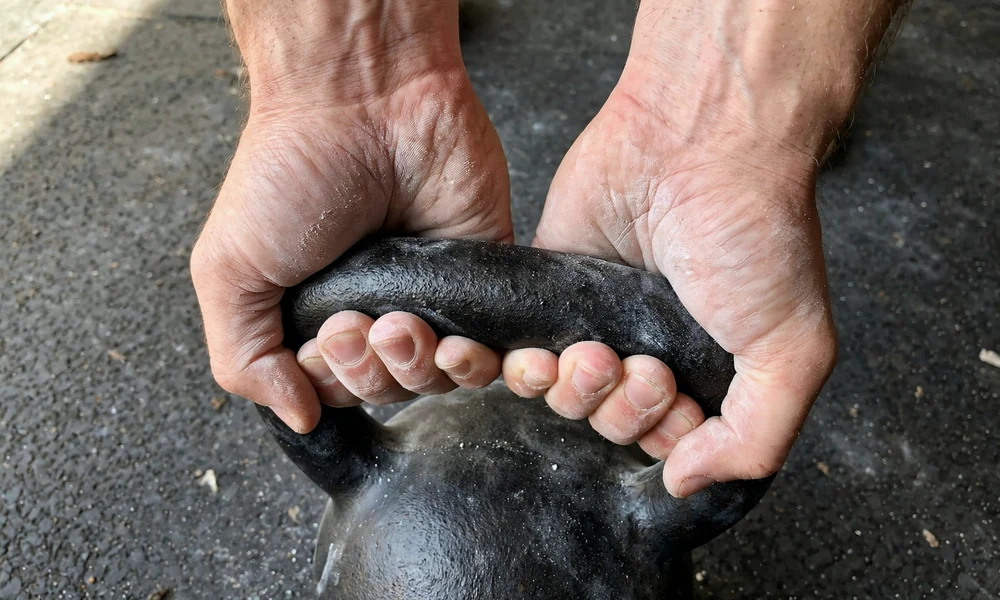
Weight is the first decision, and it is the one most beginners get wrong, usually by going too heavy. A kettlebell that is too heavy teaches bad habits from the first rep: the back rounds, the arms do the lifting, and the swing turns into a heave. A kettlebell that is a little light lets you learn the hinge, the breathing and the timing, and you can always go heavier later. Most women who are new to strength training start well with an 8 kg kettlebell, and most men start well with 12 kg. Those numbers are starting points, not rules: a smaller beginner may be happier with 6 kg, while someone who already lifts may be fine at 16 kg.
The test that matters is the deadlift test. Stand over the bell, hinge at the hips, pick it up with a flat back, and set it down again. If you can do that ten times with control, the weight is light enough to learn on. Then try a two-handed swing: the bell should float to chest height on the power of your hips, not the pull of your arms. If your arms are doing the work, or the bell is dragging you forward, it is too heavy for now.
One kettlebell is enough to start. A second bell is a luxury, not a need, and a full set is something to build toward, not to buy on day one. The money you save by buying one good bell instead of a cheap set buys a better bell: a smooth handle, a flat base, and a finish that does not chip into your palms. If you want a sense of the wider range first, the general guide to the best kettlebells shows what the different types offer across all levels.
Cast Iron, Competition or Coated: Which Type Suits a Beginner?
Cast iron is the classic beginner choice. A cast-iron kettlebell is one solid piece of iron, cheap for its weight, and it lasts forever. The bell gets bigger as it gets heavier, which is fine when you are only buying one or two. The downside is the finish: bare iron can rust in a damp garage, and a rough casting can feel harsh on the palms. Run your hand over the handle before you buy.
Competition kettlebells are the serious lifter’s tool. Every weight is the same size, so your technique never changes as you go heavier. That consistency is lovely, but it is a luxury a beginner does not need, and the price is roughly double the cast-iron equivalent. Unless you know you want to compete, save the money.
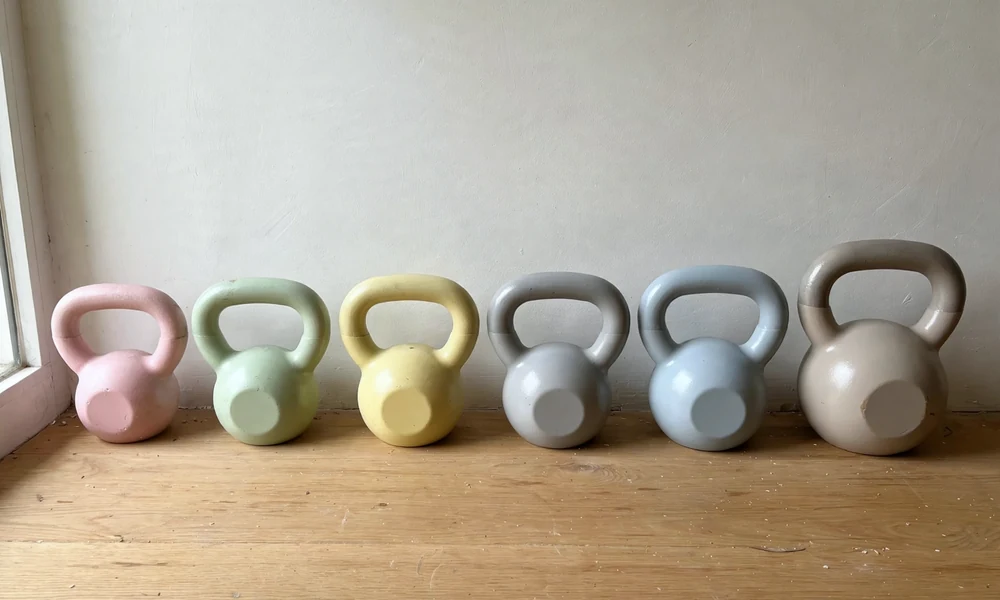
Vinyl and neoprene coated kettlebells suit some beginners well. The coating protects floors, the bright colours make weights easy to tell apart, and the handle is softer on the hands. The trade-off is durability: the coating can peel over time, and the handle is often thicker, which tires small hands faster. They suit a living-room corner and light use. For most beginners, a plain cast-iron bell is the honest middle ground: cheap, tough, and easy to learn on.
Handle, Grip and Finish: The Details Beginners Miss
The handle decides whether you enjoy the kettlebell or dread it. A good beginner handle is wide enough for two hands side by side, because most beginner moves are two-handed. It should be smooth, not knurled like a barbell, because a rough handle tears skin during swings. Most adults find a handle around 33 to 35 mm comfortable. If you have small hands, look for a bell with a slimmer handle rather than fighting a thick one.
The finish matters more than it looks. Powder coating gives a slightly rough grip that holds chalk well and does not slip when your hands sweat, and it is the finish most coaches recommend for a first bell. Bare iron is slippery when sweaty and needs oiling to stop rust. Whatever finish you choose, chalk helps: a little on the palms stops slipping without the torn skin that comes from death-gripping a sweaty handle.
Check the base, too. A flat base lets the bell stand upright on the floor, which matters every time you set it down, and even more in a small room where a rolling bell finds the skirting board. A flat base, a smooth handle and a sensible weight: those three details are worth more than any brand name on the side.
The First Five Moves to Learn
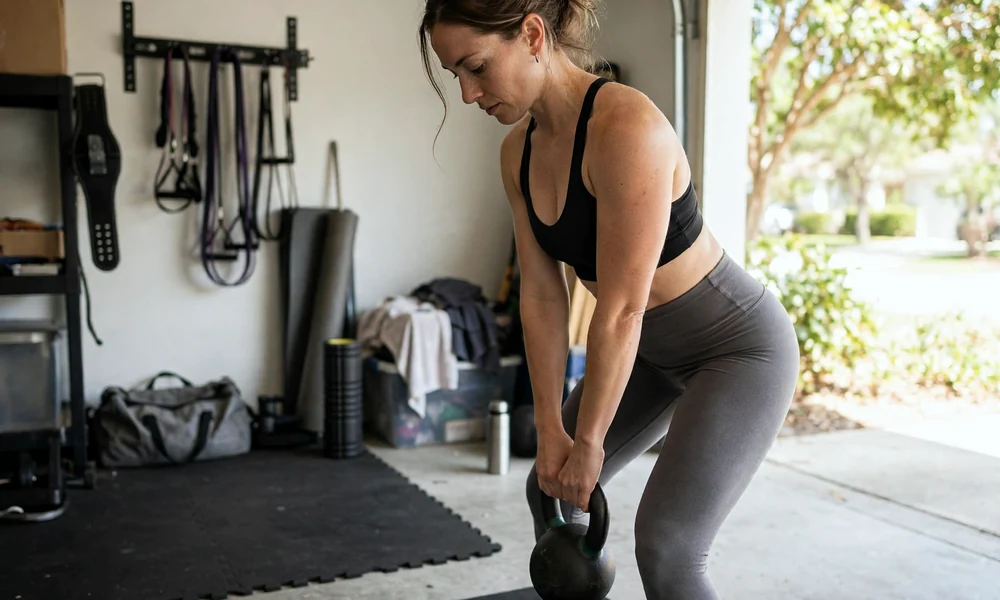
Learn the deadlift first. It is not glamorous, but it is the foundation of everything else. Stand with the bell between your feet, hinge at the hips with soft knees, grip the handle, and stand up by driving the floor away. Your back stays flat and the bell stays close to your body. Ten good deadlifts teach your body the hinge pattern better than a hundred rushed swings, and the hinge is the pattern that keeps your back safe.
The two-handed swing comes next. From the deadlift position, hike the bell back between your legs, snap your hips forward, and let the bell float to chest height. Your arms are ropes, not levers: they guide the bell, they do not lift it. The power comes from the hips, and the breath comes out with a sharp exhale at the top. Start with sets of ten. Three sets is plenty for a first week.
The goblet squat is the third move, and the kindest way to learn to squat. Hold the bell by the horns at your chest, sit down between your heels, and stand up. The weight in front pulls you into a good position and your chest stays up. The Turkish get-up and the one-handed swing can wait until these three moves feel easy, and a beginner who masters them has a real training programme.
Your First Four Weeks: A Simple Beginner Plan
Week one is about learning, not suffering. Train three times, with a rest day between sessions, and keep each session to twenty minutes. Warm up for five minutes, then do three sets of ten deadlifts, three sets of ten two-handed swings, and three sets of eight goblet squats, resting a minute between sets. If your form falls apart, stop the set: a beginner who stops early learns faster than one who grinds through bad reps.
Week two adds a set to each move. Week three is where the swing starts to feel like a swing instead of a lift: the hips snap, the bell floats, and the breathing falls into rhythm. Add five reps to each set, or a fourth move if you are ready. Week four is a test week: try the deadlift test with the next weight up, and if it moves cleanly for ten reps, that is your second bell.
The plan works because it is boring. Three moves, three sessions a week, small steps. Beginners fail when they chase variety, adding a new move every session and mastering none of them. If you want to build the rest of your home setup around the bell, the guide to the best home gyms shows how a single kettlebell fits into a small space without taking it over.
Mistakes That Hurt Beginners
The most common mistake is lifting with the arms. When the arms take over, the shoulders tire, the back rounds, and the bell stops floating. If your arms are sore after swings and your hips are not, the arms are doing too much. The fix is simple: practise the deadlift again and let the arms stay loose.
The second mistake is going too heavy too soon. A beginner who jumps from 8 kg to 16 kg in a fortnight is not progressing, they are compensating, and the compensation usually lands in the lower back. Add weight in small steps, 2 kg or 4 kg at a time, and only when the current weight moves cleanly for every rep of every set.
The third mistake is skipping the warm-up and the rest days. Kettlebell training is grip-heavy and hip-heavy, and tired hands tear and tired hips round. Warm up for five minutes, rest a day between sessions, and stop a set when your grip starts to fail. Chalk, a smooth handle, and stopping before failure keep your hands in one piece.
When to Go Heavier, and What to Buy Next
You are ready for a heavier bell when your current one feels easy for every rep of every set, and when the deadlift test with the next weight up moves cleanly ten times. For most beginners that takes six to twelve weeks, not six days. When you do go heavier, buy the same type and finish as your first bell, so the handle feels familiar and the technique transfers cleanly.
What comes after the second bell depends on your goals. If you want strength, a heavier bell and a pair of dumbbells give you pressing and rowing options the kettlebell does alone less well, and the guide to the best dumbbells is a good place to compare the two. If you want conditioning, a second kettlebell of the same weight opens up double-bell work. None of those are urgent. The beginner who owns one good bell and uses it three times a week is already ahead of the person with a rack of bells gathering dust.
Frequently Asked Questions
Is one kettlebell enough for a full workout? Yes. A single kettlebell covers the hinge, the squat, the press and the carry, and a twenty-minute session with three moves is a complete workout for a beginner. Add a second bell when the first one gets easy, not before.
Are kettlebells good for weight loss? They help, because swings and squats burn energy and build muscle. But no kettlebell out-trains a bad diet, and the beginners who succeed are the ones who train three times a week and eat sensibly, not the ones who buy the heaviest bell.
Can kettlebells hurt your back? They can, if the hinge is wrong and the back rounds under load. They can also make your back stronger, if the hinge is right and the weight is sensible. Learn the deadlift first and stop any set the moment your back rounds.
How heavy should a kettlebell be for a beginner? Most women start well with 8 kg and most men with 12 kg, but the deadlift test matters more than the number: if you can deadlift it ten times with a flat back, it is the right weight to learn on.
The Bottom Line
The best kettlebell for a beginner is a light, smooth-handled cast-iron bell with a flat base, bought one at a time, learned slowly, and used three times a week. It is not the heaviest bell or the most expensive bell. It is the one that lets you learn the hinge, the swing and the squat without tearing your hands or rounding your back. Buy one good bell, learn five moves, follow a boring plan for four weeks, and the kettlebell will do the rest.