
A Guide to Lip Scrubs That Actually Smooth in 2026
A good lip scrub is one of the smallest products in the bathroom and one of the most satisfying, because the result shows up in minutes. Dry, flaky lips go smooth, lipstick sits evenly instead of catching on rough patches, and a dab of balm afterwards actually stays put. The best lip scrubs in 2026 do this gently, with fine sugar or a soft enzyme, and they leave the lips softer than they found them instead of raw.
The catch is that lips are the thinnest skin on the body, and they have no oil glands of their own. That is why they dry out so fast in cold air and air conditioning, and why a scrub that is too harsh can do real damage. A lip scrub is a useful tool when it is gentle and occasional, and a bad habit when it is rough and daily. This guide is about telling the difference, and building the small routine that keeps lips soft for longer than an afternoon.
Key takeaways
- A lip scrub removes loose, flaky skin so balm and lipstick can work properly, but it cannot moisturise lips on its own.
- Fine sugar scrubs are the safest choice for most people; coarse salt or rough grains can scratch thin lip skin.
- Scrub once or twice a week at most, for about thirty seconds, and never scrub lips that are cracked, bleeding or sunburned.
- Always follow a scrub with a rich balm, because freshly exfoliated lips lose moisture fast and need sealing straight away.
- A homemade sugar and honey scrub works as well as most shop-bought pots, and you control exactly what goes in it.
What a lip scrub actually does
Lips flake for a simple reason. The skin on the lips is only three to five layers thick, compared with sixteen or more on the rest of the face, and it has no oil glands to keep it supple. When the air is dry, the outer layers lose water and die, and they sit on the surface as flakes. Licking your lips makes it worse, because saliva evaporates and takes even more moisture with it. A balm on top of flakes just sits on the dead skin. A scrub removes the flakes first, so the balm can reach the living skin underneath.
That is the whole job, and it is a small one. A lip scrub does not heal lips, it does not add moisture, and it does not change the lips themselves. It clears the surface. The healing comes afterwards, from the balm, and from the days in between, when the lips are protected from wind and sun. People who scrub every day usually end up with worse lips, because they keep removing new skin before it has had a chance to settle.
Sugar, salt and enzyme scrubs, compared
Most lip scrubs work in one of three ways. Sugar scrubs use fine sugar crystals, and they are the most forgiving, because sugar dissolves as you rub, so it gets gentler the longer you use it. Salt scrubs use salt crystals, which stay sharp and can sting on any small split. Enzyme scrubs use no grains at all: fruit enzymes dissolve dead skin chemically, and they suit people whose lips are too sensitive for any rubbing.
| Type | How it works | Best for | How often | Watch out for |
|---|---|---|---|---|
| Fine sugar scrub | Sugar crystals polish, then dissolve | Most people, everyday flaking | Once or twice a week | Sticky if the base is very sweet |
| Salt scrub | Salt crystals polish, stay sharp | Very rough, unbroken lips | Once a week at most | Stings on splits; too harsh for most lips |
| Enzyme scrub | Fruit enzymes dissolve dead skin | Sensitive or easily irritated lips | Once or twice a week | Can tingle; slower visible result |
| Oil-based sugar scrub | Sugar plus oil or butter base | Dry lips that need softening too | Once or twice a week | Greasy finish; needs wiping off |
| DIY honey and sugar | Sugar in honey, made fresh | Anyone who wants full control | Once or twice a week | Make small batches; it does not keep |
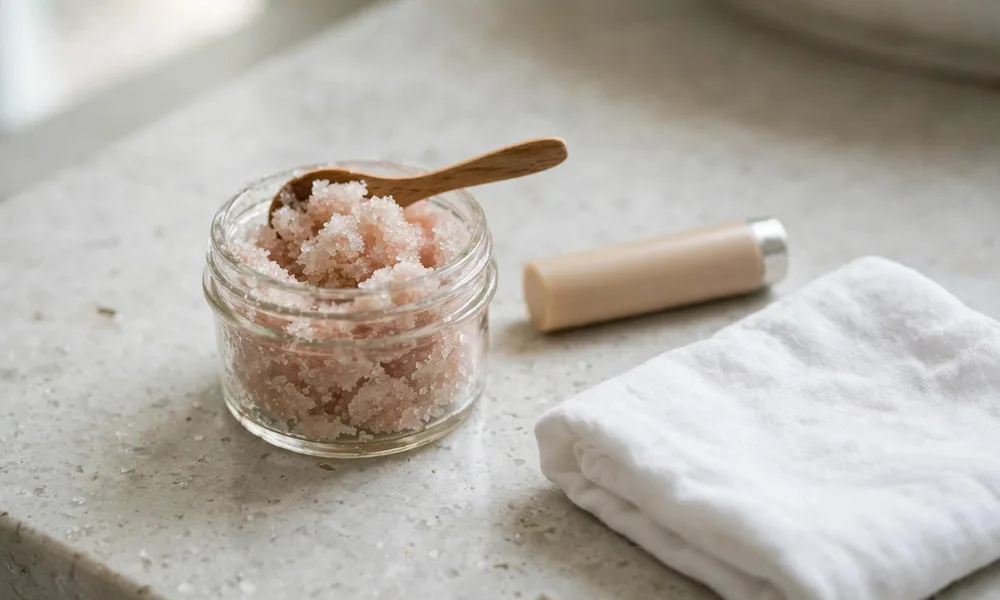
How to scrub without hurting your lips
The technique is simple, but the details matter. Start with clean, slightly damp lips, because a scrub on bone-dry lips drags and catches. Take a pea-sized amount on your fingertip and rub it over your lips in small, gentle circles for about thirty seconds, no longer. Use the pad of your finger, not your nail, and keep the pressure light. Pay attention to the centre of the lower lip and the corners, where flakes collect.
Then wipe it off with a damp, warm cloth instead of licking it away. Licking puts saliva back on freshly exfoliated skin, which dries it out again within minutes. A warm cloth lifts the grains and the flakes cleanly, and the warmth helps the balm that follows sink in better. Pat the lips dry, do not rub them, and apply a thick layer of balm immediately, while the skin is still slightly damp.
Shop-bought or homemade
A shop-bought lip scrub is convenient, and the good ones are genuinely good. Look for a short ingredient list: sugar, an oil such as jojoba or coconut, a butter such as shea, and perhaps a flavour. That is all a scrub needs. Be wary of long lists of fragrances and colourings, because the lips are one of the most reactive areas of skin, and a flavoured scrub that tastes wonderful can also irritate.
A homemade scrub is just as effective, and it has one advantage the shop cannot match: you know exactly what is in it. Mix a teaspoon of fine sugar, not coarse, with half a teaspoon of honey and a few drops of a plain oil such as olive or jojoba, and you have a scrub. Make it fresh each time or in a very small batch, because a homemade scrub has no preservative and will not keep.
Either way, the scrub is only half the routine. The balm that follows it is what keeps the result, and it should be richer than the one you carry in your pocket. A balm with shea butter, beeswax or lanolin seals moisture in for hours. Our guide to lip balms that really heal dry lips in 2026 explains which ingredients actually repair lips and which ones only shine: the scrub prepares the surface, and the balm does the work that lasts.

The routine around the scrub
A lip scrub works best as part of a small, regular routine rather than as a rescue mission. Protect your lips during the day: a balm with sun protection in summer, a plain balm under a scarf in cold wind. Drink water, because lips dry out from the inside as well as the outside. Stop licking your lips, the single most common cause of chronic flaking. And scrub once or twice a week, in the evening, followed by a thick balm.
The lipstick step deserves a note of its own, because it is where the result of a scrub becomes visible. Matte lipsticks show every flake, and they are the reason most people discover lip scrubs. A scrubbed, balmed lip takes matte colour smoothly, and the colour lasts longer. Our guide to lipsticks worth wearing every day in 2026 is a good place to choose a shade, and our best versus worst lip balms of 2026 shows which balms genuinely heal and which only shine for ten minutes.
Mistakes that make lips worse
The biggest mistake is scrubbing too often. Daily scrubbing keeps the lips in a permanent state of repair, and the new skin never gets a chance to settle. If your lips feel rough every day, the problem is not a lack of scrubbing, it is a lack of protection: more balm, less licking, and a scarf in the wind will do more than a stronger scrub.
The second mistake is scrubbing too hard. Pressing firmly, using a coarse grain, or scrubbing for minutes instead of seconds can scratch the thin skin and leave it raw. Light pressure, fine grains, thirty seconds: that is the whole technique, and anything more is damage. The third mistake is skipping the balm afterwards, because freshly scrubbed lips lose moisture fast, and leaving them bare undoes the work in minutes.

Lip scrub buying checklist
- Choose a fine sugar scrub first: it dissolves as you rub, so it gets gentler instead of harsher.
- Check the base: an oil or butter base leaves lips soft, a thin watery base leaves them tight.
- Keep the ingredient list short: sugar, an oil, a butter, and little else is all a scrub needs.
- Skip coarse salt scrubs unless your lips are very rough and completely unbroken.
- Buy a small pot: at once or twice a week, a small pot lasts months, and a big pot goes stale.
- Pair the scrub with a rich balm, because the balm is what keeps the result after the scrub.
Frequently asked questions
How often should I use a lip scrub?
Once or twice a week is enough for most people. That gives the lips time to recover between scrubs and keeps the flakes under control. If you find yourself wanting to scrub every day, the problem is protection, not exfoliation: use more balm, drink more water, and stop licking your lips.
Can I make a lip scrub at home?
Yes, and it works as well as most shop-bought scrubs. Mix a teaspoon of fine sugar with half a teaspoon of honey and a few drops of plain oil, and use it straight away. Make it fresh each time or in a very small batch, because it has no preservative. Use a clean spoon to take it out of the pot, never a wet finger.
Should I scrub my lips if they are cracked?
No. Never scrub lips that are cracked, bleeding, blistered or sunburned. A scrub on broken skin stings, delays healing, and can make the damage worse. Keep the lips protected with a rich balm until the skin is intact again, and only then go back to scrubbing once a week.
What should I put on after a lip scrub?
A thick, rich balm, applied immediately while the lips are still slightly damp. Look for shea butter, beeswax or lanolin on the ingredient list, and avoid balms that are mostly fragrance or flavour. The balm seals in the moisture the scrub has exposed, and it is what keeps the lips soft for the days after the scrub.
Does lip scrub help lipstick last longer?
Yes. Lipstick sits on the surface of the lips, and if that surface is flaky, the colour catches on the flakes and wears off unevenly. A smooth, balmed lip takes colour evenly and holds it longer, especially with matte formulas. Scrub in the evening, balm overnight, and apply lipstick in the morning for the best result.
Are enzyme scrubs better than sugar scrubs?
They are different, not better. Enzyme scrubs dissolve dead skin without any rubbing, which suits lips that are sensitive or easily irritated. Sugar scrubs give a more immediate, visible result and suit most people. If sugar scrubs leave your lips sore, try an enzyme scrub.
The bottom line
A lip scrub is a small, simple tool, and it works best when it stays small and simple. Fine sugar, thirty seconds, once or twice a week, in the evening, followed immediately by a rich balm. That is the whole routine, and it is enough to keep lips smooth through the winter. The scrub clears the way. The balm does the lasting work.


