Best Loofahs 2026
A loofah is the simplest tool in the bathroom, and the easiest to get wrong. Buy one that is too coarse and it leaves your skin red and stinging. Buy one that is too soft and it barely lathers, collapsing into a damp lump after a week. Buy one with no way to dry it and it turns musty long before it wears out.
Get the loofah right, though, and the daily shower feels better for almost no money: a gentle scrub, a proper lather, and skin that feels clean rather than stripped. These are the best loofahs of 2026, chosen for fibre quality, exfoliation level, drying, and how long they actually last.
Key Takeaways
- Natural loofahs exfoliate best, but they need to dry fully between showers, so a hanging loop and airflow matter more than the price.
- Choose the firmness for your skin: soft mesh for daily washing, medium natural fibre for weekly exfoliation, and firm loofah only on rough skin such as elbows and heels.
- A loofah is a consumable, not a keepsake. Replace a natural loofah every four to six weeks, and sooner if it smells, darkens, or sheds fibres.
- Long-handled loofahs are the only kind that reaches the middle of your back, so buy one if reach is the reason you are shopping.
- Rinse well, squeeze out the water, and hang the loofah where air can reach it. A loofah left sitting in a puddle is a loofah growing bacteria.
Loofahs 2026 at a Glance
| Best for | Loofah type | Exfoliation | Standout strength |
|---|---|---|---|
| Best overall | Natural whole loofah | Medium | Real plant fibre that softens in warm water |
| Best for daily washing | Soft mesh bath pouf | Gentle | Big lather, kind to sensitive skin |
| Best for deep exfoliation | Firm natural loofah pad | Firm | Scrubs rough elbows, knees, and heels |
| Best for hard-to-reach skin | Long-handled loofah | Medium | Reaches the whole back without twisting |
| Best for travel | Flat loofah slice | Medium | Light, dries fast, packs flat |
| Best for sensitive skin | Fine-weave loofah cloth | Very gentle | Mild scrub with a soft, even texture |
What a Loofah Really Is
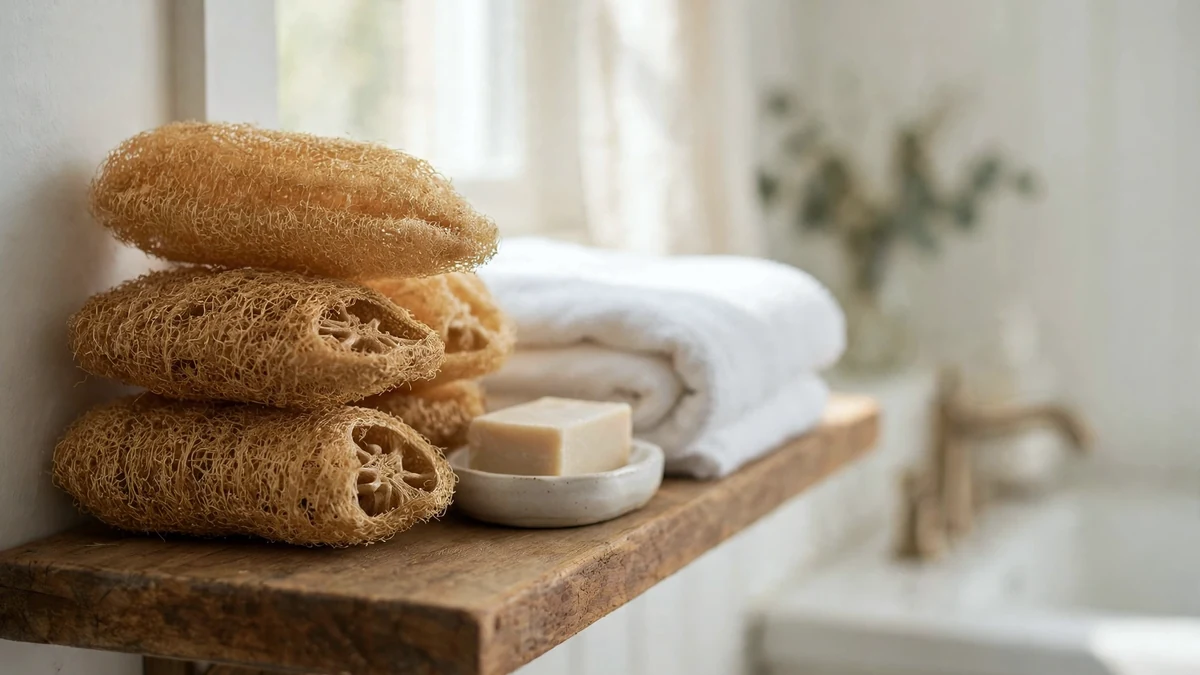
A loofah is the dried skeleton of a gourd, a plant in the cucumber family that grows on a vine, is left to ripen, and is then peeled and dried until only a tough network of fibres remains. When dry it feels hard and scratchy, but under warm water it softens into a springy scrubber with an open, airy structure that holds soap and rinses clean.
That natural origin is what separates a loofah from the other scrubbing tools in the bathroom. A bath brush reaches further and scrubs harder, and our guide to the best bath brushes of 2026 covers brushes in detail. A loofah is the gentler, cheaper, everyday option: softer than a brush, firmer than a washcloth, and easy to replace when it wears out.
The Main Types of Loofah
Loofahs fall into a handful of types, and the right one depends on your skin and how you shower. The differences look small on the shelf, but they feel large on the skin.
The natural whole loofah is the classic: a whole dried gourd, usually 15 to 25 centimetres long, that you hold in your hand. It is the best all-rounder, firm enough to exfoliate and soft enough for daily use once it has soaked for a minute. Its weakness is size, since a whole loofah is awkward on small areas such as the face and feet.
The soft mesh bath pouf is the gentlest option, a ball of fine netting that whips body wash into a thick lather with very little product. It barely exfoliates, which is exactly the point for sensitive skin and daily washing. Its weakness is drying: the dense folds hold water, so it needs a hook and airflow, and it should be replaced every month or two.

The firm natural loofah pad is a flat, dense slab of loofah fibre, often with a fabric backing or a handle. It is the best choice for rough skin, scrubbing elbows, knees, and heels that a soft pouf cannot touch. Use it once or twice a week rather than daily, since firm fibre on soft skin causes redness.
The long-handled loofah solves the one problem no hand-held loofah can: reaching the middle of your back. A loofah pad or brush head sits on a handle 30 to 45 centimetres long, so you can wash and exfoliate your back without twisting. If reach is your main complaint, this is the type to buy, and our guide to shower brushes in 2026 covers the brush version of the same idea.
The flat loofah slice is a thin cross-section of the gourd, light and quick to dry. It is the best travel loofah, packing flat in a wash bag and drying overnight on a towel rail. It is also a good face and foot scrubber, since the small size fits into awkward spots. Its weakness is lifespan: a thin slice wears through faster than a whole loofah.
Natural Versus Synthetic
The natural-versus-synthetic choice is the first decision, and it shapes everything else. Natural loofah is a plant fibre, so it is compostable, free of plastic, and gives a firm, even scrub that softens with use. It also absorbs water, holds soap well, and feels warmer and more natural in the hand than any plastic alternative.
Synthetic loofahs, usually mesh poufs and plastic scrub pads, solve the drying problem. They dry faster, keep their shape for months, and cost very little. They are plastic, though, and they shed tiny fibres into the drain with every wash. They also give a softer, less even scrub, and a cheap mesh pouf can unravel into a tangle of netting within a fortnight.

Exfoliation: How Firm Is Too Firm
Exfoliation is the reason most people buy a loofah, and it is also where most people overdo it. A loofah removes dead skin cells from the surface, which leaves skin smoother and helps moisturiser absorb. Scrub too hard or too often, and the same action strips the skin barrier, leaving redness, dryness, and sensitivity.
Match the firmness to the skin. Soft mesh suits daily washing on any skin, including sensitive skin. Medium natural fibre suits normal skin two or three times a week. Firm loofah suits only rough, thick skin: elbows, knees, heels, and the soles of the feet. Never use a firm loofah on the face, on sunburn, on broken skin, or on skin that is already irritated.
Pressure matters as much as fibre. Let the loofah do the work, using light, circular strokes and warm water, and stop when the skin feels smooth rather than raw. If the skin stays pink for more than a few minutes after the shower, the loofah is too firm or the pressure too hard. For a gentler exfoliating option, our guide to exfoliating gloves in 2026 covers mitts that give a similar scrub with more control over pressure.
Drying, Hygiene, and When to Replace
A loofah lives in the warmest, dampest room in the house, which makes hygiene the real test of a good one. Bacteria and mould love damp fibre, so how a loofah dries matters more than how it scrubs.
After every shower, rinse the loofah thoroughly under clean running water until no soap remains, squeeze it gently without wringing it hard, and hang it by its loop somewhere air can move around it. A hook on the wall or the side of a shower caddy beats a shelf, and a spot near a window or a vent beats a steamy corner. Never leave a loofah sitting in a puddle or in the bottom of the shower.
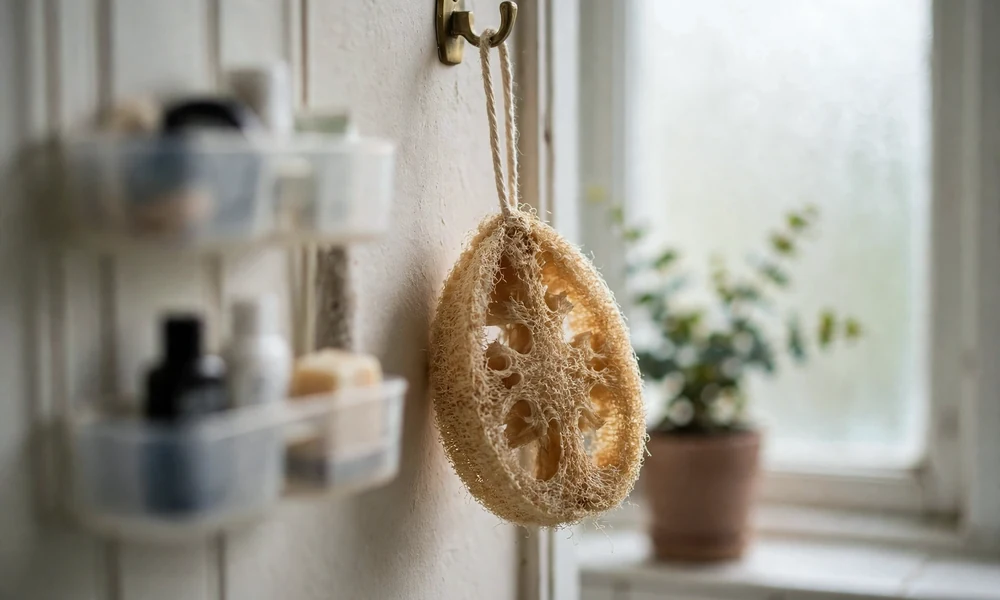
Replace a natural loofah every four to six weeks, and a mesh pouf every one to two months. Replace sooner if it smells musty after drying, if the colour darkens, if it sheds fibres into the shower, or if the fibre feels slimy rather than springy. A loofah that smells is a loofah that has already failed, and no amount of rinsing will fix it.
Choosing the Right Size and Shape
Size sounds trivial until the loofah is in your hand. A whole loofah 20 centimetres long is a good fit for most adults, covering the arms, legs, and torso in broad strokes. Smaller hands suit a shorter loofah or a flat slice, which is easier to grip when wet and soapy. Larger loofahs suit backs and legs but feel clumsy on the chest and feet.
Check for a hanging loop before you buy. The best loofahs come with a sturdy cotton or rope loop sewn or tied through the fibre, because hanging is the only reliable way to dry one. A loofah without a loop needs a hook, a peg, or a caddy, and one without any drying plan will sit damp and spoil quickly.
Loofahs for Sensitive Skin
Sensitive skin and loofahs can mix, but only with the softest options. A fine-weave loofah cloth or a soft mesh pouf gives a mild, even scrub without the scratch of coarse fibre. Use it with a gentle, fragrance-free body wash, light pressure, and lukewarm rather than hot water.
Avoid firm natural loofah on sensitive skin entirely, and avoid exfoliating more than once a week. Skip the loofah altogether during a flare-up, on eczema patches, or on skin that has just been shaved or waxed. Patch test a new loofah on the inside of the forearm first: if the skin stays calm after a day, it is safe to use more widely.
Before You Buy: A Short Checklist
- Pick the fibre for your skin: soft mesh for daily washing, medium natural fibre for weekly exfoliation, firm loofah only for rough skin.
- Check the size in your hand, and make sure you can grip it when it is wet and soapy.
- Look for a sturdy hanging loop, and decide where the loofah will hang to dry.
- Check the fibre is even, with no hard lumps, loose threads, or chemical smell.
- Plan to replace a natural loofah every four to six weeks, and a mesh pouf every one to two months.
- Buy a long-handled loofah if you cannot comfortably reach your whole back.
- Keep a separate, gentler tool for your face, and never share a loofah.
Frequently Asked Questions
Can I use a loofah every day? Yes, if it is a soft mesh pouf used gently. Save medium and firm natural loofahs for two or three times a week, and never scrub firmly every day.
Is a natural loofah better than a mesh pouf? A natural loofah exfoliates more firmly and is plastic-free, but it dries slowly and needs replacing monthly. A mesh pouf lathers better, dries faster, and lasts longer, but it is plastic and barely exfoliates.
The Bottom Line
The best loofah of 2026 is the one that matches your skin, dries properly between showers, and gets replaced before it turns musty. For most people that is a medium natural whole loofah for weekly exfoliation, plus a soft mesh pouf for daily washing.
Start with your skin, not the shelf. If your skin is sensitive, buy soft. If you want a real scrub, buy natural fibre and a hook to hang it on. Then rinse it, hang it, and replace it on time, and the cheapest tool in the bathroom will do its job well.