
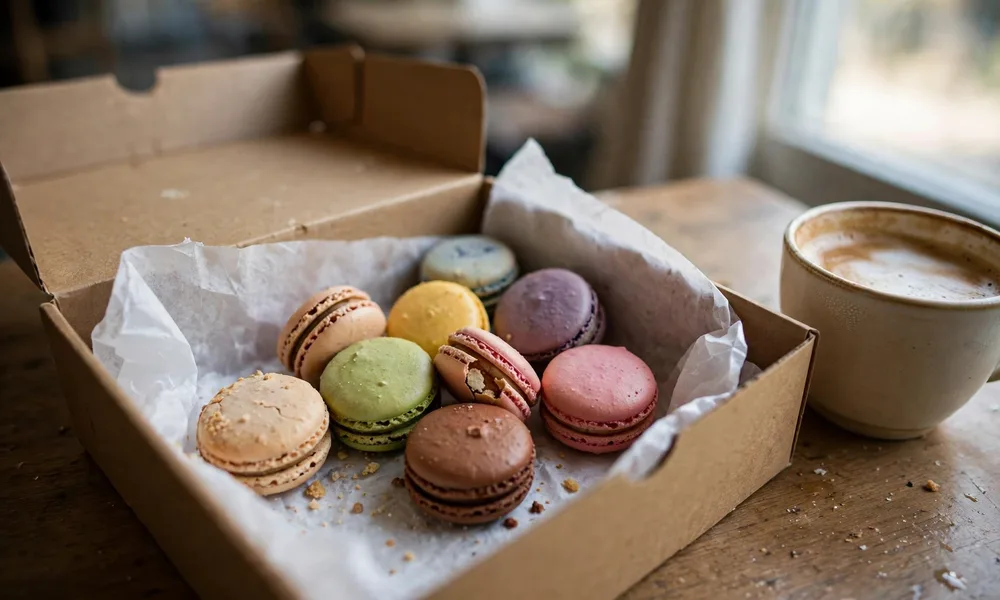
The best macarons in 2026 are small, precise and quietly luxurious: two crisp almond shells, a ruffled foot at the base, and a filling that tastes of something real rather than just sugar. A good one cracks gently, then gives way to a soft, chewy centre, and the flavour arrives in layers. A bad one is all show: brightly coloured but hollow, stale or so sweet the flavour disappears. The difference is easy to spot once you know what to look for.
Macarons have become easier to find than ever, in patisseries, supermarkets, online shops and gift boxes, and the quality range is wider than most buyers expect. Some are made the slow way, with aged egg whites and finely ground almonds, while others are rushed and filled with little more than sweetened butter. This guide shows how to choose the best macarons in 2026, whether you are buying a box, ordering online, or baking your own.
Key Takeaways
- A great macaron has a crisp shell, a visible ruffled foot, and a soft, chewy centre.
- The filling should taste of its named flavour, whether pistachio, chocolate or raspberry, not just of sugar and butter.
- Fresh macarons are best eaten within two to three days, and they improve after a night in the fridge, which softens the shell.
- Classic flavours such as vanilla, chocolate and salted caramel are the safest test of a bakery, because they hide nothing.
- Buy from a bakery that makes macarons daily in small batches, and be wary of brightly coloured shells with no flavour to match.
How to Spot a Good Macaron
Judging a macaron takes about ten seconds, and you can do most of it before you take a bite. Start with the shell. It should be smooth on top, with no cracks, bumps or lumps, and the colour should look like the flavour it promises: pistachio a soft green, raspberry a gentle pink, chocolate a warm brown. Colours that are neon bright usually mean heavy food colouring, and they rarely come with flavour to match. It should feel light, not dense or heavy.
The Shell and the Foot
The foot is the ruffled, frilly layer at the base of each shell, and it is the clearest sign that a macaron was made properly. A good foot is even all the way around, about as tall as the shell itself, and slightly spongy to the touch. Macarons with no foot, or one that is uneven, were probably rushed, and they will usually taste rushed too. The shell itself should be crisp on the outside and soft inside, like a thin meringue that melts into a chewy centre. Stale shells shatter into dry crumbs; underbaked ones stay soft throughout.

The Filling Makes the Flavour
The filling carries almost all of the flavour. A good filling is generous but not overflowing, smooth, and clearly flavoured: pistachio should taste nutty and rich, raspberry should taste sharp and fruity, chocolate should taste dark and deep. Buttercream works well when made with real butter and real flavouring, but turns cloying when it is mostly sugar. Ganache, made from chocolate and cream, is richer and usually better in chocolate and coffee macarons. Fruit curds and jams bring brightness, and they suit lemon, raspberry and passion fruit best. It should be thick enough to hold the shells apart without squeezing out.
Freshness and the Overnight Rest
Freshness in macarons works differently from most baking. A macaron eaten the hour it is filled can taste dry and crisp, because the filling has not yet softened the shells. The best macarons are filled, then rested in the fridge overnight, a step bakers call maturing, which lets the moisture from the filling seep gently into the shells. The result is the ideal texture: a shell that still cracks, a centre that is soft and chewy, and a flavour that tastes fuller and more rounded. A macaron bought today and eaten tomorrow is often better than one eaten straight from the box. After three days the shells soften too much, so buy only what you will eat within a few days.
The Best Macaron Flavours in 2026
Choosing a flavour is partly personal taste and partly a test of the bakery. The classics have survived for a reason: vanilla, chocolate, pistachio, raspberry, lemon and salted caramel each show off a different part of the craft. Vanilla should taste warm and floral rather than artificial. Chocolate should use dark chocolate with a little salt to sharpen the flavour. Pistachio is the most expensive flavour to make well, because real pistachio paste costs far more than flavouring, and a pale green macaron that tastes only of almond is a sign the bakery cut corners.
Raspberry and lemon work best with a sharp fruit filling that cuts through the sweetness of the shell. Salted caramel is the crowd-pleaser, sweet and buttery with a salty edge that keeps it from becoming dull. Beyond the classics, coffee, rose, and Earl Grey have become bakery staples, and they suit people who want something more grown-up.
| Flavour | Filling | Best For | Flavour Character |
|---|---|---|---|
| Vanilla | Vanilla buttercream | First-timers, gifts | Warm, floral, gentle |
| Dark chocolate | Chocolate ganache | Chocolate lovers | Rich, deep, slightly bitter |
| Pistachio | Pistachio ganache | Special occasions | Nutty, rich, delicate |
| Raspberry | Raspberry jam and ganache | Summer, afternoon tea | Sharp, fruity, bright |
| Lemon | Lemon curd | People who dislike sweet | Zesty, fresh, tangy |
| Salted caramel | Caramel buttercream | Crowd-pleasing gifts | Sweet, buttery, salty |
| Coffee | Coffee ganache | After dinner | Bold, roasted, smooth |
Buying Macarons: Bakery, Online or Supermarket
Where you buy your macarons matters almost as much as which flavour you choose, because freshness and handling decide the texture. A good patisserie that bakes macarons daily is still the best source. The shells are fresh, the fillings are made in small batches, and you can ask what was made today and which flavours are selling fastest. If you can, buy a single macaron first and taste it before committing to a box.
Online shops are the best option if you live far from a good bakery or want a gift delivered. The best ones bake to order, pack macarons in rigid boxes, and ship them chilled with a clear eat-by date. Supermarket macarons are the most convenient and the cheapest, and a few are genuinely good, but most are made weeks in advance, frozen, and filled with buttercream that leans heavily on sugar. They are fine for a party platter, but they rarely match a fresh bakery macaron. Keep them refrigerated and let them reach room temperature for twenty minutes before eating.

Baking Macarons at Home
Baking macarons at home is famously fussy, but it is not impossible, and it is the cheapest way to eat a lot of them. The two ingredients that matter most are almond flour and egg whites. The almond flour must be very fine, with no coarse pieces, because coarse flour makes lumpy shells that crack in the oven. Our guide to baking with almond flour in 2026 explains how to choose a flour fine enough for macarons and how to sieve it properly. Egg whites work best when they are aged, left uncovered in the fridge for a day or two, because aged whites whip into a more stable meringue. Weigh everything, because macarons are far more sensitive to ratios than most baking.
The steps that cause most failures are the macaronage, the folding of the dry ingredients into the meringue, and the rest before baking. Fold too little and the batter is too stiff to pipe smoothly, leaving peaked shells. Fold too much and the batter turns runny, spreading into flat discs with no foot. The right texture flows off the spatula like a slow ribbon and settles into a smooth disc when piped. After piping, the shells must rest until they are dry to the touch, usually thirty to sixty minutes, before they go into the oven. Baking on parchment paper that actually stops sticking in 2026 makes the shells release cleanly, and an oven that runs even ten degrees too hot will brown the shells and ruin the colour. Expect the first tray to be imperfect.
Storing and Serving Macarons
Macarons keep best in the fridge, in an airtight container, for two to three days, and they freeze well for up to a month if you wrap them carefully. To freeze them, place them in a single layer in a rigid container, separate the layers with parchment, and thaw them overnight in the fridge rather than on the counter, which keeps the shells from going soggy. Never store them in a warm room or in sunlight.
Serving matters more than most people think. Take macarons out of the fridge twenty to thirty minutes before serving, so they reach room temperature and the filling softens enough to taste properly. Present them on a flat plate or a stand, with space between each one, and pair them with coffee, tea or champagne rather than a sweet drink. A simple cake stand that makes bakes look bakery-worthy in 2026 turns a box of macarons into a proper centrepiece for afternoon tea or a party table.
The Macaron Checklist
- Shell is smooth, uncracked and lightly crisp, with a visible ruffled foot all the way around.
- Filling tastes of its named flavour, not just sugar, and is generous without overflowing.
- Colour matches the flavour and looks natural, never neon or artificial.
- Macarons were made within the last day or two, or were matured overnight in the fridge.
- Bakery makes them in small daily batches and can tell you what is fresh today.
- Box is rigid, each macaron is held in place, and the eat-by date is clearly marked.
Frequently Asked Questions
How long do macarons last?
Macarons are best within two to three days of being filled, kept in an airtight container in the fridge. They freeze for up to a month, but lose some crispness after thawing.
Why do my macarons have no feet?
Missing feet usually mean the piped shells did not rest long enough to form a dry skin before baking, or the oven was too cool. Let the shells rest until dry to the touch, usually thirty to sixty minutes.
Are macarons gluten-free?
Traditional macarons are made from almond flour, egg whites and sugar, so they are naturally gluten-free. Some fillings contain gluten, and cross-contamination is possible, so always ask if you have coeliac disease.
How much should a good macaron cost?
A good bakery macaron usually costs between two and four pounds each, depending on the city and the flavour. Nut-heavy flavours cost more. Very cheap macarons usually use flavouring instead of real ingredients.
Can you make macarons without almond flour?
You can make macarons with other nut flours, such as hazelnut or cashew, but the texture and flavour will change, and the shells may be less smooth. Seed flours work for nut-free versions, but rarely match the delicate chew of a true almond macaron.
What is the difference between a macaron and a macaroon?
A macaron is a French sandwich cookie made from almond flour meringue with a filling, while a macaroon is a chewy coconut mound, usually dipped in chocolate. They share a name root but are entirely different bakes.
The Bottom Line
The best macarons in 2026 are made slowly, in small batches, with real ingredients and a proper overnight rest: crisp shells, a proud foot, a chewy centre and a filling that tastes of what it claims to be. Buy from a bakery you trust, start with the classics, and eat them at room temperature within a few days. And remember, macarons are the delicate French sandwich cookies, not the chewy coconut macaroons.


