A melon baller is a small tool with a single job, and it does that job better than anything else in the kitchen drawer. It cuts neat, round balls from the flesh of a melon, turning a watermelon, a cantaloupe or a honeydew into a bowl of perfect spheres in a few minutes. The best melon ballers of 2026 do it cleanly, without tearing the flesh, without slipping in a wet hand, and without leaving half the melon behind as mush. The worst ones crush more than they cut, and the difference is obvious the moment you look at the bowl.

What a Melon Baller Is, and What It Is Not
A melon baller, sometimes called a Parisienne scoop, is a small handle with a tiny metal cup at one end, or a cup at each end. The cup has a sharp rim, and you press it into the melon flesh and twist. The rim cuts a circle, the cup fills, and the ball pops out. That is the whole mechanism. There is no motor, no blade to sharpen and no setting to learn, which is part of the appeal: it is a tool you can pick up and use well the first time you hold it.
It is not an ice cream scoop, even though the two look like cousins in a drawer. An ice cream scoop is larger, with a deeper bowl built to carve hard, frozen scoops, and it is sized for a serving, not for a garnish. A melon baller is much smaller, with a shallow cup that suits soft fruit, and its balls are meant to be eaten in one or two bites. If you try to use an ice cream scoop on a melon you will get ragged chunks, and if you try to use a melon baller on hard ice cream you will get nowhere. They are different tools for different jobs, and this guide is about the smaller one.
How to Choose: The Five Things That Matter Most
Start with the size of the cup. Most melon ballers come with a cup around two to two and a half centimetres across, which makes a ball about the size of a large grape. That is the size that works best in a fruit salad, because the balls sit neatly together and are easy to eat with a fork. A smaller cup makes delicate balls for cocktails and desserts, while a larger cup makes generous balls for a fruit platter. Double-ended ballers give you two sizes in one handle, which is useful if you serve fruit in different ways, but check that both ends are genuinely sharp rather than one good end and one afterthought.
Next, look at the sharpness of the rim. This is the single most important quality in a melon baller, and it is the one that separates a good tool from a frustrating one. A sharp rim cuts through melon flesh with light pressure and leaves a smooth, round ball. A blunt rim has to be forced, and forcing it tears the flesh, crushes the ball and leaves juice everywhere. Run your thumb gently across the rim before you buy if you can: it should feel crisp, not rounded. A rim that is sharp on day one and dull after a summer is no bargain either, so a well-made cup in good steel matters more than a fancy handle.
The handle comes third. A melon baller is used with wet hands, over a wet board, with juice running down your wrist, so grip matters. Look for a handle that is comfortable to hold, slightly textured, and long enough to keep your knuckles clear of the melon. A handle that is too thin will twist in your hand when you turn the cup, and a handle that is too smooth will slip at the worst moment. Some handles are shaped so your thumb rests naturally on top, giving you control over the twist, and that small detail makes a real difference when you are scooping a whole melon.
Material is fourth, and it is mostly about the cup. Stainless steel is the usual choice for a reason: it stays sharp, it does not rust, it does not stain, and it washes clean. Cheaper cups can bend, lose their edge or develop rough spots that drag through the flesh. A solid steel cup with a smooth inside releases the ball cleanly, while a rough or pitted cup holds onto it and has to be tapped or scraped out. The handle can be steel, wood or a sturdy plastic, and any of those works if it is firmly fixed to the cup and does not wobble.
Cleaning is fifth, and it is easy to overlook until the tool is sitting in the sink. A melon baller should rinse clean under a tap in seconds, with no joints or grooves where juice can hide. Double-ended designs and sets with several cups are the ones to check most carefully, because a joint between the cup and the handle can trap pulp. If you use a dishwasher, check that the baller is safe for it, but even so, a quick rinse straight after use is what keeps the rim sharp and the cup free of dried-on juice.

Single-Ended, Double-Ended or a Set
A double-ended baller has a different-sized cup at each end, so you can make small balls for drinks and larger ones for a platter without reaching for a second tool. It is a good choice if you cook for different occasions, but it is slightly awkward to hold, because the end you are not using sticks out behind your hand. A set, with two or three separate ballers in different sizes, gives you the same range with a better grip on each one, at the cost of more drawer space and more washing up. For most kitchens, one double-ended baller or one good single-ended baller is enough, and a set is for people who serve fruit often.
Which Melons Work Best
Watermelon is the easiest melon to scoop, because the flesh is soft, even and seedless in most varieties sold today. The balls come out cleanly and hold their shape in a bowl, and the colour makes a fruit salad look bright. Cantaloupe is slightly firmer and sweeter, and it scoops well too, although the flesh near the rind can be tougher, so start in the centre of the half and work outward. Honeydew is the firmest of the three, and it needs a sharper rim and a little more pressure, but its pale green balls look lovely next to the orange of cantaloupe and the red of watermelon.
Ripe fruit matters more than the variety. An under-ripe melon is hard and will fight the baller, while an over-ripe one is soft and will collapse into the cup. A melon that is ripe but still firm, that smells sweet at the stem end and feels heavy for its size, is the one to scoop. Chill the melon first, because cold flesh cuts more cleanly than warm flesh, and the balls will hold their shape longer on the table. If you are serving the balls in a bowl, our guide to the best serving bowls of 2026 covers bowls that keep a fruit salad looking neat instead of crowded.
The Technique: Neat Balls Every Time
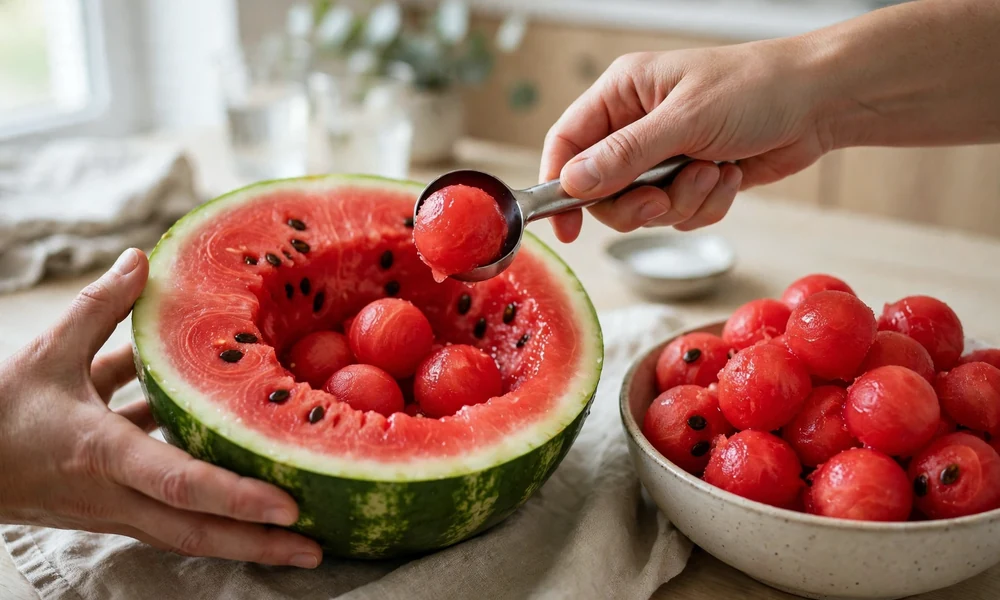
Cut the melon in half and scoop out the seeds if there are any. Hold the half steady on a board, cut side up, and press the cup of the baller into the flesh at a slight angle. Push it in until the rim is buried, then twist your wrist in a smooth half-turn. The cup should fill completely, and the ball should come away cleanly when you lift. If the ball sticks, tap the handle gently against the side of the bowl, or use the tip of a knife to ease it out, but do not dig at it with your fingers, or you will dent the ball.
Beyond Melon: What Else a Baller Can Do
A melon baller is not only for melons. It makes neat balls from papaya, mango and pear, it scoops the flesh from a halved avocado for a salad, and it cores small apples and pears for stuffing. It can scoop butter into round pats for the table, shape small balls of sorbet for a dessert plate, and even core a cucumber for filling. A cook who bakes will use it to hollow out cupcakes for a filling, and a cook who makes soup will use it to scoop the seeds from a squash.
That said, do not expect it to replace your other kitchen tools. It is too small to peel a potato and too shallow to scoop ice cream, and using it as a substitute for either will only blunt the rim. For peeling, a proper peeler is still the right tool, and our guide to the best vegetable peelers of 2026 covers peelers that take the skin off without taking half the vegetable with it. Think of the baller as a specialist: excellent at its own job, useful at a few others, and not a replacement for the rest of the drawer.
What to Avoid When Buying a Melon Baller
Avoid ballers with a blunt or rolled rim. No amount of pressure will make a blunt cup cut cleanly, and the harder you push, the more the ball will crush. If the rim looks thick or rounded in the shop, or if the cup feels flimsy when you squeeze it gently, put it back. A good baller feels solid in the hand, and the cup holds its shape when you press it.
Frequently Asked Questions
Is a melon baller worth buying if you only eat melon in summer? Yes, if you like serving fruit neatly. It is a small, cheap tool that takes up almost no space, and it turns a melon into a dish that looks as if it took far more effort than it did. If you only ever eat melon in wedges, you will not miss it, but for fruit salads, parties and desserts, it earns its place in the drawer in a single summer.
Should the balls be the same size? As far as possible, yes. Balls of the same size look better, eat better and mix better in a bowl, because no one gets a mouthful that is twice the size of the next person’s. That is the real reason to choose a baller with a cup size you like and to scoop with a steady twist, rather than changing your grip halfway through the melon. A frozen dessert served alongside can be a lovely contrast, and our guide to the best ice cream makers of 2026 covers machines that churn a smooth scoop to sit next to a bowl of melon balls.
The best melon baller is the one that cuts cleanly, feels secure in a wet hand and rinses clean in seconds. Choose a sharp steel cup, a handle you can grip, and a size that suits the way you serve fruit, and a simple summer melon will look like something from a restaurant. Choose on price alone, and you will be scooping crushed melon all summer.