The best motorcycle helmets 2026 combine stronger shells, smarter ventilation and lighter weight than anything riders could buy a few years ago. A good helmet is not an accessory. It is the difference between walking away from a crash and not walking away at all.
Choosing a helmet has become harder because the market is crowded with lookalikes. Some helmets look premium and cost premium money while cutting corners where it matters most, in the shell, the liner and the retention system. Others cost far less yet pass the same tough tests as helmets three times their price.
This guide cuts through that noise. It explains how modern helmets are tested, compares the main helmet styles, and walks you through fit, ventilation, visor choice and safety ratings so you can buy with confidence.
Key takeaways
- Choose a helmet certified to ECE 22.06 or an equivalent current standard, and check the label inside before you buy.
- Full-face helmets offer the best protection for most riders, covering the chin and jaw where many impacts land.
- Fit matters more than price: a helmet should feel snug all round, with no pressure points and no movement when you shake your head.
- Good ventilation keeps you cool and alert, while a Pinlock-ready visor prevents fogging in cold or wet weather.
- Replace any helmet after a crash or after about five years of regular use, even if it looks undamaged outside.
Why the Right Helmet Matters More Than Any Other Gear
No other piece of riding gear does as much work as your helmet. Jackets, gloves and boots all matter, but your head is the one part of your body that cannot be repaired after a serious impact. A certified helmet absorbs crash energy through its crushable inner liner and spreads the force across its outer shell.
Riders wearing certified helmets suffer far fewer fatal head injuries than riders wearing uncertified novelty helmets or none at all. Comfort matters too, because an uncomfortable helmet is one you will not wear properly. A helmet that presses on your forehead or fogs up at every traffic light will tempt you to leave it at home.
What a Helmet Actually Does in a Crash
A helmet protects you in three stages. The hard shell spreads the force of an impact and resists penetration. The foam liner crushes, absorbing energy and slowing your head more gradually than a sudden stop. The padding and strap keep the helmet in place. Once that liner has crushed, it cannot crush again, so a crashed helmet must be replaced even when the outside looks fine.
How We Judge the Best Motorcycle Helmets 2026
Our judgement starts with certification. A helmet that has passed ECE 22.06, the current European standard, has survived impact, penetration, retention and visor tests far tougher than the older ECE 22.05 rules. DOT is the American baseline, while Snell approval adds extra high-energy impact testing.
Beyond the label, we look at shell construction, liner density, ventilation, visor quality, noise, weight and fit. Fibreglass composite generally absorbs impact better and weighs less than basic polycarbonate, while carbon fibre offers the best strength-to-weight ratio.
Safety Certifications Explained
ECE 22.06 tests helmets at more impact points and speeds than its predecessor, including angled impacts that mimic real crashes more closely. It also tests the visor and chin strap, so a helmet carrying the label has been checked as a complete system. If a helmet carries no recognised certification, walk away, whatever the price. See what happens when corners are cut in the worst cheap motorcycle helmets riders regret buying.
The Best Motorcycle Helmets 2026 at a Glance
Every rider is different, so no single helmet suits everyone. This table compares the main styles on the factors that matter most.
| Helmet style | Protection | Weight | Ventilation | Best for | Typical price |
|---|---|---|---|---|---|
| Full-face | Highest | 1,400–1,700 g | Good | Commuting, touring, sport riding | £150–£700 |
| Modular (flip-up) | High | 1,600–1,900 g | Good | Touring, glasses wearers, frequent stops | £200–£800 |
| Open-face | Moderate | 1,000–1,300 g | Excellent | City riding, scooters, classic bikes | £100–£400 |
| Adventure | High | 1,500–1,800 g | Excellent | Mixed on-road and off-road riding | £250–£900 |
| Half helmet | Low | 800–1,100 g | Excellent | Low-speed cruising only | £80–£300 |
Full-face helmets lead our list because they protect the chin and jaw, where research shows a large share of impacts occur. Modular helmets come close while adding a chin bar that flips up at fuel stops. Open-face helmets feel wonderfully free, but they leave your face exposed, a serious compromise above city speeds.
Full-Face Helmets: The Safest Choice for Most Riders
A full-face helmet wraps your entire head in a single protective shell, with a visor that seals out wind, rain, insects and road debris. Modern designs have solved the old complaints: ventilation channels pull fresh air across your head and out through rear exhausts, and visors swap in seconds without tools.
Weight is the main thing to watch. A heavy helmet becomes a pain in the neck on long rides, so premium models use fibreglass or carbon fibre to keep weight down. Aim for under 1,500 grams for fibreglass and under 1,400 for carbon fibre.
Modular Helmets: Convenience Without Giving Up Protection
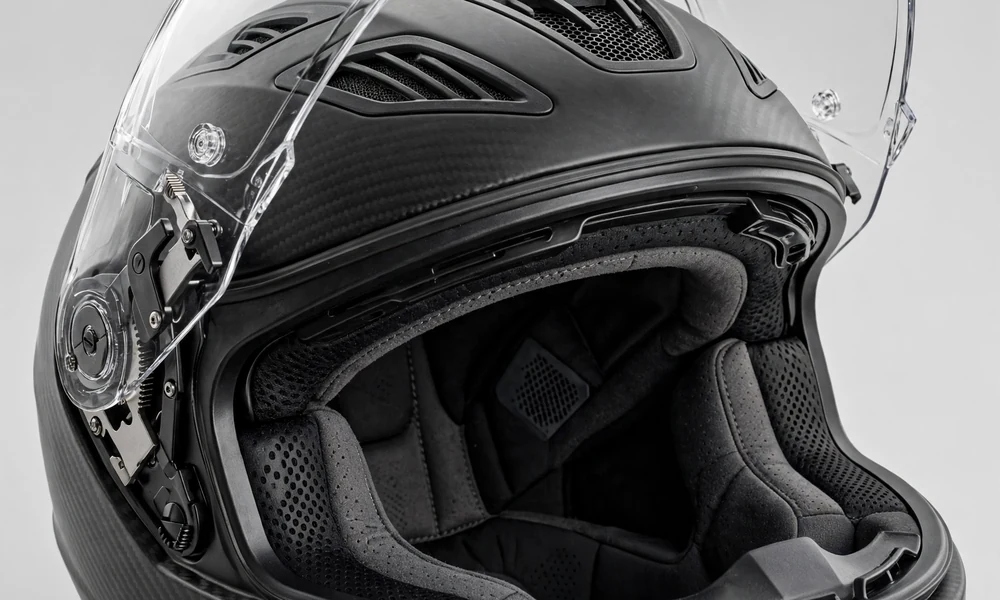
Modular helmets, also called flip-up helmets, combine a full-face shell with a chin bar that pivots up. That single feature makes everyday riding easier: you can talk to a petrol attendant, take a drink, adjust your glasses or get some air at a traffic light without removing the helmet. For tourers and glasses wearers, that convenience is genuinely transformative.
The compromise is weight and complexity. The hinge adds grams and moving parts, so modular helmets are heavier than equivalent full-face models. Look for a metal locking mechanism and a chin bar that locks firmly in both positions. The safest modular helmets are certified for use with the chin bar open as well as closed, a rating often marked as P/J. Never ride with the chin bar up on a helmet that is not P/J certified.
Open-Face and Adventure Helmets
Open-face helmets cover the top, back and sides of your head but leave your face open. They are light, airy and give excellent peripheral vision, which makes them popular with scooter riders, classic bike owners and city commuters. The trade-off is obvious: your chin, jaw and face are unprotected, and at speed the wind blast can be tiring.
Adventure helmets combine a full-face shell with a sun peak, a wider eye port for goggles and generous ventilation for slow off-road work. The peak blocks low sun on trails, while the wide opening accepts goggles when dust and mud make a visor impractical. Whatever style you choose, avoid bargain kit built to fail: read about motorcycle gear that fails when it matters before spending money on cheap equipment.

How to Choose the Right Fit
Fit is the most important factor after certification, and it is the one most riders get wrong. A helmet that is too loose will shift in a crash and may come off entirely, while one that is too tight will cause headaches that make you dread every ride. The right fit feels snug and even all round, with no loose spots and no painful pressure points.
Start by measuring your head: wrap a soft tape measure around your head just above your eyebrows and ears, and compare the result with the maker’s size chart. Try the helmet on for at least ten minutes. When you shake your head, the helmet should move your skin with it rather than sliding around.
Common Fitting Mistakes
The most common mistake is buying too large. Comfort liners compress by up to twenty percent over the first few weeks, so a helmet that feels perfect on day one will feel loose by month two. Choose the smallest size that fits without painful pressure. The second mistake is ignoring head shape: a helmet designed for a round head will press painfully on the forehead of a rider with a long oval head, whatever the size.
Helmet Care and Replacement
A good helmet lasts about five years of regular use. Sweat, sunlight, temperature changes and everyday knocks gradually degrade the liner and shell, even when nothing dramatic happens.
Clean it gently: remove the liner and wash it by hand, wipe the shell with a soft cloth and mild soap, and clean the visor with lukewarm water and a microfibre cloth. Never use solvents or harsh chemicals, and never hang your helmet where it can fall and take an impact. Replace it immediately after any crash in which your head hits the ground. Your boots matter too: the worst motorcycle boots for safety show how badly cheap footwear can fail when you need grip and ankle support.
Checklist: Before You Buy
- Check the certification label inside the helmet for ECE 22.06, DOT or Snell approval.
- Measure your head and try the helmet on for at least ten minutes before deciding.
- Shake your head side to side and up and down: the helmet should move your skin, not slide around.
- Check that the visor is optically clear, Pinlock-ready and easy to change without tools.
- Test the ventilation by feeling for airflow through the top vents and rear exhausts.
- Confirm the chin strap fastens securely and the buckle works easily with gloves on.
Frequently Asked Questions
How much should I spend on a motorcycle helmet?
Spend as much as you can afford, but price and protection are not the same thing. A mid-priced certified helmet can protect you as well as a flagship model costing three times as much. Extra money usually buys comfort, quiet, lighter weight and better ventilation.
How do I know if a helmet fits properly?
A well-fitting helmet feels snug all round with no pressure points and no loose areas. It should not slide when you shake your head, and the chin strap should hold it firmly. If the helmet rocks forward over your eyes, it is too loose.
How long does a motorcycle helmet last?
Most makers recommend replacing a helmet after about five years of regular use, or sooner after a crash or a hard drop. The liner and shell degrade gradually from sweat, sun and temperature changes, even when the helmet looks fine from the outside.
Are expensive helmets safer than cheap ones?
Not necessarily. Safety depends on certification and construction, not price. Some inexpensive helmets pass the same ECE 22.06 tests as premium models, while some expensive helmets charge mostly for brand, paint and features.
Can I wear glasses with a full-face helmet?
Yes, and many helmets have channels in the liner for glasses arms. Look for a helmet marketed as glasses-friendly, or consider a modular helmet, which makes putting glasses on and taking them off much easier. Try your glasses on with the helmet before you buy.
Should I buy a helmet online or in a shop?
Try helmets on in a shop first, even if you later buy online. Fit varies between brands and models, and a size chart alone cannot tell you whether a helmet suits your head shape. Once you know the exact model and size that fits, buying online is fine if the seller is authorised.
The Bottom Line
The best motorcycle helmets 2026 has to offer prove that you do not need to spend a fortune to protect your head properly, but you do need to choose carefully. Start with certification, prioritise fit above everything else, and pick the style that matches the way you actually ride. Buy the best helmet you can afford, wear it every time you ride, and replace it after five years or any crash.