
The Pain au Chocolats Worth the Flaky Mess in 2026
Pain au chocolat in 2026 is the pastry that turns a quiet morning into a small event. It is a rectangle of laminated dough, rolled around two bars of dark chocolate, baked until the outside shatters and the inside melts. The best ones are worth the flakes on your shirt and the chocolate on your fingers. This guide explains how to tell the two apart before you pay, which types are worth your money, and where the good ones are actually made.
Key takeaways
- A great pain au chocolat shatters when you break it, with crisp layers outside and a soft, honeycombed crumb inside.
- Look for two proper bars of dark chocolate, not a thin smear or a single strip down the middle.
- Butter is the flavour: a good pastry tastes of butter first, with chocolate second, never of shortening or sugar.
- Buy them fresh and warm when you can; a pain au chocolat goes soft within hours, and reheating only partly saves it.
- A bakery that laminates its own dough beats a factory pastry almost every time, whatever the packaging promises.
What a real pain au chocolat actually is
A pain au chocolat is not a croissant with chocolate in it, although the two share the same laminated dough. A pain au chocolat is rectangular, rolled from a rectangle around two chocolate batons, and the chocolate is part of the structure, not a filling added afterwards. That distinction matters, because the shape changes how it bakes: the rectangle gives a flatter top, a more even crumb, and a chocolate bar in every bite rather than a sweet centre and plain ends. Our guide to the best croissant covers the plain version in full, and it is the right read if you want the unfilled pastry; this guide is for the chocolate-filled one, and it judges it on its own terms.
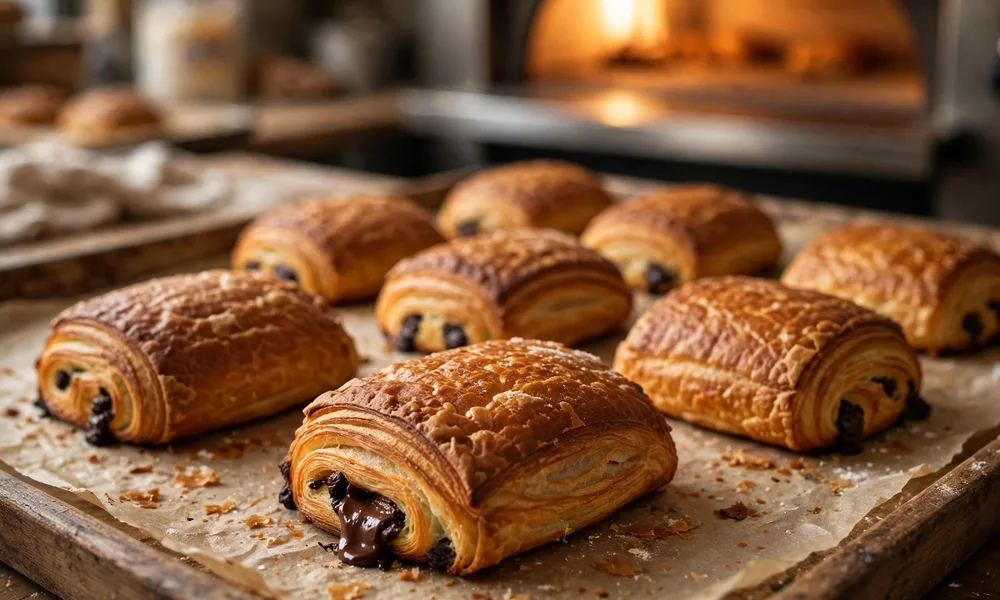
The dough is the same slow work: butter folded into dough again and again until there are dozens of thin layers, then rolled, shaped, and proved slowly before a hot bake. A proper pain au chocolat is golden rather than pale, crisp rather than soft, and layered rather than dense. The chocolate should be dark, at least 55 percent cocoa, and it should melt when the pastry is warm. When you break one open, you should see two distinct bars, separated by a thin layer of dough.
How the best pain au chocolats were chosen
Every pain au chocolat below was judged on five measures: flakiness, chocolate, butter flavour, freshness, and value. Flakiness comes first: does the outside shatter, or does it bend and tear like bread? Chocolate is second, judged on amount, quality, and whether it runs through the whole pastry. Butter flavour is third, because a good pastry tastes of butter before anything else. No single type wins on all five, so the list below matches each type to the buyer it suits best.
Comparison table: the best pain au chocolats 2026
| Rank | Pain au chocolat type | Best for | Watch out for |
|---|---|---|---|
| 1 | Bakery-made, two dark bars | The real thing, eaten warm | Highest price, sells out early |
| 2 | Artisan sourdough version | Deeper flavour, slower eating | Can taste tangy, not for everyone |
| 3 | Supermarket bakery counter | Everyday buying, fair price | Quality varies by the day |
| 4 | Frozen bake-at-home | Fresh from your own oven | Needs proving time, easy to rush |
| 5 | Mini pain au chocolat | Children, coffee breaks, sharing | Less chocolate per bite |
| 6 | Milk chocolate version | Sweet teeth, younger eaters | Too sweet, chocolate overwhelms |
| 7 | Almond-topped pain au chocolat | A richer, nuttier treat | Heavier, less crisp, more sugar |
The best pain au chocolats in 2026
1. Bakery-made, two dark bars: the real thing
A bakery-made pain au chocolat with two proper dark chocolate bars is the best there is, and it is not close. The dough is laminated on site, proved slowly, and baked in small batches through the morning, so the pastry you buy is still warm and the chocolate is still soft. The outside is a deep golden brown, the layers are visible where the pastry has cracked, and the first bite is a small shower of flakes. The chocolate is dark and slightly bitter, which balances the butter rather than competing with it.
2. Artisan sourdough version: deeper flavour
An artisan sourdough pain au chocolat uses a slow-fermented dough, which gives the pastry a deeper, slightly tangy flavour and a chewier crumb beneath the crisp outside. It suits people who find an ordinary pain au chocolat too rich or too sweet, because the tang cuts through the butter and the chocolate tastes darker by contrast. The layers are often less shattering than a classic version, and more substantial, so it eats more like a meal than a snack.
3. Supermarket bakery counter: the everyday buy
The supermarket bakery counter is the best pain au chocolat for most people, because it is there when you need it, at a price you can repeat. The best of these are baked on site in the morning, use real butter, and carry two visible chocolate bars. Read the pastry before you buy it, because the counter holds two very different products under similar names. One is a genuine laminated pastry, golden and flaky, with a crisp shell. The other is a soft, pale roll with a thin chocolate strip, baked from frozen dough with shortening instead of butter.
4. Frozen bake-at-home: fresh from your own oven
A frozen bake-at-home pain au chocolat is the best way to eat one warm without leaving the house, and it beats a stale bakery pastry every time. The dough is shaped, filled, and frozen, and you prove it at home, then bake it in a hot oven until it is golden and the chocolate has melted. The result is genuinely fresh, with a crisp outside and a soft inside, and the kitchen smells like a bakery for an hour. The catch is patience. A rushed prove gives a dense, doughy pastry, and an oven that is not hot enough gives a pale, soft one.
5. Mini pain au chocolat: small, shareable, dangerous
A mini pain au chocolat is a small version of the classic, usually half the size, made for children, coffee breaks, and sharing. It suits a morning when a full pastry feels too much, and it is the easiest way to introduce a child to the real thing without a sugar crash. The drawback is proportion. A mini pastry has less room for chocolate, so the ratio of dough to chocolate shifts, and some minis are mostly pastry with a thin chocolate thread. The best minis still carry two small bars, and they are baked until crisp rather than soft.
6. Milk chocolate version: the sweet tooth’s choice
A milk chocolate pain au chocolat swaps the dark bars for milk chocolate, which makes the pastry sweeter, softer in flavour, and more popular with children and anyone who finds dark chocolate too bitter. It is a pleasant pastry, and there is nothing wrong with liking it, but it is a different balance: the milk chocolate melts faster, tastes sweeter, and lets the butter flavour fade into the background. The best milk versions use a good-quality milk chocolate with a real cocoa taste, not a sugary compound coating.

7. Almond-topped pain au chocolat: the richer treat
An almond-topped pain au chocolat adds a frangipane filling and a scattering of flaked almonds to the classic, which makes it richer, nuttier, and heavier. It is the pastry to choose when you want a treat rather than a breakfast, and it pairs well with black coffee, which cuts through the sweetness. The trade-off is texture. The almond topping softens the crisp shell, the filling adds weight, and the pastry is less flaky than the plain version. Some versions are also very sweet, with a sugary glaze that overwhelms the chocolate.
How to judge a pain au chocolat before you buy it
Judge a pain au chocolat with your eyes and your hands before you pay. The colour should be a deep, even gold, not pale and not burnt at the edges. The surface should show visible layers, with cracks where the pastry has opened in the oven. Pick it up: it should feel light for its size, and the outside should crackle slightly under your fingers. Look at the ends, where the chocolate should be visible as two distinct bars. Avoid a pastry that feels heavy, looks pale, or bends like bread. The same care with ingredients applies to the chocolate itself, and our guide to how to choose chocolate explains what a proper dark chocolate bar should taste like and why cocoa content matters.
What to avoid when buying pain au chocolat
The most common mistake is buying a pain au chocolat that has been sitting out all day. Laminated pastry goes soft within hours, and a pastry baked at dawn and sold at four in the afternoon is a different product from the one that left the oven warm. Buy in the morning, or buy frozen and bake it yourself. The second mistake is choosing on size alone: a large, pale pastry is usually mostly dough, while a smaller, well-baked one has more flavour in every bite. The third is ignoring the chocolate. A single thin strip or a sugary compound filling is a sign of a cheap product.
Checklist: buying a good pain au chocolat
- Choose a deep golden colour with visible layers, not a pale, smooth surface.
- Check for two proper dark chocolate bars, visible at the ends of the pastry.
- Pick it up: it should feel light for its size and crackle slightly under your fingers.
- Buy in the morning, when the pastry is fresh and the chocolate is still soft.
- Ask whether the dough is laminated on site, and prefer a bakery that does its own.
- Reheat a cold pastry for five minutes in a hot oven, never in a microwave.

Frequently asked questions
What is the difference between a pain au chocolat and a croissant?
A croissant is crescent-shaped and eaten plain, while a pain au chocolat is rectangular and rolled around two bars of dark chocolate. They share the same laminated dough, but the shape and the chocolate make the pain au chocolat a different pastry, with chocolate in every bite.
How many calories are in a pain au chocolat?
A standard bakery pain au chocolat has roughly 300 to 400 calories. A mini version has about half that.
Can you freeze pain au chocolat?
Yes. Freeze them on the day you buy them, well wrapped, and reheat from frozen in a hot oven for about ten minutes. The result is much better than a pastry left out for a day, and the chocolate melts properly again.
Why does my pain au chocolat go soft so quickly?
Laminated pastry absorbs moisture from the air, so the crisp shell softens within a few hours. Keep it in a paper bag, eat it the same morning, and reheat it in a hot oven for five minutes.
Is pain au chocolat the same as a chocolate croissant?
Mostly, yes, in everyday language. Chocolate croissant is the common English name for the same pastry, but pain au chocolat is the French name, and it describes the rectangular shape and the two chocolate bars more precisely.
What should I drink with a pain au chocolat?
Black coffee or a cappuccino is the classic pairing; our guide to a great cappuccino at home explains how to make one that stands up to a rich pastry.
Bottom line
The pain au chocolats worth the flaky mess in 2026 are the ones that shatter when you break them, taste of butter first and dark chocolate second, and carry two proper bars from end to end.


