
The best paper towel holders for kitchens in 2026 solve a problem you notice a dozen times a day: a roll that will not stay put or tear cleanly. A good holder keeps the roll steady, lets you tear off one sheet with a wet hand, and sits exactly where the messes happen. A bad one topples over, unwinds half the roll onto the floor, or needs two hands when both of yours are covered in dough. This guide compares the holders that work in a real kitchen, and how to pick one.
A paper towel holder looks like the simplest thing in the kitchen, and in a way it is. But the details decide whether it helps or annoys: the weight of the base, the grip of the spindle, the tension that stops the roll spinning free, and the height that fits under your wall cabinets. Get those right and the holder disappears into the background.
Key takeaways
- For most kitchens, the best holder is a weighted freestanding one with a non-slip base.
- One-handed tearing matters most: look for a tension arm, a weighted base or a ratchet that holds the roll still while you pull.
- Measure your rolls before you buy: jumbo and multi-ply rolls are wider and fatter than standard ones, and many holders cannot fit them.
- Under-cabinet and wall-mounted holders save counter space, but need the right clearance and a fixing that suits your wall or cabinet.
- Stainless steel and sealed wood handle steam and splashes best; bare wood and cheap chrome need more care.
What a paper towel holder is, and what it is not
A paper towel holder is a kitchen fitting built to hold a roll of kitchen paper towel, the thick absorbent roll you tear sheets from to wipe spills, dry hands and clean surfaces. It holds the roll upright on a counter or horizontally under a cabinet, and its whole job is to keep the roll steady while you tear off a sheet, usually with one hand. Buying the wrong fitting is the most common mistake in this category.
The nearest lookalike is the toilet paper holder, which belongs in the bathroom. A toilet paper holder is built around a much smaller, narrower roll, usually fixed beside the seat for a gentle pull while seated. It cannot hold a kitchen roll: the roll is too wide, too heavy and too fat for the spindle, and the fixing is in the wrong room entirely. The distinction is simple: paper towel holders are for the kitchen and kitchen rolls; toilet paper holders are for the bathroom and toilet rolls.
Towel racks are different again: a towel rack holds cloth towels so they can dry, while a paper towel holder holds a disposable roll for tearing sheets off. Check the product fits a roll with a cardboard core of about 4 centimetres, the size a kitchen roll uses.
The main types of paper towel holders in 2026
Freestanding weighted holders
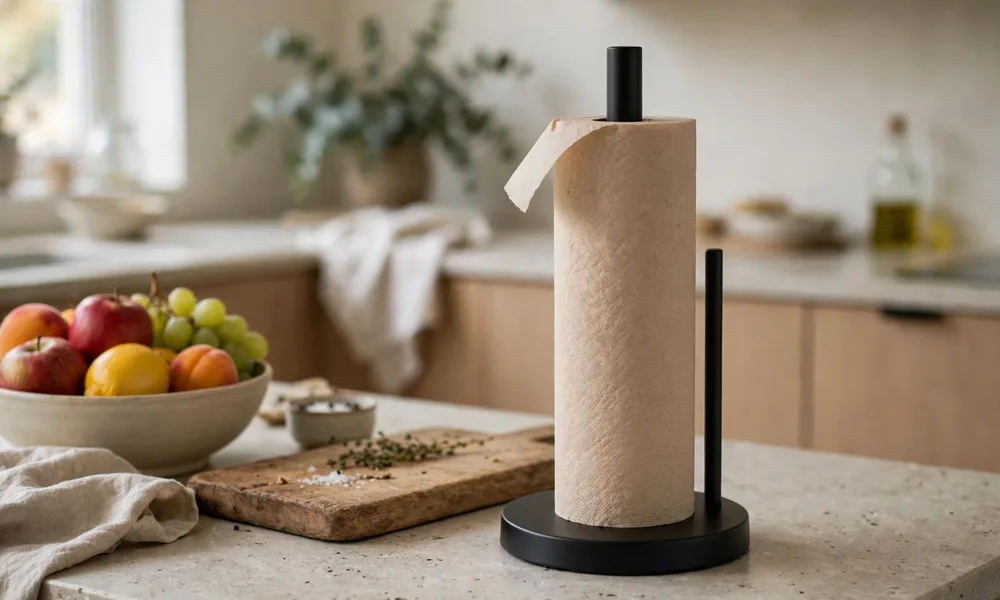
Freestanding holders are the most popular type, and the best have a heavy weighted base. The weight is the whole point: when you pull a sheet, the base stays put and the roll turns instead of the holder toppling over. Look for a base of a kilogram or more, a non-slip ring underneath, and a spindle tall enough for jumbo rolls. The best also have a tension arm or spring pressing gently against the roll, so it stops spinning the moment you stop pulling.
Wall-mounted holders
Wall-mounted holders fix to the wall beside the sink or cooker, keeping the roll off the counter entirely. They suit small kitchens, and keep the roll away from worktop splashes. The catch is the fixing: screws into a solid wall hold best, tiles and plasterboard need the right plugs, and adhesive mounts only suit light rolls in a dry spot. Measure first: it needs clearance above and below the roll, and a roll too close to a shelf will not turn.
Under-cabinet holders
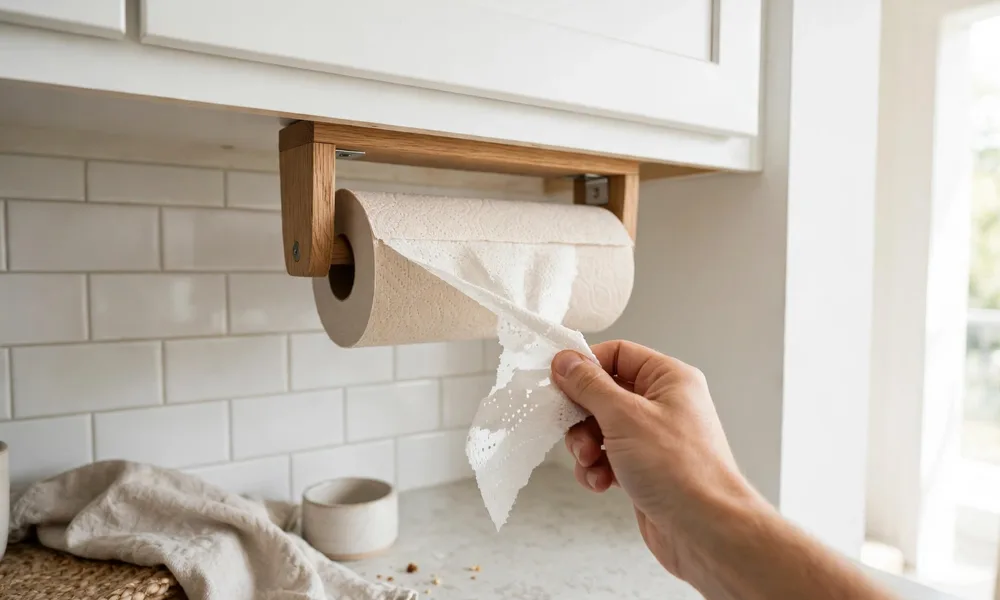
Under-cabinet holders mount beneath a wall cabinet, so the roll hangs horizontally just above the worktop, where your hands are when cooking. They are the neatest option for a tidy kitchen, and keep the roll out of the way of sink splashes. Installation is usually a few screws into the underside of the cabinet, but check the base is solid enough to hold them, and check the clearance: the roll needs room to turn without hitting the splashback. Some slide or fold away when not in use, which suits very small kitchens.
Tension and ratchet holders
Tension and ratchet holders are designed around one-handed tearing. A tension arm presses against the roll, or a ratchet lets the roll turn in one direction only, so a single pull tears a clean sheet while the roll stays put. These are the best choice if you often have one hand covered in food or soap, which is most of the time. The mechanism adds cost and a part that can wear out, so look for a simple, sturdy design, and check the tension adjusts for different roll thicknesses.
Wooden and decorative holders
Wooden holders suit kitchens where the holder is part of the look, not just a tool. A solid oak or walnut holder with a heavy base looks beautiful on a wooden worktop, and a painted one can match a country kitchen. The trade-off is care: bare wood stains if splashed often, and a wooden spindle can swell in a steamy kitchen. Sealed or oiled wood handles this well, but check the finish before you buy, and keep the holder away from the sink’s direct splash zone.
How to choose a paper towel holder
Start with the roll, not the holder. Kitchen rolls vary more than most people realise: standard rolls are about 11 centimetres wide and 11 across, while jumbo rolls can reach 15 centimetres across, and multi-ply rolls are fatter still. Measure the widest roll you buy, then check the spindle height and the clearance around it. A holder that fits a standard roll but not your usual jumbo will frustrate you every time you change the roll, so buy for the biggest roll you use, not the smallest.
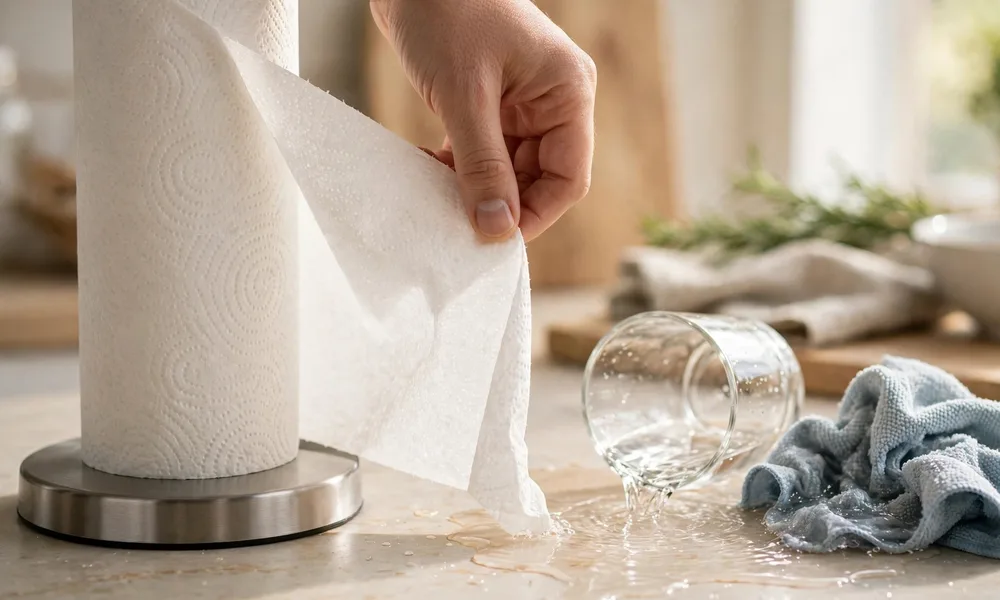
Next, test the tear. The best holders let you pull a sheet with one hand and tear it cleanly along the perforation, without the roll spinning on and unwinding a tail of paper. That takes weight, tension or a ratchet, and you can test it in a shop by pulling firmly with one hand: the holder should stay still and the sheet should come away clean. If the holder slides, tips or lets the roll spin freely, it will do the same at home. Also check the base: a non-slip ring or rubber foot matters on a smooth worktop, and a holder near the sink needs a finish that will not spot or rust.
Paper towel holders at a glance
| Type | Best for | Needs drilling | One-handed tear | Price range |
|---|---|---|---|---|
| Freestanding weighted | Most kitchens, renters | No | Good with tension arm | Budget to mid-range |
| Wall-mounted | Small kitchens | Yes | Good | Budget to mid-range |
| Under-cabinet | Tidy counters | Yes, into cabinet | Good | Mid-range |
| Tension or ratchet | One-handed use | Usually no | Excellent | Mid-range to high |
| Wooden or decorative | Matching the kitchen look | Usually no | Fair to good | Mid-range to high |
Materials and finishes that survive a kitchen
Stainless steel is the most practical material. It does not rust, it wipes clean, it suits most kitchens, and it stays looking good for years with nothing more than a damp cloth. Brushed finishes hide fingerprints better than polished ones, which matters for something you touch with wet hands. Matte black looks smart, but cheap coatings chip: check the finish is powder-coated. Chrome looks bright when new, but it spots with water and needs regular wiping.
Wood brings warmth, and a sealed hardwood holder can last for years, but bare wood is a poor choice beside a sink: it stains, swells in steam, and is hard to clean. If you choose wood, make sure it is sealed or oiled, and keep it out of the splash zone. Bamboo is a middle ground: light, strong and attractive, but it needs drying after splashes like any wood.
Placement, installation and everyday care
Where you put the holder matters as much as which one you buy. The roll should be within a step of the sink, because most sheets are torn off to dry hands or wipe a splash, and at a height where you can pull without stretching. Hang a wall-mounted holder at about shoulder height, with clear space below, and check an under-cabinet roll clears the splashback when it turns.
Installation is straightforward. Freestanding holders need nothing at all. Wall-mounted holders need screws into a solid wall or the right wall plugs for tile and plasterboard, and adhesive mounts should only be trusted for light rolls in a dry spot. Under-cabinet holders screw into the underside of the cabinet, so check the base is thick enough, and use the screws supplied rather than longer ones that could poke through the cabinet floor.
The holder is only half the purchase: the rolls matter too. The best paper towels for a holder tear cleanly along the perforation and leave no lint on glass, so match the roll to the holder as well as the holder to the kitchen.
Checklist: buying a paper towel holder in 2026
- Measure your widest roll, then check spindle height and clearance before you buy.
- Test the one-handed tear: the holder should stay still and the sheet should come away clean.
- Check the base weight and non-slip ring: a light holder tips at the worst moment.
- Decide the spot first: within reach of the sink and cooker, out of the splash zone.
- Match the fixing to your home: freestanding for renters, screws for solid walls, plugs for tile.
- Choose a finish that survives steam and splashes: stainless steel or sealed wood, not bare wood.
Frequently asked questions
What is the best type of paper towel holder for a small kitchen?
An under-cabinet or wall-mounted holder keeps the roll off the counter. If you cannot drill, choose a slim freestanding holder with a heavy base.
Why does my paper towel holder keep falling over?
The base is too light for the roll, or the roll is a jumbo the holder was not built for. A base of a kilogram or more with a non-slip ring solves most toppling, and a tension arm stops the roll spinning free.
Can I use a toilet paper holder for kitchen paper towel?
No. A toilet paper holder is built for a smaller, narrower bathroom roll, and a kitchen roll is too wide, heavy and fat for its spindle. Use a holder made for kitchen rolls, with a core of about 4 centimetres.
How do I get a clean one-handed tear?
Use a holder with a tension arm, ratchet or weighted base, and pull sharply at the perforation. Load the roll with the loose end over the top, not from underneath.
Do under-cabinet holders fit all cabinets?
Most fit standard wall cabinets, but check the underside holds screws and the roll clears the splashback when it turns. Very shallow and glass-fronted cabinets can be a problem.
How do I clean a stainless steel paper towel holder?
Wipe it weekly with a damp cloth and dry it straight away to avoid spots.
The bottom line
The best paper towel holder stays put, tears cleanly with one hand, and fits the rolls you actually buy. For most kitchens, that means a weighted freestanding holder with a non-slip base and a tension arm, in stainless steel, placed between the sink and the cooker. If your counter is crowded, an under-cabinet holder does the same job without taking up worktop. Measure your rolls, test the tear, and buy the holder that disappears into a working kitchen.


