
The best phone wallets in 2026 solve a small daily annoyance: the pocket full of plastic you carry everywhere. A phone wallet is a slim card holder that attaches to the back of your phone, so your payment card, ID and one spare travel with the one object you never leave behind. Done well, it replaces a bulky wallet for most of the day. Done badly, it peels off in a warm pocket, blocks wireless charging, or swallows the one card you need at the till. This guide shows how to choose one that stays put.
Key Takeaways
- MagSafe wallets suit iPhone owners best: they lift off in one second to charge and snap straight back.
- Adhesive stick-on wallets fit almost any phone, but they only hold on smooth, clean surfaces, and fail fastest on soft silicone cases.
- Two or three cards is the honest capacity of a phone wallet; anything that claims six will bulge, stretch, and drop cards.
- Keep your most-used card in the easiest slot, and never store a hotel key card next to a magnet.
- A phone wallet is not a wallet case: it adds cards to your phone, while a wallet case replaces the case entirely.
What a Phone Wallet Actually Is
A phone wallet is a card holder that lives on the back of your phone. It is not a case, and it is not a wallet you carry separately. The best phone wallets hold two or three cards in a pocket no thicker than a few millimetres, stuck or snapped to the phone you already carry.
The distinction matters, because shops use three different names for three different products. A phone wallet attaches to the back of a phone or its case and holds cards on the outside. A wallet case is a full phone case with card slots built into a folio cover; it replaces your case and usually your purse, and our guide to the best phone cases of 2026 covers the leather wallet case as one of its six case types. A card holder, by contrast, is a standalone slim wallet that lives in your pocket on its own and never touches your phone. Most people carry three cards: a payment card, ID, and one spare. Load it like a real wallet and it fails: the pocket stretches and the wallet peels away.
The Four Types of Phone Wallet in 2026
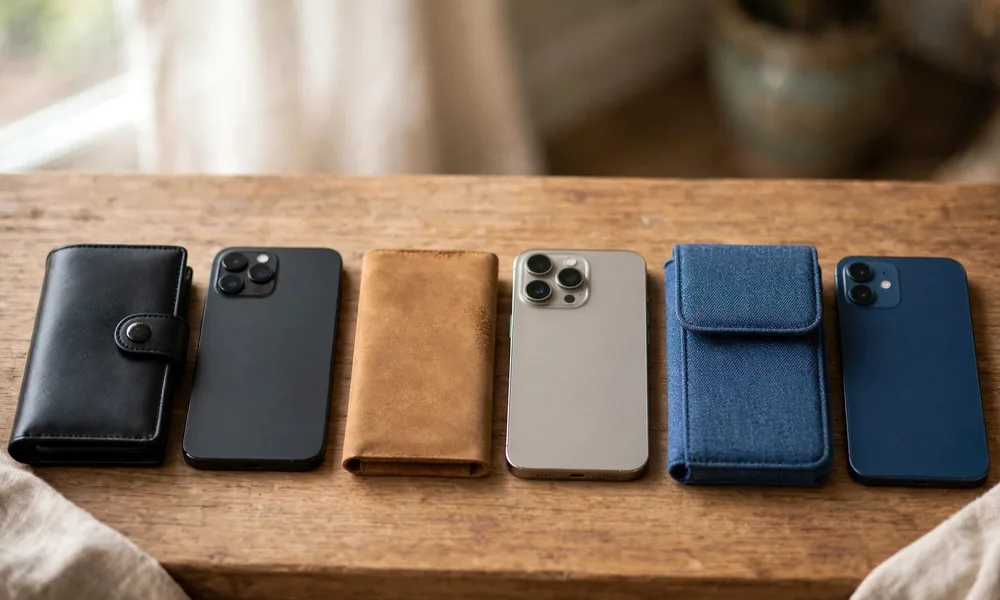
Almost every phone wallet sold in 2026 falls into one of four types, and the type decides how it attaches, how many cards it holds, and whether it plays nicely with charging. Buy the type first and the model second.
MagSafe Snap-On Wallets: Best for iPhone Users
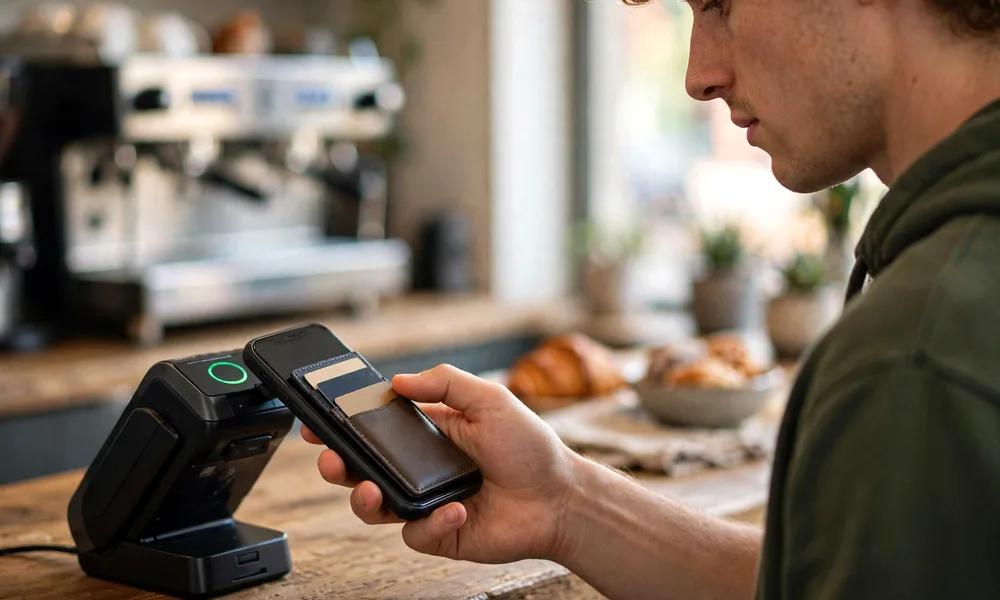
A MagSafe wallet snaps onto the ring of magnets built into the back of an iPhone, or onto a MagSafe-compatible case. It is the fastest type to use: pull it off to charge wirelessly, snap it back on when you leave, and it clicks into place with no alignment fuss. The hold is strong enough for a pocket or a bag, though a tight jeans pocket can drag it off, so the best designs add a small finger loop or a grip texture. Our roundup of the best MagSafe chargers explains the magnetic system these wallets are built on.
Adhesive Stick-On Wallets: Best for Every Other Phone
An adhesive wallet sticks to the back of the phone or its case with a strong 3M-style pad, and it fits almost any phone, Android or iPhone, with or without MagSafe. On a smooth, hard surface it holds for months; on a soft silicone case or a textured back it peels within days, because the adhesive cannot grip a surface that flexes. The fix is simple: stick it to a hard plastic case or the bare phone, clean the surface first, press firmly for thirty seconds, and leave it alone for a few hours so the bond can set.

Sleeve Wallets: Best for Protection
A sleeve wallet is a slim pocket that slides over the whole phone, holding the phone and the cards in one soft envelope. It protects the screen from keys and coins in the same pocket, which no stick-on wallet does, and it holds its shape better than a single pocket because the phone itself stiffens it. The trade is access: you slide the phone out to use it, and you slide a card out of the sleeve to pay, which takes a second longer at the till.
Wallet-Case Hybrids: Best for Leaving the Wallet at Home
A wallet-case hybrid is a phone wallet built into a minimal case: a hard shell with two or three card slots on the back, so the phone and the cards share one rigid body. It is the sturdiest option, because nothing is glued or magnetised on, and it is the only type that genuinely replaces a wallet for a night out. The compromise is bulk and commitment: you buy the hybrid for your exact phone model, and you cannot peel the wallet off when you want a slim phone again.
Best Phone Wallets 2026 at a Glance
| Wallet type | Best for | Cards | How it attaches | Wireless charging |
|---|---|---|---|---|
| MagSafe snap-on | iPhone users | 2–3 | Magnets | Lift off to charge |
| Adhesive stick-on | Any phone | 2–3 | Sticky pad | Usually blocks it |
| Sleeve | Screen protection | 2–4 | Slides over phone | Remove to charge |
| Wallet-case hybrid | Leaving the wallet behind | 2–3 | Built into case | Depends on case |
Our Picks: The Phone Wallets Worth Buying
Best overall: the MagSafe leather wallet. A full-grain leather MagSafe wallet is the pick most people should buy. It snaps on straight, holds two cards plus an ID in a tight pocket that loosens just enough over the first week, and the leather develops a patina instead of looking tired.
Best budget: the adhesive leather pocket. A simple adhesive leather pocket costs a fraction of a MagSafe wallet and works on any phone. The best ones use a genuine leather front with a strong adhesive back, hold two cards without stretching, and survive a year of daily use if they are stuck to a hard surface.
Best for grip: the stick-on wallet with a finger loop. Some stick-on wallets add a small elastic loop on the back, turning the wallet into a grip as well. A phone with cards on the back is heavier and top-heavy, and a loop stops it sliding out of your hand. Our guide to the best phone grips for one-handed use covers the same idea in depth, and a wallet with a built-in loop gives you most of that benefit without a second accessory.
How to Choose the Best Phone Wallet
Start by counting the cards you actually use. Most people need three at most, and buying a wallet rated for three when you carry two is the right margin: the pocket stays tight, the cards stay put, and you are not tempted to overfill it. A wallet rated for five or six cards is a warning sign, not a feature, because a pocket that deep stretches and drops cards.
Next, match the attachment to your phone. An iPhone with MagSafe should get a magnetic wallet, because it lifts off for charging and you lose nothing by choosing it. An Android phone, or any phone in a favourite non-magnetic case, should get an adhesive wallet stuck to a hard surface, or a sleeve if you want screen protection too. Then check the card access. The best phone wallets let you push the card up with a thumb from a cut-out at the bottom, so you never have to peel the wallet off at the till. A thick wallet can also stop a magnetic car mount from holding, so test that combination first.
Wireless Charging, Magnets and Card Safety
The most common worry about phone wallets is the magnet. A strong magnet can damage a hotel key card or a magnetic-stripe card stored right against it, and it can interfere with a transit card if the two sit together in the same pocket. The fix is boring and it works: keep magnetic-stripe cards and hotel keys in a separate pocket, and keep only chip-and-PIN and contactless cards in the wallet.
Wireless charging is the second question, and the answer depends on the type. A MagSafe wallet lifts off, so charging is unaffected. An adhesive wallet usually blocks it, because the wallet sits directly over the charging coil and adds several millimetres of leather and card between the phone and the pad. A sleeve wallet must come off entirely.
Common Mistakes to Avoid
The most common mistake is overfilling: a wallet that holds three cards comfortably will hold four cards badly, and the fourth card is the one that slides out in a pocket and vanishes. The second mistake is sticking an adhesive wallet to the wrong surface, since silicone, leather and textured cases all defeat adhesive, and a wallet that peels off in a warm pocket takes your cards with it. The third mistake is forgetting the phone’s weight: two cards and a leather wallet add forty to sixty grams to the back of the phone, and that changes how it balances in your hand.
Phone Wallet Buying Checklist
- Count the cards you carry every day, and buy a wallet rated for that number plus one spare slot at most.
- Match the attachment to your phone: MagSafe for iPhones, adhesive on a hard surface for everything else.
- Test card access before the return window closes: you should be able to push one card out with a thumb in two seconds.
- Check wireless charging with the wallet attached, and know whether you need to lift it off to charge.
- Keep hotel key cards and magnetic-stripe cards out of the wallet, and away from its magnets.
- Try the wallet in your tightest pocket and your car mount before you decide it stays.
Frequently Asked Questions
Do phone wallets damage credit cards?
Modern chip-and-PIN and contactless cards are safe in a phone wallet in normal use. Keep hotel key cards and old magnetic-stripe cards elsewhere, because a strong magnet can wipe them.
Can I use a phone wallet with wireless charging?
MagSafe wallets lift off in one second, so charging is unaffected. Adhesive and sleeve wallets usually block wireless charging and need to come off first, so check before you buy if you charge wirelessly every night.
How many cards should a phone wallet hold?
Two or three is the honest answer. A wallet that claims six cards will stretch, bulge and drop them.
Will a stick-on phone wallet stay on a silicone case?
Almost certainly not. Adhesive cannot grip a soft, flexible silicone surface, and the wallet will peel off within days. Stick it to a hard plastic case or the bare phone, or choose a magnetic wallet instead.
Is a phone wallet safe if I lose my phone?
Losing a phone with a wallet attached means losing the cards with it, so treat it like losing a wallet: freeze the cards at once through your banking app.
What is the difference between a phone wallet and a wallet case?
A phone wallet attaches to the back of your phone and holds cards on the outside, while a wallet case is a full case with card slots in a folio cover that replaces your case entirely.
Bottom Line
The best phone wallet is the one that matches your phone, your charging habit and the two or three cards you actually use. For most iPhone owners that is a leather MagSafe wallet that lifts off to charge. For everyone else it is a slim adhesive leather pocket on a hard case, or a sleeve if screen protection matters more than speed. Our verdict: the MagSafe leather wallet is the best phone wallet of 2026 for most people, with the adhesive leather pocket the best value pick for any phone.


