A pressure washer is the fastest way to make a dirty driveway, deck or car look new again — and the fastest way to ruin all three. The jet that strips a season of grime off concrete can carve stripes into softwood, peel paint off a car and blast mortar out of a brick wall. The difference between a satisfying afternoon and an expensive repair bill is rarely the machine you own. It is how you use it. This guide to pressure washers explains how to clean without damaging, surface by surface.
Most damage happens in the first ten seconds, when someone holds the lance too close, picks the narrowest nozzle because it looks the most powerful, and aims at one spot until the surface gives way. It is physics, not bad luck: a jet at 2,000 PSI hits far harder than most people imagine, and soft materials cannot take it. The good news is that nearly all of it is avoidable — a wider nozzle, a little more distance, a slower pass and a test spot on a hidden corner will protect almost anything you point the lance at.
Key Takeaways
- Damage almost always comes from the nozzle and the distance, not the machine — a wide fan nozzle held a foot away is gentle, a narrow jet held close is destructive.
- Start with the widest nozzle, test on a hidden corner, and narrow the spray only if dirt survives a slow, even pass.
- Wood, car paint and old mortar need the lowest pressure and most distance; concrete can take far more, but scars if you hold the jet in one spot.
- Let detergent and dwell time do the heavy lifting — a soapy surface needs far less pressure than a dry, dirty one.
- Keep the lance moving, hold it at a shallow angle, and overlap passes so no spot takes the full force of the jet.
Why a Pressure Washer Can Damage What It Cleans
A pressure washer does not wash the way a hose does. A hose rinses dirt away; a pressure washer cuts it away with force. At the tip of the lance, water leaves the nozzle at speeds that can exceed 200 miles per hour, and all of that energy lands on an area no bigger than a coin. On hard stone it lifts grime. On softwood it lifts the wood itself, tearing out the soft growth between the harder grain lines. On car paint it finds a stone chip and peels the clear coat back. On old brickwork it hollows out the mortar joints.
Distance is the single biggest factor in how much damage the jet can do, because pressure falls away fast as the spray spreads. Move the lance from two inches to twelve inches away from a deck board and the force on the wood drops dramatically. Damage is also often invisible until the surface dries: wet wood hides torn fibres and wet concrete hides the pale stripe where the top layer was blasted away. That is why the test spot matters — try your settings on a corner nobody sees, let it dry, and only then move on to the part everyone will see.
The Three Numbers That Decide Whether You Damage Anything
Three numbers decide whether you damage anything, and only one is printed in big type on the box. PSI is the pressure of the jet. GPM, or gallons per minute, is how much water the machine moves. The nozzle angle, marked by the colour of the nozzle tip, decides how that pressure is spread. High PSI through a narrow nozzle concentrates enormous force on a tiny spot; the same machine with a wide nozzle spreads the water over a fan several inches wide, and the force on any one point falls sharply.
For most homes, an electric machine of around 1,800 to 2,200 PSI with a flow of about 1.4 to 1.8 gallons per minute is the sweet spot — enough power to clean properly without the brute force of a large petrol machine. Gas machines past 3,000 PSI clean big driveways faster, but punish mistakes faster too, and on a deck or a car they are the wrong tool. Our best vs worst pressure washers for 2026 compares the types by job. Whatever you buy, nozzle and technique matter more than the headline PSI number.
Your Nozzle Is Your Real Pressure Control
Nozzles are colour coded, and learning the code takes two minutes and saves a hundred pounds of repairs. Red (0 degrees) fires a pencil-thin jet that can cut skin and etch concrete — for household cleaning it stays in the box. Yellow (15 degrees) is for stubborn grime on hard surfaces only. Green (25 degrees) is the everyday workhorse for driveways, patios and stone. White (40 degrees) is the gentle fan for cars, wood and painted surfaces. Black is the low-pressure soap nozzle. With an adjustable nozzle, twist to the widest fan before you start.
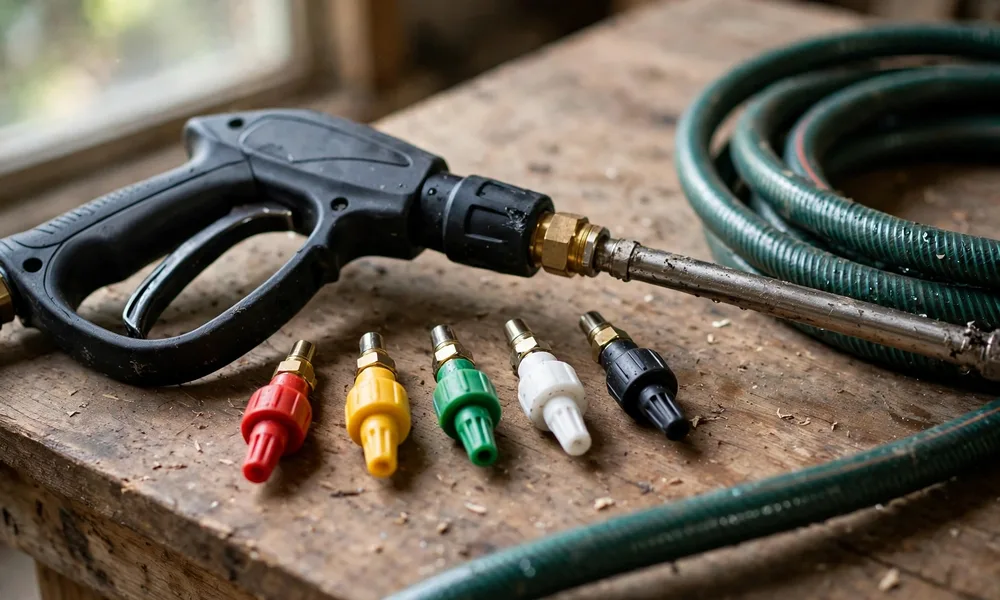
| Nozzle | Spray angle | Force on the surface | Best for | Keep away from |
|---|---|---|---|---|
| Red (0°) | Pencil jet | Extreme | Nothing at home — leave it in the box | Everything |
| Yellow (15°) | Narrow fan | High | Stubborn stains on concrete | Wood, paint, mortar, cars |
| Green (25°) | Medium fan | Moderate | Driveways, patios, stone paths | Softwood, car paint |
| White (40°) | Wide fan | Gentle | Cars, decks, fences, furniture | Nothing — the safe default |
| Black (soap) | Low pressure | Very gentle | Applying detergent | Not a cleaning nozzle |
One more number deserves a mention: the distance between the nozzle and the surface. Start at about 30 centimetres (a foot) for hard surfaces and 45 centimetres or more for anything soft, moving closer only in small steps while watching the surface. If you see wood fibres lifting, paint flexing or mortar dust in the spray, you are already too close — back off immediately. Your eyes are a better pressure gauge than any number on the box.
A Safe Pressure for Every Surface
Concrete and natural stone are the toughest customers in the garden. Sound concrete can take 2,000 to 3,000 PSI with a 25-degree nozzle, held 20 to 30 centimetres away, and a surface cleaner attachment makes the job faster and more even. Even concrete has limits: crumbling edges, patches and old, powdery slabs shed material under a strong jet, so test first and keep the lance moving.
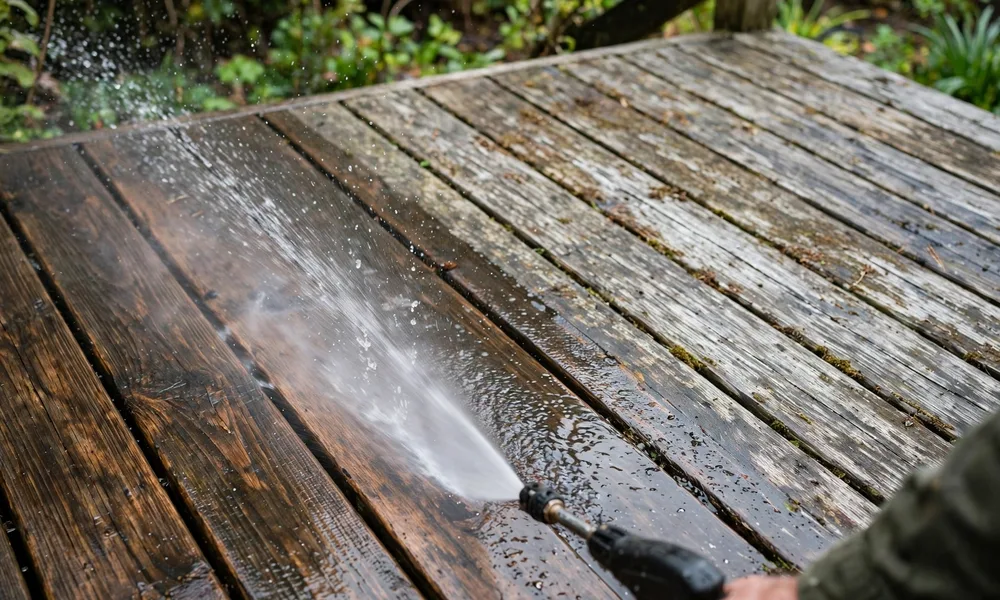
Wooden decking is where most damage happens, because a deck looks tough and behaves like a soft material. Softwood should never see more than about 1,200 to 1,500 PSI, and only with a 40-degree nozzle held at least 30 centimetres away, moving with the grain at a shallow angle. If the wood looks fuzzy or the grain stands proud, stop — the surface has been cut, and sanding is the only fix.
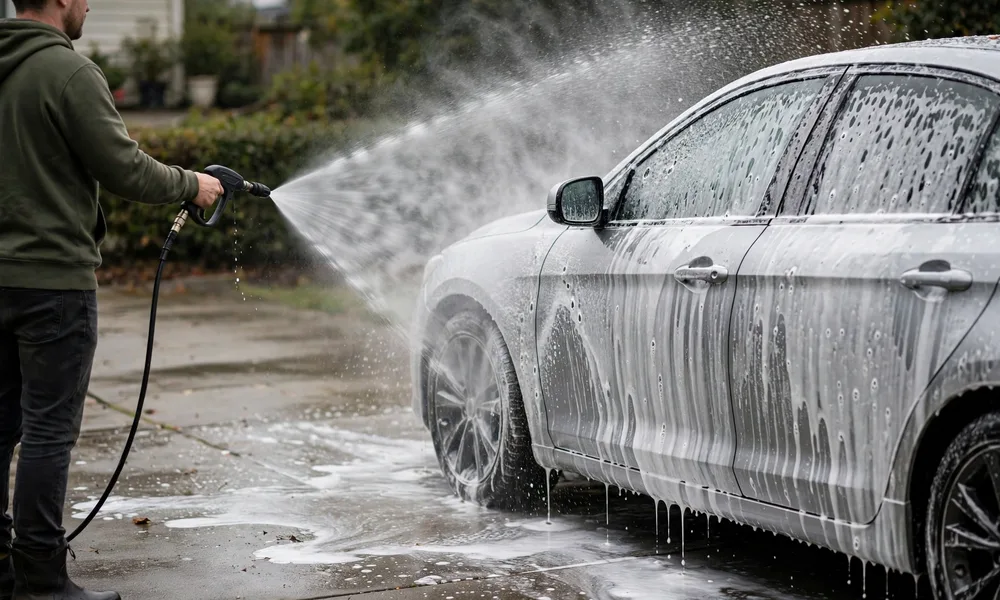
Car paint is the most unforgiving surface, because the damage is obvious and expensive. Wash a car only at low pressure, around 1,200 PSI or less, with a 40-degree nozzle held at least 45 centimetres away, and never aim at stone chips, peeling edges, seals, badges or number plates. Foam the car first and let the detergent loosen the dirt for five minutes; the rinse then needs almost no pressure.
Brick and mortar sit in the middle. Sound modern brickwork copes with a 25-degree nozzle at moderate pressure, but old lime mortar and soft handmade bricks do not — if the mortar is crumbly to the touch, keep the pressure low and the nozzle wide, or use a stiff brush instead. Patio furniture, fences and ornaments are usually safe with a wide nozzle and low pressure, though a narrow jet can score plastic and shred rattan. Your water supply matters too: a kinked or undersized hose starves the machine and makes the spray pulse, which is when people move closer and cause damage. Our guide to the best vs worst garden hoses for 2026 covers hoses that keep the flow steady, and patio furniture that turns your garden into a second living room is worth a read before you replace pieces a gentle wash would have saved.
The Step-by-Step Wash That Protects Your Surfaces
Clear the area, sweep off loose dirt and grit, and move anything fragile away. Turn the tap on fully and squeeze the trigger with the machine off until water runs steadily from the lance, purging air that makes the spray pulse. Fit the widest nozzle, stand at your starting distance, and test on a hidden corner — if the patch looks clean and undamaged once dry, you have your settings. Apply detergent from the bottom up and let it dwell for five to ten minutes without drying. Then rinse from the top down in slow, overlapping passes at a steady distance and a shallow angle of about 45 degrees, overlapping each pass by a third. Never let the jet rest on one spot. Finish with a wide-fan rinse, let the surface dry, and inspect before you pack up.
Detergent: Let Chemistry Do the Work
The most underused trick in pressure washing is detergent, because most people reach for pressure first and chemistry second. A purpose-made cleaner loosens the bond between dirt and surface, so the rinse needs far less force — and the less pressure you need, the less damage you can do. Use a detergent made for the surface, never mix products, and keep the surface damp while it works.
The Six Mistakes That Cause Most Damage
- Starting with the narrowest nozzle. Begin with the white 40-degree fan and narrow down only if the dirt survives a slow pass.
- Holding the lance too close. Two inches of distance can be the difference between clean and carved — start a foot away and move in gradually.
- Letting the jet rest on one spot. Keep the lance moving at all times; a stationary jet digs a hole.
- Washing a dry, dirty surface. Wet the surface and apply detergent first, so dirt releases instead of being blasted off with the top layer of the material.
- Skipping the test patch. A hidden corner takes two minutes to test and can save a whole driveway, deck or paint job.
- Using maximum pressure on every surface. Concrete settings will destroy wood and paint — reset your nozzle and distance for each new surface.
Frequently Asked Questions
Can a pressure washer damage concrete?
Yes, if the jet is held too close or in one spot. Sound concrete handles moderate pressure well, but a narrow nozzle at close range can etch pale stripes and break up crumbling edges. Use a 25-degree nozzle and keep the lance moving.
What PSI is safe for a wooden deck?
For softwood, stay around 1,200 to 1,500 PSI with a wide 40-degree nozzle held at least 30 centimetres away, working with the grain. If the wood looks fuzzy or the grain lifts, you are too close.
Is it safe to pressure wash a car?
Yes, at low pressure: under 1,200 PSI, a 40-degree nozzle, at least 45 centimetres of distance, and foam applied first so the rinse needs little force. Never aim at stone chips, seals or peeling paint.
Should I use the red 0-degree nozzle?
For household cleaning, no. The red nozzle concentrates the full force of the machine into a pencil jet that can cut skin, etch concrete and strip paint — more damage than dirt removed.
How far should I stand from the surface?
Start at about 30 centimetres for hard surfaces and 45 centimetres or more for wood, paint and anything delicate, moving closer only in small steps. Distance is your most effective pressure control, and it costs nothing.
Does detergent really make a difference?
A big one. Detergent loosens dirt so the rinse needs far less pressure — the easiest way to clean without damaging. Apply at low pressure, let it dwell for five to ten minutes, and rinse with a wide fan.
The Bottom Line
A pressure washer is a tool of precision, not of brute force. The best results come not from the biggest machine, but from starting wide, standing back, testing first and letting detergent do the hard work. Treat every surface as its own job, keep the lance moving, and you will get the clean driveway, deck and car you wanted — with the surfaces still in one piece.