Solar Fountains That Run on Sunshine Alone in 2026
Solar fountains are the simplest water features a garden can own: a small panel catches the sun, a pump lifts the water, and the fountain runs with no cable, no socket and no running cost. On a bright day the water dances from the moment the sun hits the panel, and a battery model keeps going into the evening. The best solar fountains in 2026 are proper little pumps with real lift and panels that work in ordinary summers. This guide explains how they work, which types suit which garden, and how to pick one that actually runs when you want it to.
A solar fountain is different from the mains fountains most gardens know. A mains fountain is a decorative water feature with a plug, and our guide to the best garden fountains covers those in full. A solar fountain is the self-powered version: the panel is the power supply, and the whole thing is designed to be picked up and moved. It is also different from a pond pump, which circulates pond water through a filter to keep it clear; a solar fountain moves water for beauty and sound, not filtration, and the best pond pumps guide covers that separate job.
Key Takeaways
- A solar fountain needs direct sun on its panel for most of the day; shade is the single biggest reason one goes quiet.
- Battery models keep running into the evening, while direct-drive models stop the moment the sun goes in.
- Floating disc fountains suit bird baths and small bowls; freestanding basin fountains suit patios and seating areas.
- Check the pump lift height and panel wattage before you buy: both decide how high the water sprays.
- Keep the panel clean and the water topped up: a dusty panel and a dry pump are the two most common failures.
What a Solar Fountain Actually Is
A solar fountain has three parts: a photovoltaic panel, a small submersible pump, and a basin that holds the water. Sunlight hits the panel, the panel makes low-voltage electricity, and the pump lifts water through a nozzle and sprays it back into the basin. The water circulates in a loop, so the fountain only needs topping up for evaporation and splash. There is no mains connection and no electrician to call, which is why solar fountains suit rented gardens, balconies and corners far from the house.
The panel decides everything. A bigger panel in watts means a stronger spray and a pump that keeps going in weaker light. One or two watts runs a floating disc in full sun and not much else; five watts or more runs a basin fountain and can charge a battery at the same time. The panel can be built in or separate on a cable, and separate is usually better: the fountain sits where you sit, and the panel sits in the sun.

The Main Types of Solar Fountain
Floating Disc Fountains
A floating disc is a round solar panel with a pump underneath that floats in a bird bath, a bowl or a small pond. Drop it in the water, wait for sun, and it sprays. It costs little, needs no assembly, and birds love it, because moving water is easy to drink from and hard for mosquitoes to breed in. It only works in full sun, stops at dusk, and suits a bird bath rather than a seating area. Buy one with several nozzle heads: a tall thin spray blows away in wind, while a low bubbling head keeps the water in the bowl.
Freestanding Basin Fountains
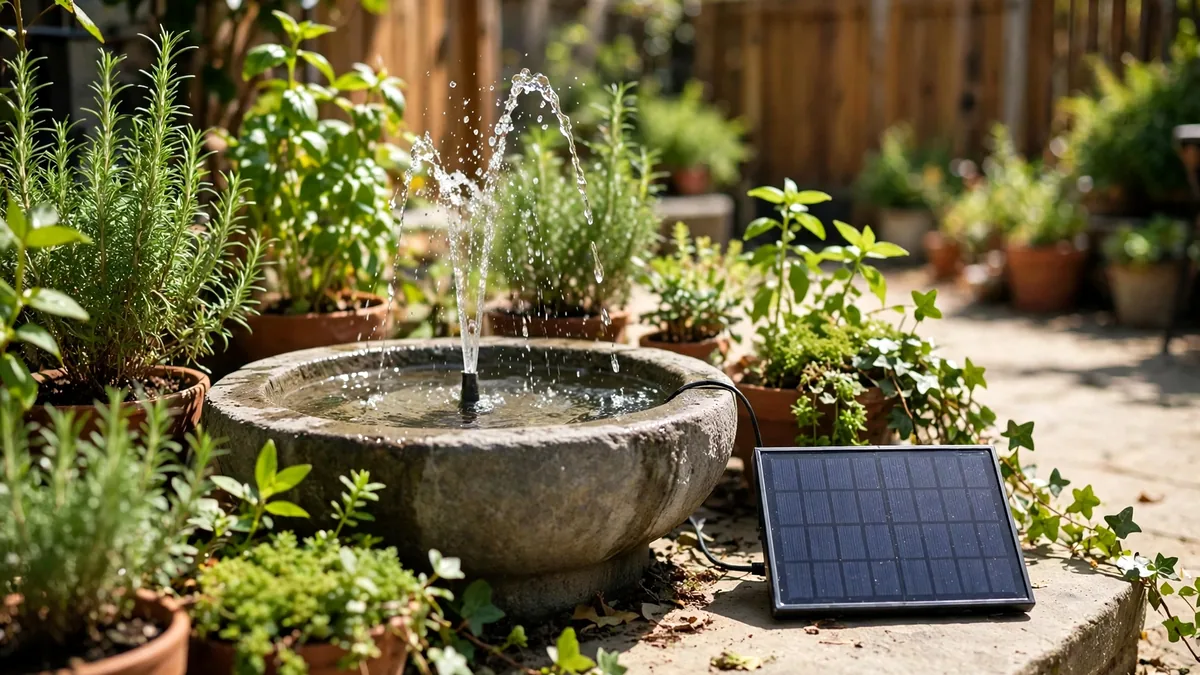
A freestanding basin fountain is a low, wide bowl or small pedestal with a pump inside and a panel on a cable. It is the best all-round solar fountain for most gardens: it holds enough water to run for hours, the spray is strong enough to hear from a chair, and the separate panel means the fountain can sit where you sit. Look for a basin at least thirty centimetres across and a pump with a dry-run guard, which stops it burning out when the water runs low. The best outdoor fountains guide includes a solar basin pick among its mains types, and the same logic applies: a basin fountain earns its place by being heard from a seat.
Tiered Solar Fountains
A tiered solar fountain stacks two or three bowls above each other, with water spilling from the top bowl down through the rest. It looks grand and sounds full, and suits a lawn or the centre of a courtyard. The catch is power: lifting water to the top tier takes a stronger pump and a bigger panel, so cheap tiered solar fountains often dribble instead of cascading. Buy one with a panel of at least five watts and a battery, and set it on a level base, because a leaning tier splashes on one side and runs dry on the other.
Wall and Rock Solar Fountains
Wall fountains hang flat against a fence or wall, and rock fountains hide the pump inside a moulded stone shape. Both suit small gardens where a freestanding fountain would take too much floor. Their basins are shallow, so they empty faster and need topping up more often, but they are the quietest solar fountains, which suits a reading corner.
Panel, Pump and Battery: How the Power Works
Three numbers decide how a solar fountain behaves: panel wattage, pump lift height, and battery capacity. One to two watts runs a floating disc. Three to five watts runs a basin fountain with a decent spray. Five watts or more, with a battery, runs a tiered fountain. Do not trust a wattage printed without a panel size to match it: a panel the size of a playing card cannot make five watts, however the box describes it.
Pump lift height is the highest the pump can push water, and it decides the spray. Thirty centimetres gives a gentle bubble, sixty gives a visible spray, and ninety or more gives a proper little jet. The lift is measured with no nozzle fitted, so the real spray is always a little lower, and wind knocks it down further. If you want height, pick the pump with the biggest lift in your budget.
The battery is what separates a daytime toy from a garden feature. A direct-drive fountain stops when a cloud passes and goes silent at dusk. A battery model stores the day’s sun and keeps the water moving for two to four hours into the evening, when most people actually sit in the garden, and it smooths out passing clouds so the spray does not stutter. Look for a battery of at least 1500 milliamp-hours and a panel that charges it while the pump runs.

Solar Fountains Compared
| Type | Best For | Key Strength | Watch Out For |
|---|---|---|---|
| Floating disc | Bird baths, small bowls | Cheapest, no assembly | Stops in shade and at night |
| Freestanding basin | Patios, seating areas | Good sound, separate panel | Needs regular topping up |
| Tiered solar | Lawns, courtyards | Grand look, full sound | Needs a big panel and battery |
| Wall or rock | Small gardens, balconies | Takes no floor space | Shallow basin empties fast |
Where to Put a Solar Fountain
Put the panel first and the fountain second. The panel needs direct sun for most of the day, ideally from late morning to late afternoon, and a panel in dappled shade under a tree will never run a pump properly. A separate-panel fountain gives you freedom: the panel goes in the sunniest corner and the fountain goes where you sit, joined by a cable of two or three metres. A built-in panel fountain has no such freedom, so it must sit in the sun itself, which often means it sits where nobody sits.
Wind matters as much as sun. A tall spray in a windy corner blows sideways, empties the basin onto the paving, and leaves the pump dry. Site the fountain out of the fiercest wind, behind a wall, a hedge or a fence, and choose a low bubbling nozzle on exposed days. Keep it away from trees that drop leaves into the water, and where you can reach it easily to top it up. A rain barrel nearby gives soft water that leaves less limescale.
Keeping a Solar Fountain Running
Top the water up every few days in summer, because evaporation and splash empty a shallow basin fast, and a pump that runs dry burns out in minutes. Once a week, lift out leaves and wipe the basin to stop algae. Every month or so, clean the pump: lift it out, rinse the intake sponge, and spin the impeller to check it moves freely. A clogged pump is the most common reason a solar fountain goes quiet, and the second most common is a dirty panel.
Keep the panel clean, because a dusty panel is the most common reason a solar fountain slows down. Wipe it with a damp cloth every week or two. Check the cable where it meets the panel and the pump, because a cable chewed by a mower or a dog is a dead fountain. Before the first hard frost, drain the fountain, bring the pump and panel indoors, and store the battery charged, because frozen water cracks stone and resin alike and a flat battery left in the cold may never hold a charge again.

Your Solar Fountain Checklist
- Check the spot gets direct sun for most of the day before you buy anything.
- Pick a panel of at least five watts for a basin or tiered fountain, with a battery for evenings.
- Match the pump lift height to the spray you want, and buy a spare nozzle set.
- Choose a basin deep and wide enough that wind will not splash it empty in an hour.
- Site it out of strong wind and falling leaves, where you can reach it to top it up.
- Plan winter storage before the first frost: drain it, dry the pump, store the battery charged.
Frequently Asked Questions
Do solar fountains work on cloudy days?
Weakly. A direct-drive fountain slows to a trickle or stops when a cloud passes. A battery model keeps running from its stored charge, though it will not recharge much on a cloudy day.
Do solar fountains run at night?
Only battery models do, for two to four hours. The battery charges during the day and powers the pump after dark. A direct-drive fountain stops the moment the sun goes down.
How long does a solar fountain pump last?
Usually two to three seasons, if it is kept wet, clean and frost-free. The impeller wears and the intake sponge clogs first. Running dry is the fastest way to kill a pump.
Can I leave a solar fountain out all winter?
Better not to. Frozen water cracks stone, resin and ceramic basins, and a battery left flat in the cold may never recover. Drain it before the first hard frost and bring the pump and panel indoors.
Will a solar fountain attract mosquitoes?
No, if the water keeps moving. Mosquitoes breed in still water, and a running fountain disturbs the surface too much for them. A fountain left off for days can become a breeding spot, so keep it running or drain it.
What water should I use in a solar fountain?
Rainwater is best, because it leaves less limescale than tap water. If you use tap water, let it stand for a day first so the chlorine fades, and never use bleach or detergents, which harm the birds that drink from it.
The Bottom Line
A solar fountain earns its place by bringing moving water to the sunny corners where a mains fountain cannot reach. Choose the panel to match the sun, pick a battery if you sit out in the evening, buy a basin big enough to hold its water, and keep the panel clean and the pump wet. Do that, and the sun does the rest, for free.