
Why Sponge Mops Are Still the Fastest Way to Clean Up a Spill in 2026
Sponge mops have been quietly doing the same job for decades, and they are still the fastest way to clean up a spill on a hard floor. A sponge mop picks up a knocked-over glass of juice, a muddy paw print or a splash of sauce in a single pass, then wrings itself nearly dry with a lever, so the floor dries in minutes. No other mop head absorbs as much liquid as quickly. This guide explains how sponge mops work, which types suit which floors, and how to choose one that lasts instead of falling apart in a month.
Key Takeaways
- A sponge mop absorbs spills far faster than a flat or string mop, because the sponge head soaks up liquid instead of pushing it around the floor.
- Cellulose sponges suit most homes: absorbent, cheap to replace, and ready the moment you wet them.
- The wringer matters more than the handle. A roller wringer squeezes evenly and lasts longer; a butterfly wringer folds the sponge and suits lighter jobs.
- Sponge mops suit smooth sealed floors best: tile, vinyl, laminate and sealed wood. They snag on rough, unsealed or heavily textured floors.
- Replace the sponge head every two to three months with regular use, and never leave a damp sponge sitting in a dark cupboard, or it will smell.
What a Sponge Mop Is, and How It Works
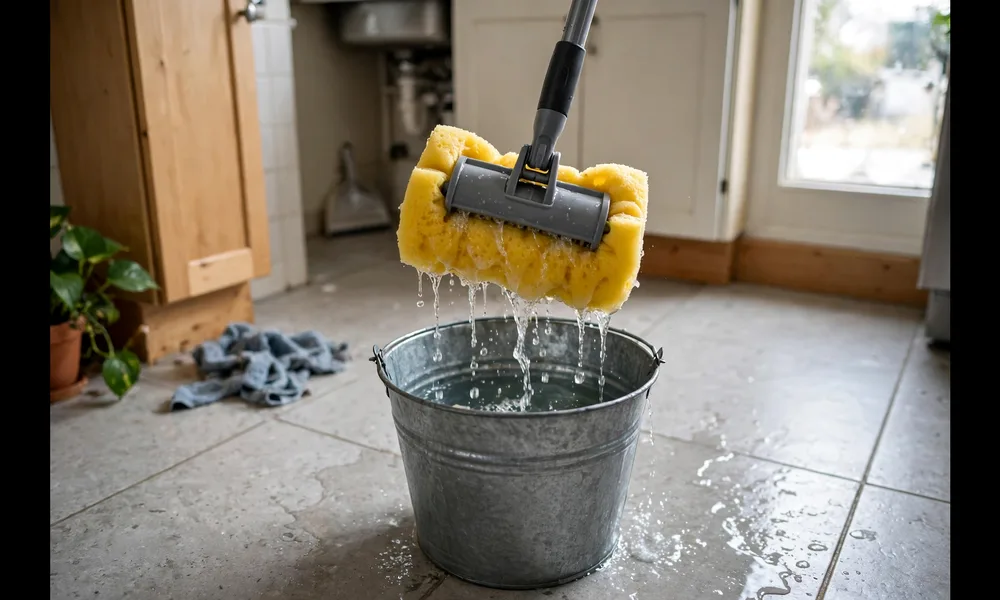
A sponge mop has a rectangular sponge head on a long handle, with a lever or roller mechanism that squeezes the sponge dry. You dip the head in clean water or a cleaning solution, wring it with the lever, and mop the floor in long passes. When the sponge fills with dirty water, you rinse it, wring it again, and carry on. The floor is left damp rather than wet, so it dries quickly without streaks.
The sponge is the whole point. Unlike a microfibre pad, which lifts dirt by trapping it in fibres, a sponge absorbs liquid into its pores. That makes it unbeatable for spills: a single press of a sponge head can lift a whole glass of spilled milk, while a flat mop would spread the same spill across the floor in a thin film. The trade-off is that a sponge also holds dirty water, so it needs rinsing more often than a pad, and a sponge that is never rinsed properly starts to smell. Rinse it in clean water, wring it hard, and store it head-up in the air.
Sponge mops are a distinct tool from the other mop types in the same cupboard. A spin mop pairs a round microfibre head with a bucket that spins it dry, and our guide to the best spin mops of 2026 covers those in full: they suit large tiled areas where the bucket does the wringing for you. A flat mop uses a washable pad that clips onto a rectangular head, and our guide to the best flat mops for hard floors explains where pads beat sponges. A sponge mop sits between the two: faster on spills than either, and simpler than a spin system.
The Main Types of Sponge Mop
Sponge mops differ in two ways that matter: how the wringer works, and what the sponge is made of. Get those two choices right and the rest is detail.
Roller Wringers
A roller wringer passes the sponge between two rollers when you pull the lever, squeezing water out evenly across the whole head. It is the most thorough wringer, it leaves the sponge damp rather than dripping, and it has fewer parts to break than a folding design. Roller mops are the best choice for large floors and for anyone who mops often, because the even squeeze means fewer passes and a faster-drying floor. The rollers can clog with grit if you mop a very dirty floor without sweeping first, so sweep or vacuum before you mop, always.
Butterfly Wringers
A butterfly wringer folds the sponge in half when you pull the lever, squeezing the two halves together. It is lighter and cheaper than a roller design, and the folding action wrings the centre of the sponge well. The edges get less pressure, so a butterfly mop can leave the corners of the sponge wetter than the middle. Butterfly mops suit small kitchens, bathrooms and quick spill cleanups, where the mop is used for a few minutes at a time.
Cellulose vs PVA Sponges
Cellulose sponges are made from wood pulp, absorb well, stay soft when dry, and are the standard head on most sponge mops. They are cheap, they rinse clean, and they last two to three months of regular use before they start to tear or lose their spring. PVA sponges are synthetic, hold even more water than cellulose, and feel almost chamois-like when damp. Their drawback is that they dry rock-hard between uses and must be soaked before they will absorb anything. For most homes, cellulose is the better buy: it is ready the moment you wet it, and a replacement head costs very little.
Sponge Mops Compared
The table below sets out the main sponge mop types at a glance, so you can match the design to your floors and your habits.
| Type | Wringer | Best for | Watch out for |
|---|---|---|---|
| Roller cellulose mop | Roller squeeze | Large floors, frequent mopping | Rollers clog with grit |
| Butterfly cellulose mop | Folding squeeze | Small kitchens, quick spills | Edges stay wetter |
| PVA sponge mop | Roller or butterfly | Maximum absorption, big spills | Dries rock-hard, needs soaking |
| Scrubber sponge mop | Roller squeeze | Stuck-on grime, tile grout | Scrub pad wears faster |
The Best Sponge Mops of 2026
The picks below are types, not brand promises. Match the specification to your floors and any well-made mop that meets it will serve you well. Shop by wringer, sponge material and head size rather than by logo.
Best Overall: A Roller Wringer with a Cellulose Head
The safest buy for most homes is a roller-wringer mop with a replaceable cellulose sponge head, roughly 25 to 30 centimetres wide. The roller squeezes the sponge evenly so the floor dries fast, the cellulose head absorbs spills in one press, and a spare head in the cupboard means the mop is always ready. Look for a handle long enough to work without stooping, a lever that moves smoothly without sticking, and a head that detaches without tools, because a head that is hard to change is a head that never gets changed.
Best for Small Spaces: A Compact Butterfly Mop
For a small kitchen, a bathroom or a flat, a compact butterfly mop is the better buy. It is lighter, it stores in a narrow gap beside the washing machine, and the folding wringer is more than enough for a few square metres at a time. Choose one with a head around 20 centimetres wide so it fits between the toilet and the bath, and check that the sponge is a standard replaceable size. The compromise is wringing power: the edges of a butterfly sponge stay wetter than the middle, so give the floor a second pass with the wrung head on floors where streaks show.
Best for Stubborn Grime: A Scrubber Sponge Mop
Some sponge mops add a scrubber strip along the front edge of the head, a strip of coarse material that lifts stuck-on food and dried mud without scratching the floor. This is the mop for a kitchen where things get dropped and dried on, and for tiled floors where grout lines collect grime. The scrubber wears faster than the sponge itself, so check whether it is part of the replaceable head or fixed to the mop.
How to Use a Sponge Mop Properly
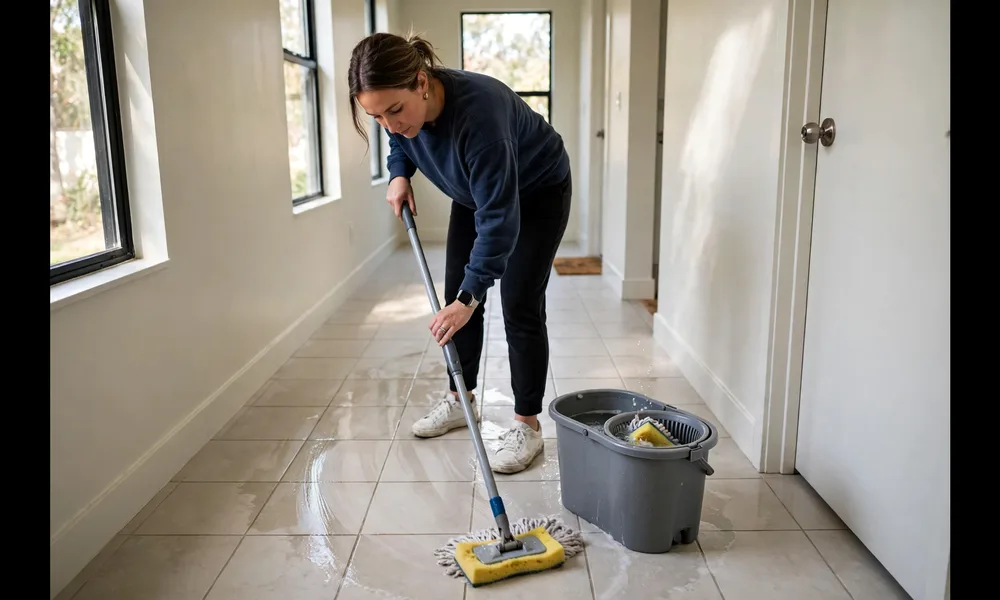
Start by sweeping or vacuuming. A sponge mop cannot pick up crumbs, pet hair or grit, and dragging grit across a floor under a sponge will scratch it. Once the loose dirt is gone, fill a bucket with warm water and a capful of floor cleaner, or plain warm water for sealed wood and laminate. Dip the sponge, wring it until it is damp rather than dripping, and mop in long overlapping passes, working away from the door so you do not walk across the wet floor.
When the floor is done, rinse the sponge in clean water, wring it as dry as the lever allows, and store the mop head-up in a ventilated spot, never flat on the floor in a dark cupboard. A damp sponge stored in the dark grows mildew and starts to smell within days, and no amount of rinsing will fix a sponge that has gone sour. If your mop came with a bucket, our guide to the best mop buckets of 2026 covers wringer buckets that pair well with sponge mops.
Which Floors Suit a Sponge Mop
Sponge mops are at their best on smooth sealed floors: glazed tile, vinyl, laminate and sealed wood. The flat sponge head stays in contact with the surface through every stroke, and the even wring leaves the floor damp rather than wet, so it dries in minutes. On unsealed wood, never use a soaking sponge: the water will soak into the grain and raise it. On rough stone, quarry tile or heavily textured floors, the sponge snags and tears, and a string mop suits those surfaces better, because its strands reach into the texture instead of catching on it.
Checklist: Before You Buy a Sponge Mop
- Choose a roller wringer for large floors and frequent mopping, and a butterfly wringer for small spaces and quick spills.
- Pick a cellulose sponge for everyday use; choose PVA only if maximum absorption matters more than convenience.
- Check the sponge head is replaceable and that spare heads are easy to find in a standard size.
- Make sure the handle is long enough to mop without stooping, and the lever moves smoothly without sticking.
- Match the mop to your floors: smooth sealed tile, vinyl, laminate and sealed wood, never unsealed wood or rough stone.
- Plan to replace the sponge head every two to three months, and store the mop head-up in the air, never damp in a dark cupboard.
Frequently Asked Questions
How often should I replace a sponge mop head?
Every two to three months with regular use, or sooner if the sponge tears, loses its spring, or starts to smell after rinsing.
Are sponge mops good for wood floors?
Yes, on sealed wood, if the sponge is wrung until barely damp. Never use a wet sponge on unsealed wood, because the water soaks into the grain and raises it.
Why does my sponge mop smell?
A damp sponge stored in a dark cupboard grows mildew within days. Rinse it in clean water, wring it as dry as the lever allows, and store it head-up in a ventilated spot. If the smell survives a thorough rinse, replace the head.
Is a roller wringer better than a butterfly wringer?
For large floors and frequent mopping, yes: the roller squeezes the whole sponge evenly, so the floor dries faster. For small spaces and quick spills, a butterfly wringer is lighter, cheaper and entirely adequate.
Can a sponge mop replace a spin mop?
For spills and small areas, yes, and it is faster. For large tiled areas, a spin mop has the edge, because the bucket wrings the head without hand contact and the microfibre head covers more ground per pass.
Do sponge mops leave streaks?
They can, if the sponge is too wet or dirty. Wring until the sponge is damp rather than dripping, rinse often, and change grey water.
The Bottom Line
A sponge mop is the simplest tool in the cleaning cupboard and still the fastest for the job it was made for: lifting a spill off a hard floor in a single pass. Buy a roller-wringer model with a replaceable cellulose head, keep a spare head in the cupboard, sweep before you mop, and store it head-up in the air.


