
How to Use Infrared Thermometers for Accurate Surface Readings in 2026
An infrared thermometer reads the temperature of a surface without ever touching it. Point it at a pizza stone, a grill grate or a pan of oil, pull the trigger, and a number appears in under a second. That speed makes infrared thermometers the most useful temperature tool in many kitchens, and also the most misunderstood. Used well, one tells you in a second what a probe thermometer takes minutes to confirm. Used badly, it gives you a confident number that is wrong by twenty degrees. This guide explains how infrared thermometers work, what they can and cannot measure, and how to take readings you can trust.
Key Takeaways
- An infrared thermometer measures surface temperature only. It cannot tell you the temperature inside food, so it never replaces a probe thermometer for checking whether meat is cooked through.
- Distance matters: every infrared thermometer has a distance-to-spot ratio, and standing too far away makes it average a wider area than the spot you are aiming at.
- Shiny metal reads low because it reflects heat instead of emitting it. A dab of oil or a strip of tape gives a far truer reading on bare steel and aluminium.
- Most household surfaces sit near an emissivity of 0.95, but polished metal can sit as low as 0.1, which is why the same thermometer can be right on a pan and wrong on a shiny tray.
- For kitchen use, a range up to about 400 degrees Celsius covers pizza stones, oil, grills and pans. Wider ranges matter mainly for workshop jobs.
How an Infrared Thermometer Actually Works
Every object gives off infrared radiation, and the hotter the object, the more radiation it gives off. An infrared thermometer collects that radiation through a lens, focuses it onto a sensor, and converts the signal into a temperature. Nothing touches the surface and nothing is inserted, so the reading appears almost instantly. That explains both the strengths and the limits of the tool. Because it reads radiated heat, it measures the surface it can see, and only that surface. Point it at a steak and you learn the temperature of the crust, not the centre. Point it at a pan of oil and you learn the temperature of the oil surface, which is usually what you need to know before food goes in.
The sensor sees a cone, not a dot. The laser pointer is only an aiming aid; the real measurement area is a circle that grows wider the further away you stand. This is the distance-to-spot ratio, usually printed on the device as something like 12:1. A 12:1 ratio means that at 12 inches away, the thermometer averages a circle one inch across, and at 24 inches it averages a circle two inches across. Stand too far back from a small target and the reading blends the target with whatever surrounds it.
Emissivity, in Plain Terms
Emissivity is a number between 0 and 1 that describes how well a surface gives off infrared radiation. Dark, matt surfaces such as cast iron, brick, painted wood and most foods sit near 0.95, which is why most infrared thermometers default to that value. Polished metal is the problem case: a shiny stainless steel pan can have an emissivity near 0.1, so it emits very little of its own heat and mostly reflects the heat of its surroundings. Point an infrared thermometer at a shiny pan and it may report a temperature far below the real one.
The fix is simple. Put a small patch of matt black tape on the surface, or a thin smear of cooking oil, and aim at that. Both raise the emissivity close to 0.95 and give a reading you can trust. Adjustable-emissivity models let you dial the setting down for bare metal, but for most home use the tape or oil trick is faster. If your thermometer has a fixed emissivity of 0.95, treat shiny metal readings as rough estimates and never as exact numbers.
Distance-to-Spot Ratio, and Why Closer Is Better
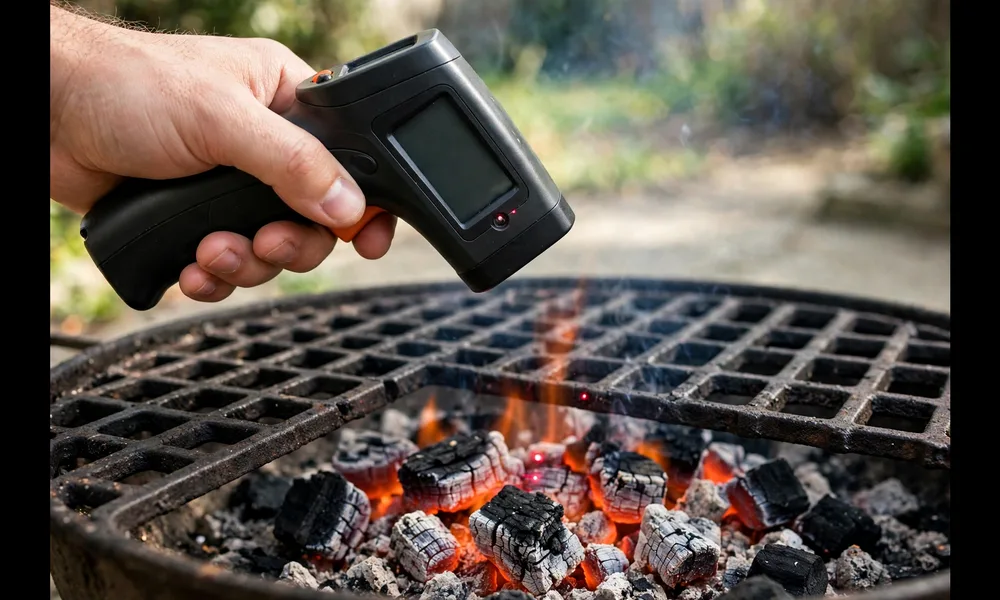
A higher ratio is better for reaching distant targets, but closer is almost always more accurate. A 12:1 thermometer held six inches from a pan reads a half-inch circle, precise enough for any cooking job. The same thermometer held three feet away reads a three-inch circle, which may include the burner, the pan edge and the worktop. For grill grates, pizza stones and oven walls, step in close, aim at the centre of the surface, and take two or three readings. If the numbers agree within a few degrees, you can trust them.
What You Can (and Cannot) Measure
Infrared thermometers shine wherever the surface is the question. Checking whether a pizza stone has reached temperature, whether oil is hot enough for frying, whether a grill grate is ready for steaks, or whether a radiator is heating evenly: all of these are surface questions, and an infrared thermometer answers them in a second. Home mechanics use them to find a dragging brake, a hot bearing or a cylinder that is not firing.
What they cannot do is measure inside anything. They cannot tell you whether a roast is done, whether a chicken is safe, or whether a loaf is baked through. For that you need a probe, and our guide to the best meat thermometers of 2026 covers the instant-read models that read true in seconds. They also cannot measure through glass, steam or clear plastic: the sensor reads the surface of the glass, not what is behind it, and steam scatters the signal. A pot with a glass lid must be opened before the contents can be read.
Infrared Thermometers Compared
The right infrared thermometer depends on the job. A kitchen-only model needs a modest range and a simple display. A workshop model needs a wider range, adjustable emissivity and a higher distance-to-spot ratio. The table below sets out the main types.
| Type | Temperature range | Best for | Watch out for |
|---|---|---|---|
| Basic kitchen model | -50 to 400°C | Pizza stones, oil, pans, grills | Fixed emissivity, short range |
| Adjustable-emissivity model | -50 to 550°C | Bare metal, mixed surfaces | Costs more, needs setup |
| High-ratio workshop model | -50 to 800°C | Engines, brakes, electrical panels | Overkill for a kitchen |
| Infrared forehead thermometer | 32 to 43°C | Body temperature, children | Not for cooking or surfaces |
The Best Infrared Thermometers of 2026
The picks below are types, not brand promises. Match the specification to your job and any well-made model that meets it will serve you well. Shop by range, ratio and emissivity control rather than by logo.
Best Overall: A Mid-Range Kitchen Model
The safest buy for most homes reads from about -50 to 400 degrees Celsius, has a 12:1 distance-to-spot ratio, and shows both Celsius and Fahrenheit with a backlit display. That covers a pizza stone at full heat, a pan of frying oil, a grill grate and a radiator, which is everything most households will ever point it at. A laser pointer helps you aim, and a hold function freezes the reading on screen so you can look at it after you pull the trigger.
Best for Bare Metal: Adjustable Emissivity
If you measure a lot of bare steel, aluminium or copper, buy a model with adjustable emissivity. Dialling the setting down to match the metal stops the thermometer from reporting reflected room heat as the surface temperature. These models usually stretch to about 550 degrees Celsius, which also suits a very hot grill or a pizza oven. Just remember to set the emissivity back to 0.95 for ordinary surfaces, or every reading after that will be wrong in the other direction.

How to Take an Accurate Reading
Accuracy is mostly technique. Hold the thermometer at a right angle to the surface where possible, because a steep angle stretches the measurement circle into an ellipse and pulls in surrounding material. Step close enough that the target fills the measurement circle with room to spare. For a pan, aim at the centre of the cooking surface; for a pizza stone, aim at the middle rather than the edge, which runs cooler.
Take the reading twice. The first pull of the trigger often catches the thermometer still adjusting, especially if it has just come in from a cold garage or a warm pocket. Let it sit in the room for a few minutes first, then take two or three readings a few seconds apart. If they agree, trust the number. If they drift, the surface itself may be changing temperature, or you may be catching steam, a draught or a reflective patch. For an oven, remember that the thermometer reads the surface of the oven wall or the stone, not the air inside. Our guide to why an oven thermometer fixes uneven baking explains the difference between air temperature and surface temperature in full, and why both numbers matter.
When you need to know whether food is safe, switch tools. An infrared reading of a steak’s crust tells you nothing about the centre, and the only reliable check is a probe in the thickest part. The same applies on the grill: use the infrared thermometer to check the grate is hot enough, then use a probe to check the meat. Our roundup of the best grill thermometers for perfect barbecue covers probe models built for that job.
Checklist: Before You Trust a Reading
- Stand close enough that the target fills the measurement circle, and hold the thermometer square to the surface.
- Check the surface is matt or dark; on shiny metal, use tape or a smear of oil first.
- Make sure the lens is clean and free of smudges, dust and condensation.
- Let the thermometer sit in the room for a few minutes so it matches the ambient temperature.
- Take two or three readings and look for agreement before acting on the number.
- Remember what you are measuring: a surface only, never the inside of food or anything behind glass.
Frequently Asked Questions
Can an infrared thermometer check whether meat is cooked?
No. It measures the surface only, so it can tell you the crust is hot but not whether the centre is safe. Use a probe thermometer in the thickest part of the meat for doneness and safety.
Why does my infrared thermometer read low on a stainless steel pan?
Polished steel has very low emissivity, so it reflects the heat of its surroundings instead of emitting its own. Aim at a patch of matt black tape or a thin smear of oil on the pan for a true reading.
What distance-to-spot ratio do I need?
For kitchen use, 12:1 is enough: at 12 inches it reads a one-inch circle. For workshop jobs where you must stand back from hot parts, look for 20:1 or higher.
Can I use an infrared thermometer through an oven door?
No. It reads the surface of the glass, not what is behind it. Open the door and aim directly at the stone, rack or wall you want to measure.
Is the laser the measurement area?
No. The laser is only an aiming aid. The real measurement area is a circle that grows wider with distance, set by the distance-to-spot ratio.
How accurate are infrared thermometers?
Most are accurate to within one or two degrees on matt surfaces at the right distance, which is plenty for cooking and home checks. On shiny metal, through steam or from too far away, the error can be twenty degrees or more.
The Bottom Line
An infrared thermometer is the fastest way to answer a surface-temperature question, and in a kitchen or workshop that question comes up constantly: is the stone hot enough, is the oil ready, is the grate ready, is the radiator working. Buy a mid-range model with a 12:1 ratio and a range to about 400 degrees, learn the tape trick for shiny metal, stand close, and take two readings. Do that, and the number on the screen will be one you can cook by.


