
The best standing desks of 2026 have quietly solved the problems that held the category back. Motors are smoother, frames are sturdier, and prices have fallen to the point where a genuinely good electric desk costs less than a mid-range office chair. What was once niche kit is now a normal part of a good workspace.
This guide rounds up ten standing desks that earn their place in 2026, from a budget electric model that undercuts almost everything else to a hardwood flagship built to last a decade. Every desk here was judged on stability at full height, lift quality, weight capacity, and how easy it is to live with.
We have kept the focus on desks that suit real rooms and real routines, whether you work from a spare bedroom, a corner of the living room, or a dedicated office.
Key takeaways
- Choose a dual-motor electric desk with memory presets if your budget allows it; it lifts smoother, holds more weight, and remembers your heights.
- Match the desktop to your setup first: 140 cm suits one monitor and a laptop, while 160 cm or more is the right call for dual monitors.
- Check the height range against your body: tall users need a frame reaching at least 125 cm.
- Stability at standing height matters more than lift speed; a wobbling desk ruins the whole point.
- Alternate sitting and standing in short spells rather than standing for hours at a time.
How we chose the best standing desks of 2026
We started with the frame, because the frame decides almost everything else. A good standing desk uses a steel frame with three-stage lifting columns, which keep the desk steady at both ends of its travel. Cheaper two-stage columns flex more at full height.
Motors came next. Dual-motor frames lift heavier loads more evenly and tend to run quieter than single-motor designs, usually under 50 decibels, which is about the level of a quiet conversation. Memory presets save your sitting and standing heights for one-touch switching.

The 10 best standing desks of 2026
The ten desks below cover every budget and every room, from a compact electric model for a bedroom corner to a wide L-shaped workstation for serious multi-monitor setups. The reviews below explain who each one suits best.
| Desk | Size | Lift | Capacity | Best for |
|---|---|---|---|---|
| Everyday Electric | 160 x 80 cm | Electric, dual | 120 kg | Best overall |
| Value Electric | 140 x 70 cm | Electric, single | 80 kg | Best budget |
| Hardwood Flagship | 180 x 80 cm | Electric, dual | 140 kg | Best premium |
| Compact 120 | 120 x 60 cm | Electric, single | 70 kg | Small rooms |
| Corner Workhorse | 160 x 160 cm | Electric, dual | 130 kg | L-shaped setups |
| Extended Lift | 160 x 80 cm | Electric, dual | 125 kg | Tall people |
| Wide Battle Station | 180 x 90 cm | Electric, dual | 130 kg | Gamers |
| Desktop Riser | 90 x 60 cm | Gas spring | 15 kg | Existing desks |
| Bamboo Classic | 150 x 75 cm | Electric, dual | 110 kg | Eco-friendly pick |
| Quiet Whisper | 140 x 70 cm | Electric, dual | 100 kg | Shared spaces |
1. Best overall: Everyday Electric
The Everyday Electric is the desk we would buy first. Its 160 by 80 cm top fits two monitors, a laptop, and a notebook without feeling crowded, and the dual-motor frame lifts smoothly from 62 to 128 cm. Memory presets store four heights, so switching from sitting to standing takes a single touch. At full height it stays impressively steady, and the motor hums along at a quiet 48 decibels. It is the safest all-round pick in this guide.
2. Best budget: Value Electric
The Value Electric proves you do not need to spend a fortune to stand at work. Its single motor lifts a 140 by 70 cm top from 70 to 120 cm, which covers most users and a single-monitor setup with room to spare. It lacks memory presets, so you hold the button until the desk reaches your height, but the lift is smooth and the frame is sturdier than its price suggests. If your budget is tight and your setup is modest, this is the desk to buy.
3. Best premium: Hardwood Flagship
The Hardwood Flagship is the desk for people who want to buy once and forget about it. A solid hardwood top, 180 cm wide, sits on a dual-motor frame rated to 140 kg, and the whole thing feels built to outlast the room it stands in. The lift range runs from 60 to 130 cm, the motor is near-silent. It is heavy and costly, but nothing else here feels quite as permanent.
4. Best for small rooms: Compact 120
The Compact 120 squeezes a proper sit-stand desk into a 120 by 60 cm footprint, which fits a bedroom corner, a hallway nook, or the end of a sofa. Its single motor lifts from 72 to 122 cm, and the narrower top still holds a laptop, a monitor on an arm, and a keyboard comfortably. If floor space is your limiting factor, this is the most desk you can fit into the least room, and it pairs well with the best desk organizers for small desks to keep a tight surface tidy.
5. Best L-shaped: Corner Workhorse
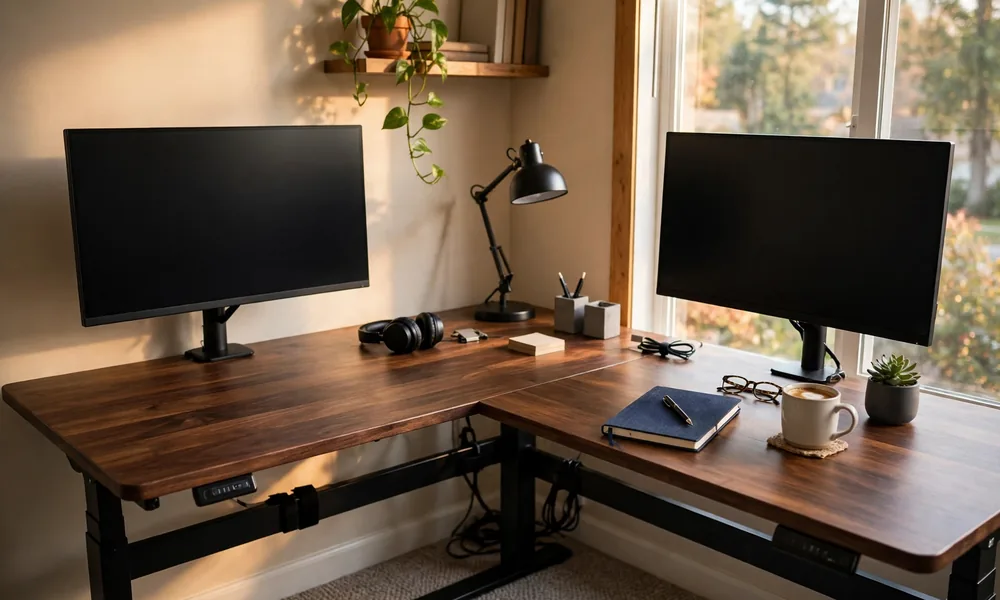
The Corner Workhorse turns dead corner space into a serious workstation. Its 160 by 160 cm L-shaped top gives you a main run for monitors and a return wing for paperwork, a printer, or a second project, all on one dual-motor frame that lifts evenly across both sections. The frame stays steady even when one side carries more weight. Assembly takes longer than a straight desk, and it is the hardest desk here to move once built, but for a dedicated corner office it is unbeatable.
6. Best for tall people: Extended Lift
Most standing desks top out around 120 cm, which leaves taller users hunching over a keyboard that sits too low. The Extended Lift solves that with a range of 65 to 135 cm, the highest in this guide, on a three-stage column that stays stable even at full extension. Dual motors lift evenly with no lag on one side. If you are over 190 cm tall, this is the desk that finally lets you stand with straight shoulders and a level screen.
7. Best for gamers: Wide Battle Station
The Wide Battle Station is built around one idea: surface area. Its 180 by 90 cm top swallows a wide monitor, a second screen, a full-size keyboard, and still leaves room for a drink and a notebook. The dual-motor frame lifts from 62 to 128 cm and carries 130 kg, The braced frame stops the wobble that ruins aim at standing height. Gamers with a multi-screen rig will appreciate every centimetre.
8. Best converter: Desktop Riser
The Desktop Riser is the cheapest way to test standing work without replacing the desk you already own. It sits on your existing desktop and lifts a 90 by 60 cm platform on a gas spring, from sitting height to standing height in one smooth motion. It holds 15 kg, enough for a monitor and a keyboard tray, and it folds flat when you want your old desk back. As a low-commitment first step, it is excellent value.
9. Best eco-friendly: Bamboo Classic
The Bamboo Classic pairs a fast-growing bamboo top with a dual-motor frame, giving you a desk that looks warm and natural while performing like a modern electric model. The 150 by 75 cm surface is hard-wearing and easy to clean, the lift range runs from 62 to 128 cm, and the 110 kg capacity covers a dual-monitor setup.
10. Best for shared spaces: Quiet Whisper
The Quiet Whisper earns its name: at 42 decibels, its dual motors are the quietest in this guide, softer than a library conversation. That makes it the right desk for a shared living room, a bedroom office with a sleeping partner nearby, or an open-plan space where every whirr gets noticed. Memory presets keep adjustments to a single quiet touch. In a shared home, silence is worth more than extra kilos.
Electric, manual, or converter: which lift suits you
Electric desks are the best choice for most people. They adjust at the touch of a button, hold heavier loads, and usually include the memory presets that make switching positions effortless. Dual-motor models are worth the small premium.
How to set up your standing desk properly
A standing desk only helps if it is set up right. Start with screen height: the top of your monitor should sit at or just below eye level. A monitor arm makes this easy, and the best laptop stands for desks can raise a laptop screen to the same level instead of forcing you to look down at a keyboard-height display.
Next, set your elbow angle. With your shoulders relaxed, your elbows should rest at about 90 degrees when your hands are on the keyboard, whether you are sitting or standing. Save both heights as memory presets on day one.
Finally, think about what goes under the desk. A good chair still matters, because you will sit for much of the day, and the best desk chairs for home offices pair well with a standing desk by supporting you properly during the sitting spells.
Before you buy: the standing desk checklist
- Measure your space first, including the room the desk needs at full height and the clearance for the lifting columns.
- Check the height range against your body: sitting elbow height for the low end, standing elbow height for the high end.
- Add up the weight of everything that will live on the desk, including monitors, arms, and books, and leave a margin under the rated capacity.
- Look for memory presets, a motor under 50 decibels, and a cable tray for tidy wiring.
- Confirm the warranty covers the frame and motor for at least five years, and check what the return policy allows.
- Plan your accessories too: a monitor arm, an anti-fatigue mat, and a good chair.
Frequently asked questions
How long should I stand at a standing desk each day?
Most people do best with short standing spells of 20 to 30 minutes, two or three times a day, adding up to one or two hours in total. The goal is movement and variety, not swapping one fixed position for another.
Are standing desks good for your back?
They can help, mainly because they break up long periods of sitting and encourage small movements that keep the spine and hips from stiffening. They are not a cure for back problems, though.
What size standing desk do I need?
A 120 cm desk suits a laptop and one monitor, a 140 cm desk fits a monitor and a laptop comfortably, and 160 cm or more is the right size for dual monitors with room to work. When in doubt, go wider: extra width is useful every day.
How much weight can a standing desk hold?
Budget single-motor desks usually carry 70 to 80 kg, while good dual-motor frames handle 100 to 140 kg. Choose a frame with at least 20 kg of headroom above your total.
Do standing desks use much electricity?
Very little. The motor only draws power while the desk is moving, which amounts to a few seconds per adjustment, and standby draw is a fraction of a watt.
Can I put a standing desk on carpet?
Yes, though thick carpet can make the feet sit unevenly and the frame feel less stable. A flat board under the feet helps on carpet.
The bottom line
The best standing desk of 2026 is the Everyday Electric: a dual-motor, 160 cm desk with memory presets, a 120 kg capacity, and a price that undercuts most of its rivals. The Value Electric covers the essentials for less; the Hardwood Flagship is the desk to grow old with. Whichever you choose, set it up carefully, alternate sitting and standing, and let the desk work around your day rather than the other way round.


