Top Tyre Pressure Gauges in 2026 That Read True Every Time
A tyre pressure gauge is one of the smallest tools you will ever own for your car, and one of the most useful. It tells you in seconds whether your tyres are at the pressure the manufacturer intended, and that number affects how your car grips the road, how much fuel it burns, and how quickly your tyres wear out. The best tyre pressure gauges in 2026 are accurate to within a pound or two, easy to read in poor light. The worst ones lie to you with confidence, and a wrong reading is worse than no reading at all.
Most drivers check their pressures far less often than they should. Tyres lose air slowly through the rubber, faster in cold weather, and a tyre can be several PSI under without looking flat. A good gauge turns a vague glance into a definite answer.
Key Takeaways
- A gauge only measures pressure; it does not add air, so pair it with a pump or inflator.
- Digital gauges are the easiest to read accurately, while a good dial gauge lasts longer and never needs a battery.
- Accuracy matters more than features: a gauge that reads within 1 PSI beats one with a torch and a dozen modes.
- Check pressures when tyres are cold, using the pressure on the door jamb or fuel flap, not the number on the tyre sidewall.
- A gauge that lives in the car gets used; one kept in a drawer at home does not.
A Gauge Measures, an Inflator Adds Air
The first thing to get straight is what a tyre pressure gauge actually does. A gauge measures the air pressure already inside a tyre and shows you the number. That is all it does. It cannot add air, and it will not rescue a flat tyre. An inflator, by contrast, is a small compressor that pumps air into the tyre, and most inflators have a gauge built in so you can watch the pressure rise. The two tools overlap in what they display, but they do different jobs, and a standalone gauge exists for the driver who wants one thing: a trustworthy reading.
That distinction matters when you shop, because the gauge on a cheap inflator is often the least accurate part of the machine. A dedicated gauge is built around one job, so its sensor or mechanism is usually better, and it is small enough to check a tyre in seconds without dragging a compressor out of the boot. If you already own an inflator, a separate gauge is still worth having, because it lets you double-check the inflator’s own reading.
The Main Types of Tyre Pressure Gauge
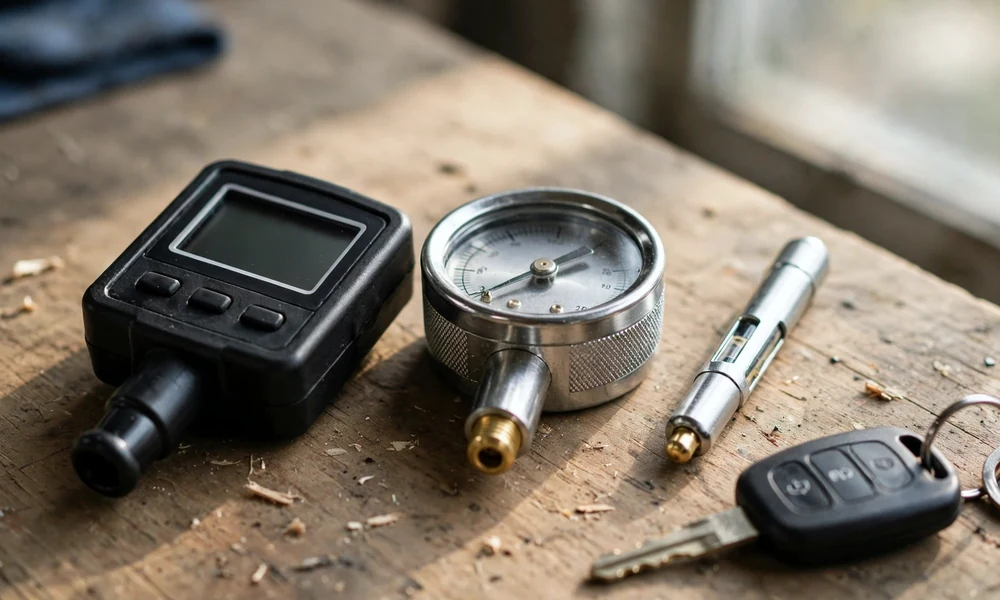
Tyre pressure gauges come in three main forms, and each suits a different kind of driver.
Digital Gauges
A digital gauge shows the pressure as a number on a small screen, usually to one decimal place, and that is its great advantage: there is no needle to interpret and no error from reading a dial at an angle. They are the easiest type to use correctly, especially in poor light. Their weaknesses are a battery that will eventually die, usually at the least convenient moment, and electronics that do not enjoy being dropped onto concrete. Buy one with an auto-off function, and keep a spare battery in the glovebox.
Dial Gauges
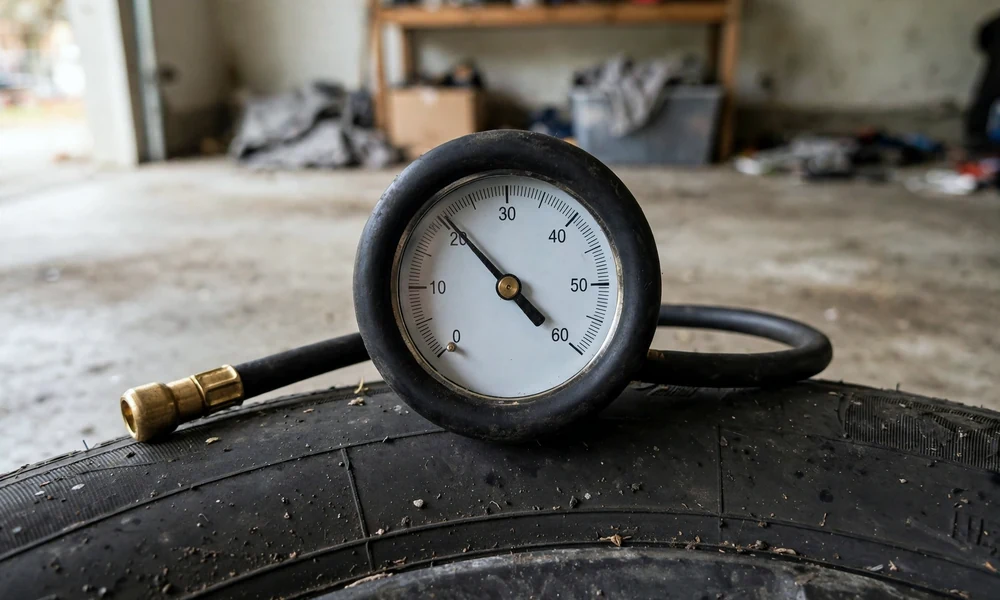
A dial gauge, also called an analogue gauge, has a round face with a needle, a rubberised case, and often a short hose ending in a chuck that clips onto the valve. Dial gauges need no battery, shrug off cold weather, and a well-made one will still be accurate after a decade. Their drawback is that a small or crowded dial is harder to read precisely, and a cheap dial gauge can be several PSI out from new.
Pencil Gauges
A pencil gauge is a slim metal tube, not much bigger than a pen, with a small rod that slides out to show the pressure against a printed scale. It costs almost nothing, weighs nothing, and fits in a shirt pocket. Its accuracy is modest, typically within a couple of PSI, and the scale can be hard to read in dim light, but for a rough check it is far better than guessing. A pencil gauge is a good backup for a second car or a motorcycle toolkit where space is tight.
What Accuracy Really Means
Accuracy is the whole point of a gauge. A gauge that reads 32 PSI when the tyre actually holds 29 PSI has failed at its only job, and you will drive around on under-inflated tyres believing they are correct. The best gauges are accurate to within 1 PSI across their working range
Cheap gauges are the worst offenders, because a poor sensor can be several PSI out, and the error is rarely consistent, so you cannot simply learn to compensate for it. Temperature affects readings too, because pressure falls as tyres cool and rises as they warm up. A tyre that reads 32 PSI cold may read 35 PSI after a long motorway run, and neither reading is wrong. That is why the standard advice is to check pressures cold, before driving, or after the car has sat for at least three hours.
How to Check Your Tyre Pressure Properly
Checking a tyre takes less than a minute once you know the routine. Start by finding the correct pressure for your car, printed on a sticker on the driver’s door jamb, inside the fuel filler flap, or in the owner’s manual. The number moulded into the tyre sidewall is the maximum the tyre can safely hold, not the pressure your car needs, and using it will leave your tyres over-inflated and your ride harsh.
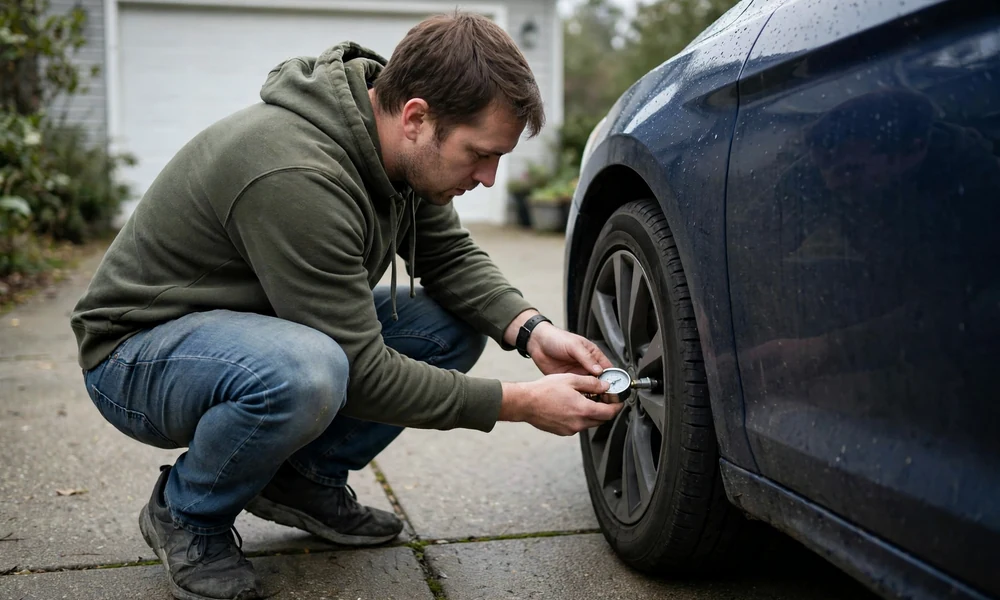
Unscrew the valve cap and keep it somewhere safe, then press the gauge firmly onto the valve stem, straight and square, until the hissing stops. A crooked connection lets air escape and gives a low reading, so push on firmly and hold it still for a second or two. Read the number and check it against the sticker. If the tyre is low, add air; if it is high, press the small release to bleed a little out, then check again. Replace the cap and repeat for all four tyres, including the spare. Do this at least once a month and before any long journey, and more often in winter, when cold air shrinks and pressures drop.
What to Look For Before You Buy
The best tyre pressure gauge for you is the one you will actually use, so the practical details matter as much as the accuracy figure. A gauge with a large, clear display or dial is easier to read at arm’s length in a dim garage, and a backlit screen is genuinely useful on a dark winter morning.
Build quality is easy to judge by hand. A gauge that feels solid, with a rubber bumper around the case and a hose that does not kink, will survive being dropped and rattled around in a door pocket. A flimsy plastic gauge with a stiff, short connector will annoy you every time you use it, and annoyance is what stops people checking their tyres. Range matters too: most car tyres run between 28 and 36 PSI, so a gauge that reads up to 60 PSI covers cars, vans and bicycles, while one that tops out at 50 PSI is fine for cars but no good for a road bike. Avoid gauges that bury the reading behind menus you will never use, because a tool that needs a manual is a tool that stays in the drawer.
Tyre Pressure Gauges Compared
| Type | Best for | Accuracy | Needs battery | Price |
|---|---|---|---|---|
| Digital | Fast, clear readings | Within 1 PSI | Yes | Mid-range |
| Dial | Long life, all weathers | Within 1–2 PSI | No | Mid to high |
| Pencil | Backup and tight spaces | Within 2–3 PSI | No | Very cheap |
| Inflator built-in | Quick top-ups | Often 2–3 PSI out | Yes | Varies |
The table makes the trade-offs plain. Digital gauges win on readability, dial gauges win on longevity, and pencil gauges win on price and portability. The built-in gauge on an inflator is convenient but should be treated as an estimate rather than a measurement.
Mistakes That Ruin a Good Reading
Even a good gauge gives a bad reading if it is used badly. The biggest mistake is checking hot tyres and comparing the result to the cold specification, which makes every tyre look over-inflated and tempts you to let air out that the tyre actually needs. The second is a loose connection to the valve, which hisses air away while you read and leaves the number lower than the truth. Push on firmly, straight and square, and wait for the hiss to stop before you read. Do not rely on the dashboard warning light alone either: most systems only warn when a tyre is under-inflated, often 25 percent below the correct pressure.
Checklist: Buying a Tyre Pressure Gauge
- Accuracy within 1 PSI, from a brand or model with a stated accuracy figure rather than a vague claim.
- A display you can read at arm’s length in poor light, with a backlight on a digital gauge.
- A chuck or hose that reaches your valves easily without kneeling or wrestling with wheel trims.
- A range that covers your vehicles, at least 60 PSI for cars, vans and bicycles together.
- A hold function on a digital gauge, or a clear, uncluttered dial on an analogue one.
- Build quality that survives a drop, with a rubber bumper and a hose that does not kink.
Frequently Asked Questions
How often should I check my tyre pressure?
At least once a month, and before any long journey. Tyres lose roughly 1 PSI a month through the rubber, and faster in cold weather.
Should I check tyres hot or cold?
Cold, before driving or after the car has sat for at least three hours. Hot tyres read higher, so a hot reading cannot be compared with the cold pressure on the door sticker.
What pressure should my tyres be?
The pressure on the sticker in the driver’s door jamb or fuel flap, which is specific to your car. The number on the tyre sidewall is the maximum the tyre can hold, not the pressure to use.
Are digital gauges more accurate than dial gauges?
A good digital gauge is usually easier to read accurately, but a well-made dial gauge can be just as accurate and never needs a battery. Accuracy depends on the quality of the individual gauge more than on the type.
Can I trust the gauge on a petrol station air line?
Not always. Forecourt gauges are often knocked about and rarely calibrated, so they can be several PSI out. Use your own gauge to check the result after topping up.
Do I need a separate gauge if my inflator has one?
It is worth having one. A dedicated gauge is usually more accurate than a built-in one, and it lets you double-check the inflator’s reading.
The Bottom Line
The best tyre pressure gauges in 2026 are the ones that give you a true reading, quickly, in any weather, and that you can rely on month after month. A digital gauge is the most practical choice for most drivers, a dial gauge is the one to buy if you want a tool that never needs a battery, and a pencil gauge is a fine backup for a second car. Whichever type you choose, the real value is the habit it creates: a minute a month, four tyres and a spare, and a car that grips better, wears its tyres evenly, and uses less fuel. If you already own an inflator, read our guide to the best vs worst tyre inflators to see how its built-in gauge compares, keep a bike pump handy for two wheels, and remember that a gauge measures pressure only, unlike a multimeter, which measures electrical values instead.