
A baby bottle looks like the simplest thing in the nursery, and it is, until you have spent a night with the wrong one. The wrong one leaks down your sleeve, collapses its teat mid-feed, or hides milk in corners you cannot reach with a brush, and it will make the hardest weeks of new parenthood measurably harder. The difference between the best and the worst baby bottles in 2026 is not a brand name, because every brand makes both good and bad bottles, and it is not price, because some of the worst bottles are expensive. A bottle that works well at home, in the car, and at three in the morning is worth more than any clever feature printed on the box. It is about whether the bottle was designed around a real feed, at real hours, by people who understood what tired parents actually need.
This head-to-head comparison puts the two sides against each other properly, rather than praising good bottles on one page and warning about bad ones on another. On one side, the bottles that feed well, clean easily, and survive months of daily sterilising without going cloudy or leaky. On the other, the bottles that look smart in a photograph and then fail in the ways that matter most: teats that flow too fast or too slow, valves that clog, seals that weep, and necks so narrow that washing them becomes a chore you dread.
Key Takeaways
- Anti-colic venting is the feature that matters most for a windy baby, because a bottle that lets air in through a vent, rather than through the teat, cuts down the air a baby swallows with every feed.
- Teat flow decides whether a feed is calm or chaotic: a slow-flow teat suits a newborn, and a teat that flows too fast will make a baby gulp, splutter, and take in air.
- Wide necks beat narrow necks for everyday life, because a wide-neck bottle is faster to fill, easier to clean, and simpler to assemble correctly when you are half asleep.
- Glass stays clear and odour-free far longer than plastic, while plastic is lighter and safer to drop, so the best choice depends on where the bottle will be used.
- Buy two or three bottles first and test them with your baby before buying a full set, because the best bottle on paper is useless if your baby refuses its teat.
What Makes a Great Baby Bottle
A great baby bottle is judged by three things: how it feeds, how it cleans, and how it lasts. Feeding comes first, because a bottle exists for the feed. The teat is the heart of it. A good teat is soft but not floppy, shaped so the baby can latch comfortably, and matched to the baby’s age with a clear flow rate: slow for a newborn, medium as the baby grows, fast only much later. The right flow makes the feed calm, and calm feeds are the whole point.
Venting is the second half of the feeding question, and it is the detail most parents only learn about after a windy baby keeps them up at night. When a baby drinks, air has to replace the milk leaving the bottle. If that air comes in through the teat, it mixes with the milk and the baby swallows it, which is how wind and colic get worse. An anti-colic bottle lets air in through a vent or a valve at the base or in the teat ring, so the milk stays smooth and the teat does not collapse inwards mid-feed. It is not a cure for colic, and no bottle can promise that, but for a baby who takes in a lot of air, a well-vented bottle can make a real difference to how settled the evening feels.
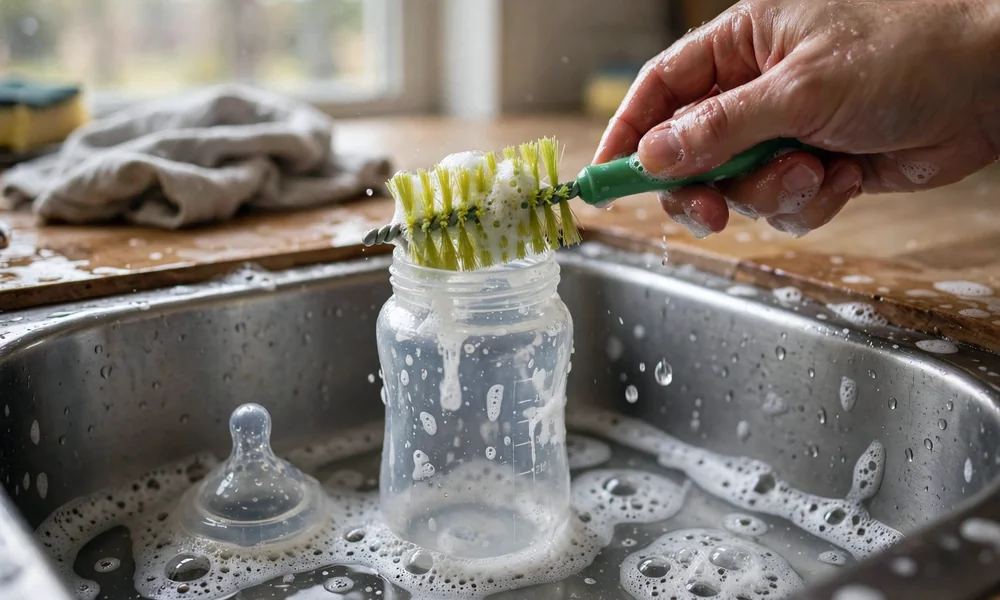
Cleaning is the test you will run more often than any other, several times a day, usually when you are tired. A good bottle comes apart into few, simple parts, with no hidden valves or tiny seals that trap milk and grow mould. A wide neck lets a brush reach every corner, and smooth, rounded shoulders leave nowhere for milk to hide. The bottle should also survive sterilising, whether by steam, cold water, or boiling, without warping, clouding, or losing its measurement markings.

The Best Baby Bottles of 2026
The best side of this comparison is not one bottle but four kinds of bottle, each of which earns its place by feeding well for a particular kind of baby and a particular kind of day.
1. The Anti-Colic Vented Bottle: Best Overall
If you only buy one kind of bottle, this is the one to buy. A well-designed anti-colic bottle, with a vent or valve that lets air in away from the teat, keeps the milk smooth and the teat full, so the baby swallows far less air with every feed. The best of them have wide necks, clear measurement markings, and teats in several flow rates, so the same bottle grows with the baby from the first weeks onwards.
2. The Wide-Neck Bottle: Best for Everyday Ease
The wide-neck bottle is the best choice for the daily grind, because it makes everything around the feed easier. Filling it is faster, with less spilt milk on the counter. Cleaning it is simpler, because a brush reaches the bottom without a struggle. Assembling it is more forgiving, because the teat and ring seat correctly without fiddling, even at three in the morning.
3. The Glass Bottle: Best for Purity and Longevity
Glass bottles are the best choice for parents who care about what the bottle is made of and how long it lasts. Glass does not absorb odours or stains, it does not go cloudy after months of sterilising, and it does not leach anything into the milk, which matters to parents who have thought carefully about materials.
4. The Slow-Flow Newborn Bottle: Best for Newborns
A newborn needs a slow-flow bottle, and the best newborn bottles are designed around that single fact. The teat releases milk slowly, so the baby can feed at its own pace without gulping, and the bottle itself is small, usually around 120 to 150 millilitres, which suits the small, frequent feeds of the first weeks.
The Worst Baby Bottles of 2026
The worst side is just as instructive as the best, because the same mistakes appear again and again, at every price.
1. The Leaky Cheap Bottle: Worst Overall
The worst baby bottle of all is the leaky cheap bottle, the one that weeps milk from its seal no matter how carefully you assemble it. The ring does not seat properly, the teat does not seal against the neck, or the vent lets milk out as happily as it lets air in, and the result is milk down your sleeve, milk in the changing bag, and milk wasted at every feed.
2. The Fast-Flow Bottle for a Newborn: Worst for Young Babies
A bottle with a fast-flow teat, given to a newborn, is the worst mismatch in the nursery. The milk comes too quickly for a small baby to manage, so the baby gulps, splutters, and coughs, milk spills from the corners of the mouth, and a large amount of air is swallowed with every mouthful.
3. The Narrow-Neck Bottle with Hidden Parts: Worst to Clean
The narrow-neck bottle with a complicated valve system is the worst bottle to live with, because it turns washing into a chore you dread. The neck is too narrow for a brush to reach the bottom, the shoulders are square, so milk collects in corners you cannot see, and the valve has tiny parts that trap milk and need taking apart and drying separately.
4. The Cloudy Scratched Plastic Bottle: Worst for Longevity
Cheap plastic bottles that go cloudy and scratched after a few weeks of sterilising are the worst value on the shelf. The plastic clouds, so you can no longer read the measurement markings properly, the inside scratches, so milk residue clings to it, and the bottle starts to smell of old milk no matter how carefully you wash it.
Best vs Worst Baby Bottles at a Glance
| Baby Bottle | Best For | Teat and Flow | Cleaning | Verdict |
|---|---|---|---|---|
| Anti-colic vented bottle | Best overall | Slow to medium, vented | Wide neck, few parts | Best |
| Wide-neck bottle | Everyday ease | Soft, breast-shaped teat | Easy, brush reaches all | Best |
| Glass bottle | Purity and longevity | Standard teats, slow flow | Easy, stays clear | Best |
| Slow-flow newborn bottle | Newborns | Slow flow, small size | Easy, simple parts | Best |
| Leaky cheap bottle | Nothing; avoid | Poor seal, leaks | Average | Worst |
| Fast-flow bottle for newborn | Nothing; avoid | Too fast for newborn | Average | Worst |
| Narrow-neck bottle, hidden parts | Nothing; avoid | Valve clogs | Hard, traps milk | Worst |
| Cloudy scratched plastic bottle | Nothing; avoid | Teat degrades | Residue clings | Worst |
Who Each Side Is For
The best baby bottles are for any parent who wants feeds to be calm. The anti-colic bottle suits the windy baby, the wide-neck bottle suits the parent who values ease several times a day, the glass bottle suits the parent who cares about materials and longevity, and the slow-flow newborn bottle suits the first weeks above all.
The worst baby bottles are for nobody who wants to feed a baby, and that is the honest verdict. The leaky bottle is for a buyer who has not yet used one, the fast-flow bottle is for an older baby, not a newborn, and the narrow-neck bottle is for a parent with far more time than any new parent has. None of them is for a newborn feed at three in the morning.
How to Choose and Care for Your Baby Bottles
Choosing well starts with a small test, not a big shop. Buy two or three bottles of different kinds first, try them with your baby, and watch how the baby feeds: Also check that spare teats are easy to buy for the bottle you choose, because a bottle whose teats are hard to find becomes useless the moment the first teat wears out. a calm feed, with steady swallowing and no spluttering, tells you the teat and flow are right, while gulping or frustration tells you to try another.
Care is simple but unforgiving. Wash every bottle straight after a feed, with hot soapy water and a brush, taking apart every valve and seal, and let the parts dry fully before reassembling them, because trapped moisture is where smells start.
For more on the rest of the nursery, our guide to the best diaper bags of 2026 covers what leaves the house with you, while the best cribs of 2026 covers where the baby sleeps, and our comparison of the best vs worst baby monitors in 2026 will help you keep an eye on the nursery once the feed is done. The verdict stands: buy the bottle that feeds calmly and cleans easily, walk past the bottle that only looks good on the shelf, and the nights will be easier for it.


