The best rice cakes for light, crunchy snacking in 2026 are the ones that stay crisp from the first bite to the last, taste of something real, and hold a topping without snapping in half. Rice cakes have quietly become one of the most useful snacks in the pantry: light enough for an afternoon nibble, sturdy enough to carry peanut butter or smoked salmon, and simple enough that a short ingredient list is usually a good sign. A bad rice cake, though, is a sad thing. It tastes of stale air, crumbles into dust, or goes soft within minutes of the packet opening.
What changed in 2026 is the range. Plain rice cakes are no longer the only option, and the flavoured ones are no longer just salt and caramel. There are brown rice cakes, multigrain cakes, thin and thick styles, and topping-friendly rounds made to be loaded up like an open sandwich. This guide explains how to judge a rice cake before you buy it, how the main types compare, what to put on top, and how to keep a packet crisp once it is open.
Key Takeaways
- Crunch is the first test: a good rice cake snaps cleanly and stays crisp, while a soft or bendy one is stale or poorly made.
- Plain rice cakes are the most versatile, because you control the flavour with toppings; flavoured cakes suit plain snacking straight from the packet.
- Check the ingredient list: the best rice cakes are mostly rice with a little salt, and the worst hide sugar, flavourings and oil behind a healthy-looking packet.
- Thickness matters more than brand: thick cakes carry toppings and feel like a meal, while thin cakes suit dipping and light snacking.
- Seal the packet well and eat it within a week or two of opening, because rice cakes go soft fast.
What Makes a Rice Cake Good
A rice cake is a simple food: puffed rice pressed into a round, sometimes with a little salt, and that is often the whole recipe. A good one is dry all the way through, with a clean snap when you break it and a light, airy crunch when you bite it. It should taste faintly nutty and toasted, like popcorn pressed flat, rather than tasting of nothing at all.
Texture is where rice cakes differ most. The best ones have an even, open crumb: the puffed grains are evenly sized, the cake holds together without shedding a snowdrift of crumbs, and it does not shatter when you spread something on it. A cake that crumbles at a touch was pressed too loosely, and a cake that is dense and hard in the middle was pressed too hard.
Flavour is the second test, and it is easy to judge. Eat one plain, with nothing on it, before you decide what to pair it with. A good plain rice cake tastes of toasted rice with a whisper of salt. A bad one tastes of cardboard, or of the flavouring dusted on the outside with nothing underneath. If the cake only tastes good once it is covered in something else, it is not a good cake.
Plain vs Flavoured: The Main Types Compared
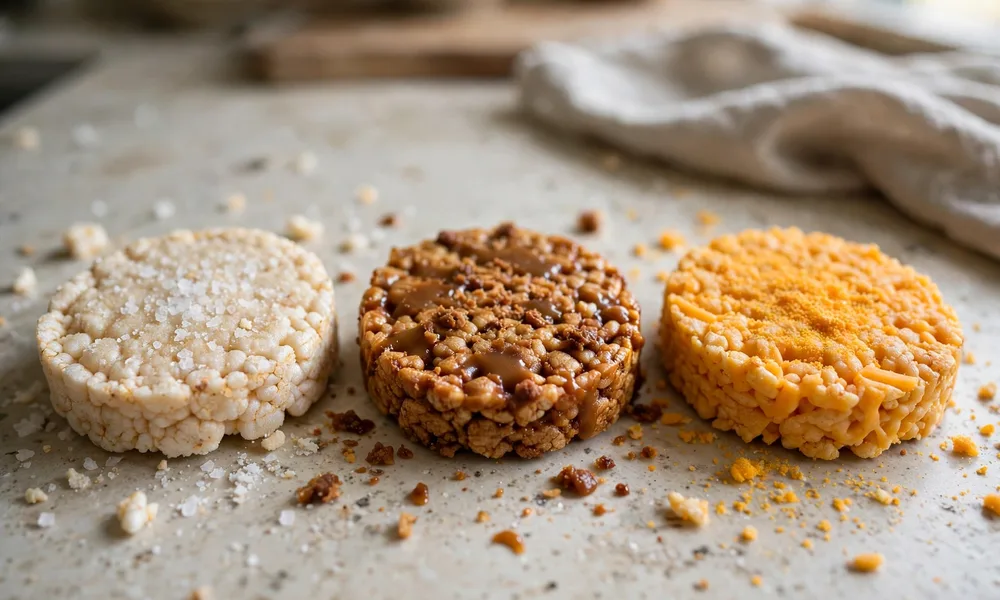
Most rice cakes fall into a few clear families, and knowing them makes choosing faster. Plain rice cakes are the original: puffed white or brown rice, a little salt, nothing else. They are the most versatile, because they take on whatever flavour you put on top, from sweet peanut butter and banana to savoury cream cheese and smoked salmon. Their weakness is that eaten plain they can be dull, and a dull snack is one you will not finish.
Flavoured rice cakes come in two styles. The first is lightly seasoned: sea salt, cheese or barbecue flavour that stays in the background. These are good for plain snacking, and the best of them taste seasoned rather than coated. The second style is sweet: caramel, chocolate or yoghurt-coated. These are closer to a biscuit than a snack, and they are best treated as one: fine as an occasional treat, but not the everyday choice if you are watching sugar.
Brown rice cakes deserve a mention of their own. They are made from wholegrain brown rice, so they taste nuttier and a little earthier than white rice cakes, and they keep you fuller for longer. The texture is usually a little denser, which some people prefer and others do not. Thin rice cakes, sometimes sold as thins, are lighter and more delicate, and they work well with dips, where a thick cake would be clumsy. Their weakness is strength: they snap under a thick spread.
| Type | Flavour | Crunch and strength | Best use |
|---|---|---|---|
| Plain white rice | Mild, toasted, lightly salted | Light, snappy, medium strength | Toppings, open sandwiches |
| Plain brown rice | Nutty, earthy, fuller | Denser, chewier, sturdy | Toppings, filling snacks |
| Lightly seasoned | Sea salt, cheese, barbecue | Crisp, snappy | Plain snacking, lunchboxes |
| Sweet and coated | Caramel, chocolate, yoghurt | Crisp, sometimes sticky | Occasional treats |
| Thin and multigrain | Light, nutty, varied | Delicate, very crisp | Dips, light snacking |
Toppings That Turn a Rice Cake Into a Meal
A rice cake on its own is a light snack. A rice cake with the right topping is a small meal, and the difference is protein, fat or fibre. The classic pairing is peanut butter and banana: the peanut butter adds protein and fat, the banana adds sweetness and bulk, and the cake adds crunch. It is quick, it keeps you full for an hour or two, and it tastes far better than the sum of its parts.
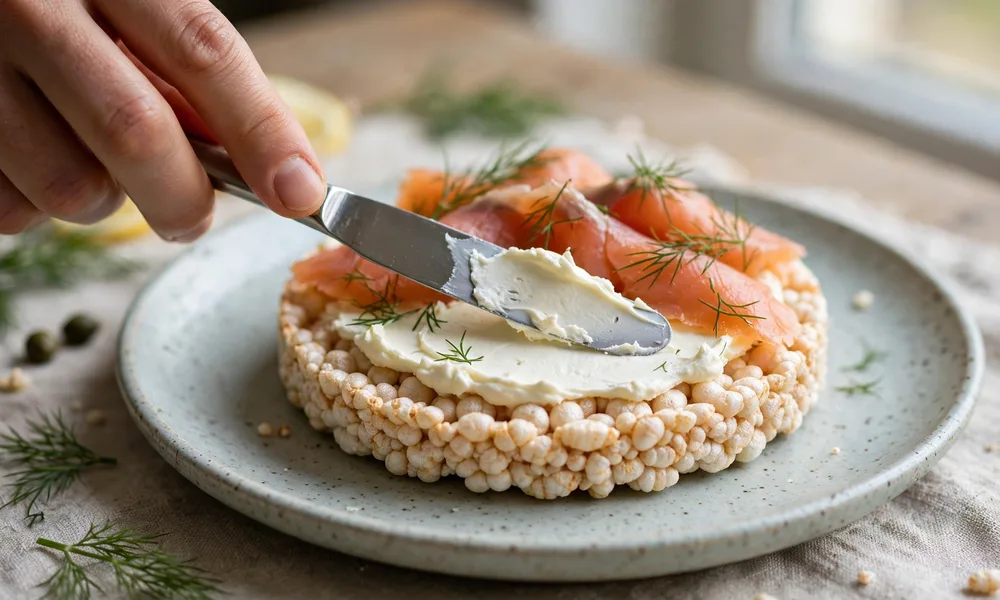
On the savoury side, cream cheese and smoked salmon is the pairing that makes people take rice cakes seriously. The cream cheese gives the cake a soft, rich layer, the salmon adds salt and protein, and a squeeze of lemon finishes it. Avocado and a soft-boiled egg is another good one, as is hummus with sliced cucumber. The rule is the same every time: something soft and rich underneath, something fresh on top, and the cake doing the crunching.
If you are building a snack board, rice cakes sit happily next to the foods that already work that way. A crisp cracker is the closest cousin, and the same rules apply: the base should support the topping, not compete with it. For a fuller guide to choosing that base, see our round-up of the best crackers for cheese boards and snacking, which covers sturdiness, flavour and pairing in detail.
Calories, Crunch and the Health Question
Rice cakes have a reputation as a diet food, and it is only half deserved. A single plain rice cake is usually around 35 calories, which is genuinely light, and it is fat-free, gluten-free and easy to digest. That is the good news. The less good news is that a single rice cake is also very light in every other way: it has almost no protein, very little fibre, and it will not keep you full on its own. Two plain rice cakes are about the same as a slice of bread, with less staying power.
The health question, then, is not whether rice cakes are good or bad. It is whether what you put on them makes a proper snack. A rice cake with peanut butter is a reasonable snack. A rice cake with nothing on it is a placeholder. And a sweet, caramel-coated rice cake is a biscuit wearing a health halo, which is the worst of both worlds: the sugar of a biscuit and the satisfaction of a rice cake.
For a snack that keeps you fuller, pair rice cakes with something that has protein or fat, or keep a second snack alongside them. A small handful of nuts does the job well, and the same label-reading rules apply: short ingredient list, nuts first, salt near the end. Our guide to mixed nuts worth snacking on explains how to spot a good blend, and the portability rules in our trail mix guide work just as well for a bag of rice cakes in a coat pocket or a desk drawer.
How to Store Rice Cakes So They Stay Crisp
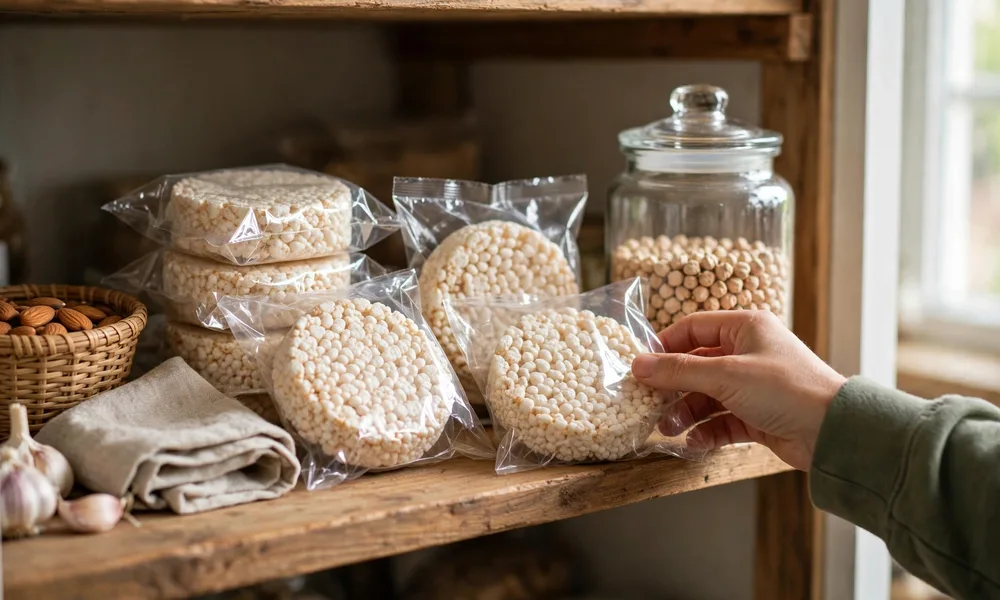
Storage is where most rice cakes are lost. A packet left open in a damp kitchen goes soft within a day or two, and a soft rice cake is not worth eating. Seal the packet tightly after every use, with a clip or a rubber band, and keep it in a cool, dry cupboard rather than on top of the fridge, where warm, damp air rises. If you live somewhere humid, move the cakes into an airtight tub or a glass jar with a tight lid the day you open them.
Rice Cake Shopping Checklist
- Break one in half and listen for a clean snap: a cake that bends is already stale.
- Eat one plain before you buy a second packet, and judge it on its own flavour, not its topping.
- Read the ingredient list: rice first, a little salt, and nothing you cannot pronounce in the first three ingredients.
- Check the sugar per cake, especially on sweet and yoghurt-coated flavours, where it can be higher than a biscuit.
- Choose thick cakes for toppings and thin cakes for dipping, and do not expect one cake to do both jobs.
- Buy the size you will finish within two weeks, and move opened cakes into an airtight tub if your kitchen is humid.
Frequently Asked Questions
Are rice cakes healthy?
Plain rice cakes are light, low in calories, fat-free and gluten-free, which makes them a reasonable base for a snack. They are not very filling on their own, because they have almost no protein or fibre, so pair them with a protein-rich topping like peanut butter, egg or smoked salmon.
How many calories are in a rice cake?
A single plain rice cake is usually around 35 calories, and a thick brown rice cake a little more, around 40 to 45. Flavoured and coated cakes are higher: a chocolate or yoghurt-coated cake can reach 60 to 70 calories, so check the packet.
Are rice cakes gluten-free?
Most rice cakes are naturally gluten-free, because they are made from puffed rice, but not all are certified gluten-free, and some flavoured varieties add barley malt. If you need to avoid gluten, look for a certified gluten-free label on the packet.
What is the best topping for a rice cake?
Peanut butter and banana is the classic sweet topping, and cream cheese with smoked salmon is the classic savoury one. Both pair something soft and rich with the crisp cake. Avocado and egg, and hummus with cucumber, are good alternatives too.
Why do my rice cakes go soft?
Rice cakes absorb moisture from the air, so a packet left open in a damp kitchen goes soft quickly. Seal the bag tightly after every use, keep it in a cool, dry cupboard, and move the cakes into an airtight tub if your kitchen is humid. Do not store them in the fridge.
Are rice cakes better than crackers?
They are different rather than better. Rice cakes are lighter, airier and usually lower in calories, while crackers are denser, more flavourful and sturdier under a heavy topping. Rice cakes suit light snacking; crackers suit cheese boards and thick dips.
The Bottom Line
The best rice cakes for light, crunchy snacking in 2026 are plain, crisp, and honest about what they are. A plain brown rice cake with a good topping is a genuinely satisfying snack, and a lightly seasoned cake eaten straight from the packet is a fine one too. Skip the cakes that are mostly flavouring and sugar, and the giant packets that go soft before you finish them.
Buy small, buy plain, seal the packet, and put something worth eating on top. Do that, and a rice cake stops being a diet food and becomes what it should have been all along: a light, crunchy, useful snack that earns its place in the pantry.