
A changing table is the piece of nursery furniture you will use more than any other in your baby’s first year. Ten or twelve changes a day, every day, adds up to thousands of nappy changes before your child is out of nappies, and every one of them happens at waist height on a surface that needs to be safe, steady, and within reach of everything you need. The best changing tables of 2026 are solid, well-organised, and built to survive daily use. The worst ones wobble, sag, and make a simple job harder than it needs to be, usually because they were built to a price rather than to a standard.
Key Takeaways
- The best changing tables have a wide, heavy base, raised safety rails on all four sides, and a firm, wipe-clean mat.
- A dresser-style table with drawers is the best long-term value, becoming an ordinary chest of drawers when the nappy years end.
- Wall-mounted fold-down tables are the best choice for a small home or a bathroom, if they are fixed to a solid wall.
- Avoid thin folding tables, sagging fabric shelves, and any table with no safety rail or a soft, squishy mat.
- Never leave a baby unattended on a changing table, not even for a second, and always keep one hand on your baby.
What Makes a Changing Table Safe
Safety is the first test for a changing table, because a baby lying at waist height can roll further and faster than new parents expect. The top should have raised rails on all four sides, at least five centimetres high, so a rolling baby meets a barrier rather than an edge. The surface should be flat and firm, with a mat that fits snugly and does not slide. If the mat moves when you press it, add a non-slip base or choose a different mat, because a sliding mat is a hazard disguised as a comfort.
The frame matters just as much as the top. Push the table firmly from the side: a good one barely moves, while a cheap one rocks on its legs or flexes at the joints. Check every bolt and screw when you build it, and check them again every month, because daily use loosens fixings faster than you would think. If the table has wheels, they must lock, and if it folds, the open position must lock too, so it cannot collapse under a baby’s weight.
The Best Changing Tables of 2026
The Dresser-Style Table: Best Overall
The best overall changing table of 2026 is a dresser-style table: a solid chest of drawers with a changing top that can be removed later. It is heavy, which is exactly what you want in a piece of furniture a baby lies on, and the drawers put nappies, wipes, creams, and clean clothes exactly where you need them, within arm’s reach but out of your baby’s grasp. When the nappy years end, you lift off the changing top and you are left with an ordinary, useful chest of drawers that stays in the room for years.

Solid wood is the material to look for, with dovetailed or well-screwed joints rather than thin panels held together by small screws. The top should be wide enough for a baby up to about fifteen kilograms, with room for a nappy and a packet of wipes beside the mat. The drawers should run smoothly on proper runners and have stops so a toddler cannot pull one out onto themselves. A good dresser table costs more than a folding frame, but it replaces two pieces of furniture and lasts for years, which makes it the best value in the nursery.
The Wall-Mounted Fold-Down Table: Best for Small Spaces
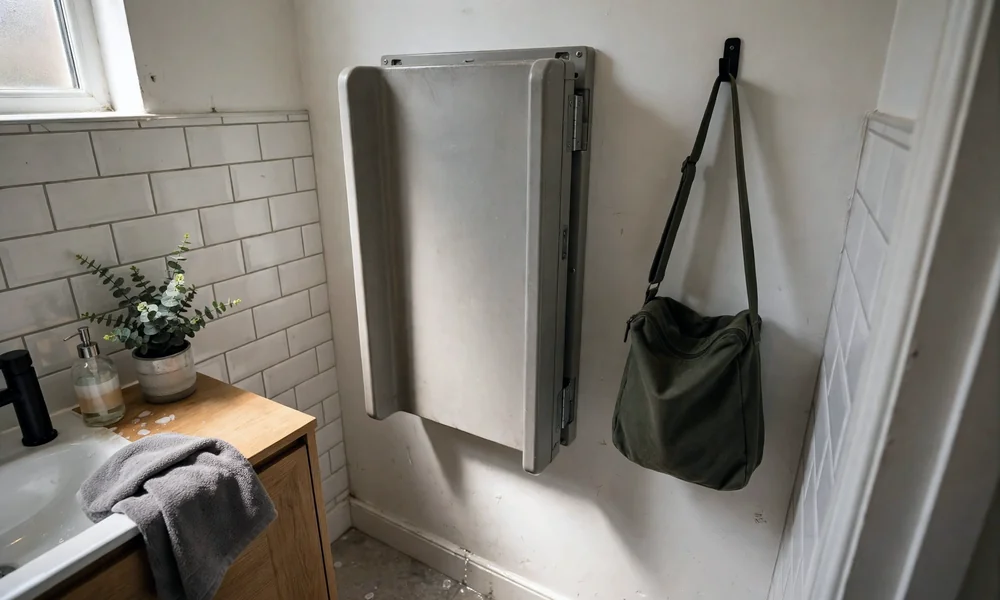
For a small flat, a bathroom, or a nursery that doubles as a spare room, the best choice is a wall-mounted fold-down changing table. It folds flat against the wall when not in use, freeing the floor, and drops down to a firm, waist-height surface when you need it. The good ones are made from solid wood or sturdy laminate, with strong hinges and a support mechanism that locks firmly, and a safety rail that folds up with the table.
The Changing Topper: Best Budget Option
If money is tight, the best budget option is a changing topper: a simple tray with raised sides that sits on top of a chest of drawers you already own. A good topper is made from solid wood or sturdy plastic, has rails on all four sides, and is secured to the dresser with straps or screws so it cannot slide off. It costs a fraction of a full changing table, it uses furniture you already have, and it removes cleanly when the nappy years are over.
The Worst Changing Tables of 2026
The Cheap Folding Table: Worst Overall
The worst changing tables of 2026 are the ultra-cheap folding tables, and they fail in the ways that matter most. The legs are thin metal tubes that flex when you press the top, the joints are held by small plastic catches rather than proper bolts, and the whole frame rocks when you lean on it. The changing surface is often a thin piece of fabric stretched across the frame, which sags under a baby’s weight and leaves the baby lying in a dip rather than on a flat, safe surface.

These tables are also badly organised. The shelves below are usually shallow fabric pockets that hold almost nothing, so nappies and wipes end up in a pile on the floor, out of reach at the moment you need them. After a few months the fabric stains, the frame loosens, and the mat tears at the seams. A table like this is not a bargain. It is a replacement waiting to happen, and while you wait, it is the table your baby lies on a dozen times a day.
The No-Rail Table: A Design That Should Not Exist
The second group to avoid is any changing table with no safety rail, or with a rail on only two sides. Some modern designs drop the rails for a clean, minimal look, but a flat top with no barrier is a fall waiting to happen. Babies roll without warning, and a baby who has lain still for a hundred changes can roll on the hundred and first. A rail does not replace your hand, but it buys you the second you need to catch a rolling baby.
Changing Tables Compared
| Type | Stability | Storage | Lifespan | Best For |
|---|---|---|---|---|
| Dresser-style table | Excellent | Drawers, excellent | Years | Best overall |
| Wall-mounted fold-down | Good, if fixed well | Limited | Years | Small spaces |
| Changing topper | Good, on solid dresser | Uses existing drawers | Nappy years | Best budget |
| Cheap folding table | Poor | Shallow fabric pockets | Months | Avoid |
| No-rail table | Varies | Varies | Nappy years | Avoid |
Storage and Organisation
A changing table is only as good as its storage, because a change goes wrong when the thing you need is out of reach. The best setup keeps nappies, wipes, and nappy cream within arm’s reach, on a shelf or in a drawer beside the mat, and keeps clean clothes one step further away, where you can reach them without leaving the table. The worst setup keeps everything in a box on the floor, which means you either leave your baby to fetch it, which you must never do, or you juggle a baby with one hand while reaching with the other.
Set the table up before your baby arrives, and practise the routine with a doll or a rolled towel. Put the nappies on the side of your strong hand, the wipes where you can pull one out with one hand, and a small bag or bin for dirty nappies within reach but out of your baby’s way. Keep a spare change of clothes on the table too, because a nappy change that goes wrong usually involves clothes. A table that is organised like this turns a dozen daily changes into a calm, quick routine instead of a scramble.
Cleaning and Care
Changing tables need cleaning more often than any other nursery furniture, and the best ones make it easy. A wipe-clean mat and a smooth, sealed top can be cleaned in a minute after every change, and that matters, because a changing surface that is not cleaned properly becomes unhygienic quickly. Wood should be sealed or varnished so it does not absorb moisture, and fabric parts should be removable and washable, or avoided altogether.
When the Nappy Years End
Most children stop needing a changing table between two and three years old, when they move to nappies only at night or start using a potty. The sign is usually that your child is too big for the top, or too wriggly to lie still for a change. Do not force it: a child who can stand for a change, or who uses the potty, is ready to move on, and standing changes are safer for a big toddler than a high table.
This is where a good table earns its price. A dresser-style table becomes an ordinary chest of drawers, a topper lifts off and leaves a useful dresser, and a fold-down table folds away and leaves the room clear. A cheap folding table, by contrast, goes in the bin, because it is worn out and nobody wants it second-hand. Buy a table with a life after nappies, and you will have bought a piece of furniture, not a disposable accessory.
Mistakes to Avoid
The most common mistake is buying a changing table before measuring the nursery. A table that does not fit beside the cot, or that blocks the door, will be used less and resented more. Measure the room, including the space you need to stand beside the table, and check that the table fits through the door if you plan to move it. The second mistake is choosing a table for how it looks in the shop rather than how it works at three in the morning: pale fabric and open shelves look lovely until the first messy change.
The third mistake is putting the table in the wrong room. The changing table belongs where your baby sleeps, or where you spend most of your time, not in a cold spare room you will avoid at night. If the nursery is small, a fold-down table in the bathroom or a topper on a bedroom dresser works better than a full table squeezed into a corner. And remember the rest of the nursery: a good crib is where your baby sleeps between changes, a well-packed diaper bag carries the same essentials when you go out, and a reliable baby monitor lets you hear your baby the moment they wake.
The Verdict
The best changing table of 2026 is the dresser-style table: solid, stable, well-organised, and useful long after the nappy years end. If space is tight, a properly fixed wall-mounted fold-down table is the next best choice, and a changing topper on a solid dresser is the best budget option. The worst changing tables are the cheap folding frames and any table with no safety rail: they wobble, sag, and need replacing within months.
Buy a table that is stable, organised, and built to last, keep one hand on your baby at all times, and never leave the table, even for a second. A changing table is used a dozen times a day, and the right one makes every one of those changes calmer, quicker, and safer.


