Best Welcome Signs That Make Guests Feel at Home in 2026
A good welcome sign is the first thing a guest reads when they step through the door, and it sets the tone: warm, relaxed, and glad you came. The best welcome signs in 2026 are easy to read from a few steps away, made from materials that suit where they hang, and honest about the home behind them. This guide covers the materials, sizes, and wordings that work. Pair it with a good welcome mat at the threshold and the entrance takes care of itself.
Key Takeaways
- Readability comes first: letters at least 5 centimetres tall, with strong contrast against the sign behind them.
- Wood suits sheltered porches and hallways; powder-coated metal and sealed acrylic cope best fully outdoors.
- Size the sign to the wall: about two-thirds of the width of the door or bench below it.
- Short wording wins: one word, or one short phrase, reads better than a paragraph at the door.
- Hang it at eye level, where guests naturally look.
What Makes a Welcome Sign Work
A welcome sign has one job: to make a guest feel expected before anyone says a word. The letters need to be large and the contrast high, so the word registers without squinting. The material needs to suit the spot, because a sign that warps, fades, or rusts in its first winter stops welcoming anyone. And the message needs to sound like the people who live there, not like a slogan copied from a shop display.
Start with legibility. A sign hung on a front door is read from the path, often two or three metres away, so the main word should be at least 5 centimetres tall, and larger is better on a wide porch. Thin script fonts look elegant in a photograph and fail in real life, especially in low light or for older guests. Dark letters on a pale board, or pale letters on a dark board, beat any combination where the letters and the background sit close in tone.
Next, match the material to the weather it will face. A hallway sign lives in dry, stable air and can be made from almost anything: raw pine, painted board, woven fibre, or chalkboard. A porch sign faces rain, sun, and frost, and needs a finish that can take it. Sealed hardwood, powder-coated metal, and exterior acrylic hold up well. Raw untreated wood, paper-backed prints, and chalk lettering outdoors do not.
Finally, think about the wording. “Welcome” on its own is the most reliable choice, because it needs no translation and suits every guest. Short phrases work too: “Welcome to our home”, “Come in, we are glad you are here”, or a family name with the year the home was built. Long quotes, jokes that only make sense to the family, and instructions disguised as greetings all weaken the effect: a sign is not a noticeboard.

The Main Types of Welcome Sign
Welcome signs fall into a few clear types, and each suits a different spot in the home. The table below gives a quick comparison, and the sections that follow explain where each one shines and where it falls short.
| Type | Best For | Outdoors | Upkeep |
|---|---|---|---|
| Painted wood | Front doors and hallways | Covered porch only | Reseal yearly |
| Metal letters or plaque | Exposed porches and walls | Yes, powder-coated | Wipe clean |
| Chalkboard | Hallway tables, seasonal messages | No | Rewrite often |
| Woven or fabric | Hallways and bedrooms | No | Dust gently |
| Acrylic | Modern entrances | Yes, sealed | Wipe clean |
Best Overall: Painted Wooden Sign
A painted wooden sign is still the best all-round welcome sign for most homes, and the one to buy if you only buy one. A solid pine or oak board with painted or routed letters looks warm without trying too hard, and it suits cottages, modern flats, and family homes alike. Look for a board at least 40 centimetres wide with letters you can read from the path, and a rope or sawtooth hanger fixed firmly at the back. Keep it under a porch roof or indoors, and it is the easiest type to repaint when you fancy a change.
Best for Outdoors: Metal Plaque
When a sign has to live fully outdoors, metal wins. A powder-coated steel or aluminium plaque with raised or cut-out letters will not warp, fade, or soak up rain, and it reads clearly in bright sun and at dusk. The best versions have a dark bronze or matte black finish with letters in a contrasting tone, fixed with hidden screws so nothing rusts across the face. Metal suits brick, stone, and rendered walls. It costs more than wood and needs proper wall plugs, but you can hang it once and forget it for years.
Best for Changing Messages: Chalkboard Sign
A chalkboard welcome sign is the best choice when the message changes with the season or the occasion. A framed chalkboard propped on a hallway console table lets you write “Welcome” in summer, a guest’s name at Christmas, and a birthday message in spring, all with the same board. The weakness is legibility: chalk lettering needs a steady hand and a thick chalk marker, and thin, scratchy writing defeats the purpose. Keep the board indoors, away from damp, and rewrite it when the message fades or smudges.
Best for Soft Interiors: Woven Sign
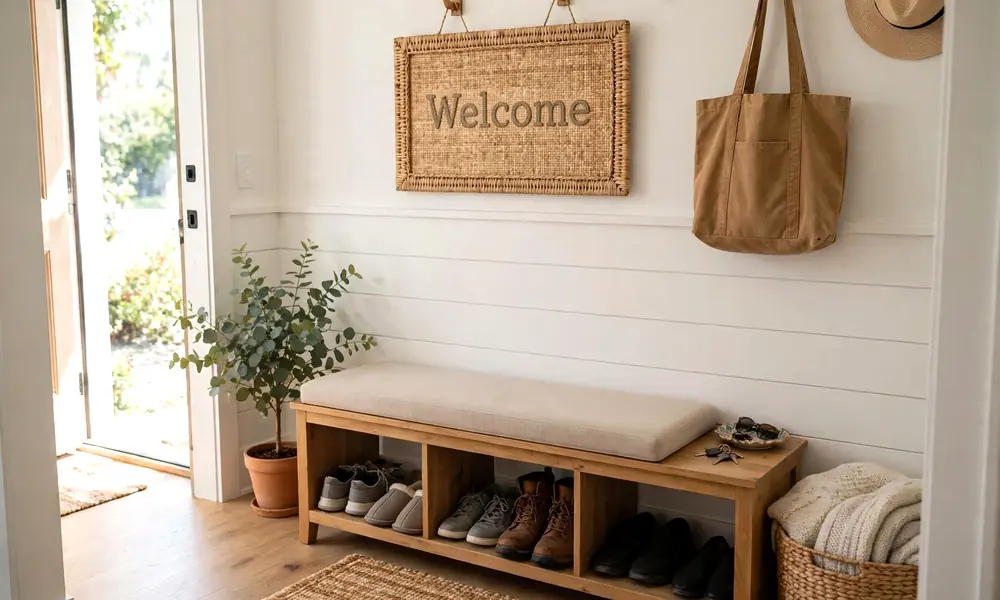
A woven or fabric welcome sign suits calm, soft interiors where wood and metal would feel too hard. Woven seagrass, jute, or macrame frames with stitched or appliqued lettering bring texture to a hallway wall, and they work well above a shoe bench or beside a coat rack. They are light, easy to hang with a single hook, and forgiving of uneven walls. They are strictly indoor signs: damp, sun, and dust will age them quickly, and they cannot be wiped clean like a hard surface. Dust them gently and keep them out of the bathroom and the porch.
Best for Modern Homes: Acrylic Sign
An acrylic welcome sign suits modern entrances where a rustic wooden board would look out of place. Clear or frosted acrylic with painted or vinyl letters looks crisp against a white or grey wall, and it is easy to wipe clean. The best versions use thick acrylic, at least 5 millimetres, with letters applied to the back so they cannot be scratched off. Thin acrylic flexes, scratches, and looks cheap, so check the thickness before buying. Acrylic works indoors and, sealed properly, on a covered porch. It is the most contemporary option, and the one that pairs best with modern wall art in the same hallway.

Where to Hang a Welcome Sign
Placement matters as much as the sign itself. The most natural spot is on or beside the front door, at eye level, where a guest looks while waiting for the door to open. A sign on the door itself works if the door is sheltered and the sign is light enough not to strain the hinges; a heavy plaque belongs on the wall beside the door instead. Inside, the hallway wall above a console table or shoe bench is the classic spot. A sign hung too high, above a door frame or near the ceiling, is read by nobody, and a sign hidden behind a plant or a coat rack might as well not exist.
Size the sign to the space around it. As a rule, the sign should span about two-thirds of the width of the door, bench, or table below it. A small sign on a wide blank wall looks lost, and a large sign crammed above a narrow bench looks crowded. Measure the wall before you buy, and hold a piece of paper cut to the sign’s size against the wall to check the effect. Leave breathing room around the sign: a few centimetres of bare wall on each side makes the message stand out. If the entrance already has house numbers beside the door, keep the sign on the other side or inside, so the two do not compete.
Mistakes That Spoil a Welcome Sign
The most common mistake is buying a sign that is too small: a sign that looks generous in a shop photograph can shrink to a postcard on a real front door. Measure first, and when in doubt, go one size up. The second mistake is the wrong material for the spot: raw wood on an exposed wall, chalk outdoors, or a paper print in a damp porch. The third is cluttered wording: a sign that lists rules about shoes, dogs, and steps is not a welcome at all.
Other mistakes are smaller but still worth avoiding. A sign hung crookedly, even slightly, draws the eye for the wrong reason, so use a level and two fixings rather than one nail. A sign in a colour that clashes with the door, such as bright red lettering on a red door, vanishes at a glance. And a sign that never changes can go stale: a Christmas message left up in March tells guests the house is not really looked after. Swap seasonal signs when the season ends, and dust the sign when you dust the hallway.
Looking After Your Welcome Sign
Most welcome signs need very little care, but a little care goes a long way. Dust a wooden or woven sign weekly, and wipe metal and acrylic with a damp cloth when they gather fingerprints or pollen. Reseal an outdoor wooden sign once a year with an exterior varnish or oil, ideally before winter, and check the fixings at the same time: a loose screw or a fraying rope is easy to fix before the sign falls. Chalkboard signs need a fresh coat of chalkboard paint every year or two if the surface goes shiny and stops holding chalk. Bring a fabric sign indoors during damp weather, and never hang a paper-backed sign where rain can reach it.
Welcome Sign Checklist
- Letters at least 5 centimetres tall, in high contrast with the board behind them.
- Material matched to the spot: sealed wood or metal outdoors, anything dry indoors.
- Sign spans about two-thirds of the width of the door or bench below it.
- Hung at eye level, about 145 to 150 centimetres from the floor.
- Short wording: one word, or one short phrase, that reads in a single glance.
- Fixings checked yearly: stainless screws, firm rope, no rust or fraying.
Frequently Asked Questions
What size should a welcome sign be?
About 40 to 60 centimetres wide for a standard front door. Inside, about two-thirds of the width of the bench or table below it.
Can a wooden welcome sign hang outside?
Yes, if it is sealed hardwood under a porch roof, resealed once a year. For a fully exposed wall, choose powder-coated metal or sealed acrylic instead.
What is the best wording for a welcome sign?
“Welcome” on its own is the most reliable choice: it suits every guest and reads instantly.
Where is the best place to hang a welcome sign?
On or beside the front door at eye level, or inside above a console table or shoe bench. Avoid hanging it above the door frame, where nobody looks, or behind plants and coats.
Are chalkboard welcome signs a good idea?
Yes, indoors, when the message changes often. Use a thick chalk marker and keep the writing large and simple. They are not suitable outdoors, where damp smudges the chalk.
How do I stop a welcome sign looking cheap?
Choose a solid material with real weight, letters with strong contrast, and a size that fits the wall. Avoid thin plastic, tiny lettering, and crowded wording.
The Bottom Line
The best welcome signs in 2026 are the simple ones: big clear letters, a material that suits the spot, and a size that fits the wall. Painted wood is the best all-round choice, metal is best for an exposed porch, and chalkboard is best when the message changes.