A small kitchen does not mean giving up on good wine. It means choosing more carefully. A wine cooler that is too wide will block a drawer, one that is too tall will not fit under a counter, and one that vents from the sides will overheat in a tight cabinet. The right cooler for a small space is not simply a smaller version of a large one. It is a machine designed around a narrow footprint, quiet running, and steady temperature in a room that is already warm from cooking.
This guide looks only at coolers that genuinely suit flats, studios, galley kitchens, and compact homes. Every pick below fits a real small-space constraint: a width of forty centimetres or less, a height that works under a standard counter, or a freestanding body that tucks into a corner without needing clearance on every side. We judged them on temperature stability, noise, vibration, energy use, and how honestly their stated bottle capacity matches the bottles people actually buy.
Key Takeaways
- Measure the width, height, and depth of your space before you look at any cooler, and leave room for the door to swing open fully.
- A cooler rated for twelve bottles will usually hold nine or ten once wider Burgundy and Champagne bottles are mixed in.
- Under-counter models must vent from the front, while freestanding models need several centimetres of space at the back and sides.
- Dual-zone cooling is worth paying for only if you regularly keep red and white wine chilled at the same time.
- Look for noise below forty decibels if the cooler will sit in an open-plan living space or near a bedroom.
How We Judged
We started with the constraint that matters most in a small home: size. A cooler earned a place in this guide only if it fits a genuinely tight spot without forcing a kitchen rearrangement. That meant checking width first, then height, then depth, and then the often-forgotten measurement of door swing. A cooler that fits the gap but cannot open wide enough to slide a bottle out is not a fit at all.
Temperature stability came next. A good cooler holds its set temperature within a degree or two through a warm afternoon and a cool night. We favoured compressor models for warm kitchens, because they cope better when the room climbs above twenty-five degrees, and we noted where a quieter thermoelectric model makes sense in a cooler room.

Best Overall: The Slim Under-Counter Cooler That Does Everything Well
The best overall cooler for a small space is a slim under-counter model, roughly thirty centimetres wide, holding eighteen to twenty-four bottles. It slides into the gap where a narrow cabinet would go, vents from the front so it can sit flush, and keeps reds and whites at a steady temperature without humming through the evening. The compressor is the quiet kind, rated near thirty-eight decibels, which is about the level of a quiet library.
What sets this type apart is balance. It is wide enough for a useful collection but narrow enough for a galley kitchen. The shelves slide out smoothly, so you can reach the bottle at the back without pulling every bottle in front of it out first. The door is reversible on many models, which matters when the cooler sits against a wall on one side. A single temperature zone suits most buyers here, because a household that drinks mainly red can set it to sixteen degrees and chill a white in the kitchen fridge for an hour before dinner.
Best Under-Counter: The Built-In Model for a Neat Kitchen
The best under-counter cooler is a true built-in, designed from the start to live under a worktop. Its front vent sits at the plinth, drawing cool air in and pushing warm air out at the front, so the cabinet around it stays cool and the compressor does not work overtime. A freestanding cooler forced into the same gap would overheat, run constantly, and fail years early, which is the most expensive mistake in this category.
Look for a height of eighty-two centimetres or less, which matches a standard kitchen counter, and a depth that leaves the door flush with the cabinet fronts. Stainless steel and black glass both suit modern kitchens, but the finish matters less than the seal: a door that closes firmly keeps cold air in and warm kitchen air out. A digital display on the door is convenient, though a simple dial inside the cabinet is just as accurate and one less thing to go wrong.
Best Freestanding: The Corner Cooler for Renters and Small Flats
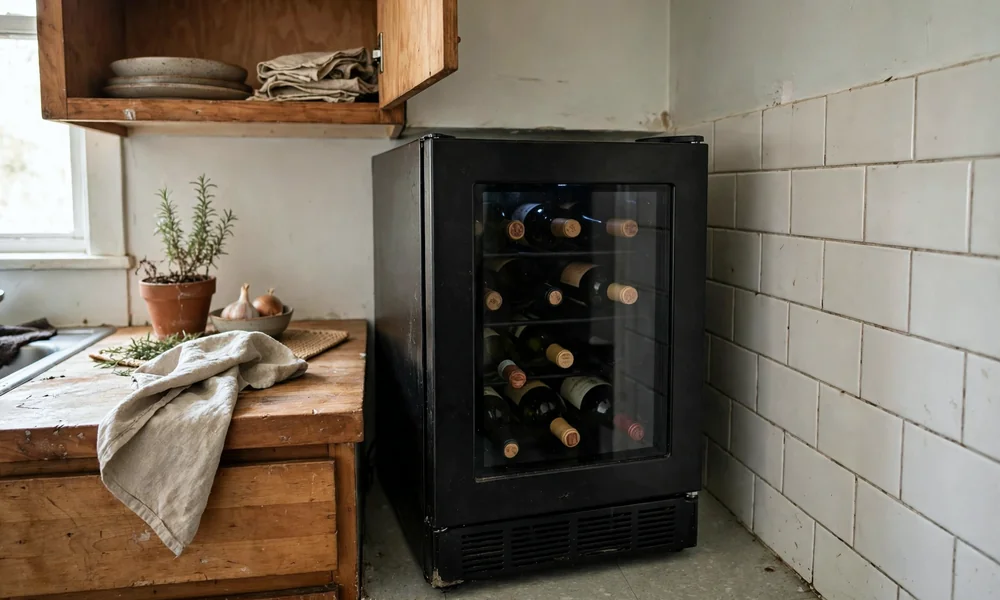
The best freestanding cooler is the friendliest choice for renters and anyone who cannot alter their kitchen. It needs no installation, plugs into an ordinary socket, and can move with you when you move home. The ideal size is twelve to eighteen bottles, about forty centimetres wide and sixty centimetres tall, small enough to sit on the floor in a corner or on a sturdy sideboard.
Freestanding coolers vent from the back and sides, so they need five to ten centimetres of clearance around them. That sounds like a small detail, but in a tiny kitchen it decides everything: a cooler pushed hard against a wall will run hot, hum loudly, and struggle to hold temperature on a summer afternoon. Give it breathing room and it will reward you with steady cooling and a long life.
Best Dual-Zone: Two Temperatures in One Small Cabinet
The best dual-zone cooler for a small space splits a narrow cabinet into two compartments, each with its own thermostat. Reds can sit at sixteen degrees in the lower zone while whites chill at eight degrees above, so every bottle is ready to pour without a trip to the kitchen fridge. For a household that genuinely drinks both colours every week, this removes a daily piece of juggling.
The catch is space. The divider between the zones eats shelf room, so a dual-zone cooler rated for twenty bottles may hold only sixteen in practice. You also pay more for the second cooling circuit, typically twenty to forty percent above a single-zone model of the same size, and the energy use is higher. That premium is worth it only if both zones are used every week. If one zone sits empty for months, you have paid for a feature you do not use.
Best Budget: The Compact Cooler That Covers the Basics
The best budget cooler for a small space is a compact twelve-bottle model that does the essentials well and skips the extras. It holds a steady temperature, runs quietly enough for a kitchen, and costs far less than a built-in. The shelves are simple wire racks rather than wooden slides, and there is no Wi-Fi app or touchscreen, which is no loss at all: a cooler needs a thermostat, not a smartphone.
Budget coolers are often thermoelectric, which means they are almost silent and vibration-free, but they can only cool about twelve to fifteen degrees below the room temperature. In a kitchen that stays below twenty-five degrees, that is fine. In a hot summer kitchen that reaches thirty degrees, a thermoelectric cooler will struggle to hold whites at eight degrees. If your kitchen runs hot, spend a little more on a small compressor model instead.
What to Look for When Choosing
Capacity is the first number to question. Makers quote capacity in standard Bordeaux bottles, the slim straight-sided shape. Your collection will include wider bottles, so knock a fifth off the quoted number to get a realistic figure. Then count the bottles you actually buy in a typical month and multiply by the longest you keep a bottle. Add a third for growth. That is your size, and it is usually one size smaller than the cooler you first wanted.
Width decides where a cooler can live. Measure the gap, then measure it again, and remember the door. A cooler that is thirty centimetres wide needs a door swing of at least the same, plus room for your hand and the bottle. Height matters under a counter, where a few centimetres decide whether the cooler fits or not. Depth matters too, especially in a galley kitchen where a cooler that sticks out will catch every hip that passes.
Temperature zones are a choice about how you drink, not a mark of quality. A single zone is simpler, cheaper, and more spacious. A dual zone suits mixed drinkers. Either way, check the temperature range: a cooler should reach down to five degrees for sparkling wine and up to eighteen for reds. If it cannot reach both ends, it cannot serve your whole collection.
Noise and vibration are easy to overlook in a shop and impossible to ignore at home. Look for a noise rating under forty decibels and read owner reports rather than trusting the brochure alone. A cooler that hums at night in a studio flat will annoy you far more than a cooler that holds temperature half a degree less precisely. Vibration matters most for wine you keep for a year or more; for bottles drunk within weeks, it is a minor concern.
Energy use is the quiet running cost. A cooler that cycles constantly in a warm kitchen will cost more over a year than a slightly dearer model that holds temperature with ease. Look for a good energy rating, a well-sealed door, and a location out of direct sunlight and away from the oven. A cooler in a cool corner of the kitchen uses far less power than the same cooler beside a radiator.

Care and Mistakes to Avoid
The most common mistake is buying for the collection you imagine rather than the one you have. A cooler bought for a hundred bottles that holds twelve will sit half empty, wasting electricity and space, while a cooler bought too small will force bottles into the kitchen fridge, where they dry out and chill too far. Count what you actually drink, not what you hope to drink one day.
The second mistake is ignoring ventilation. A freestanding cooler needs space at the back and sides, and a built-in cooler needs a front vent. Blocking either one is the fastest way to kill a cooler. Dust the vents every few months, keep the back clear of clutter, and never drape a tea towel over the top to hide the cooler from view.
Care is simple once the cooler is in place. Wipe the door seal with a damp cloth now and then, so it stays supple and seals firmly. Keep the cooler out of direct sunlight, which warms the glass and forces the compressor to work harder. Do not overload it: a full cooler with no air gaps between bottles cools unevenly, so leave a little space between bottles and rotate them occasionally. If you move house, let the cooler stand upright for a day before switching it on, so the refrigerant settles.
For a small home, the best wine cooler is the one that fits your space and suits the wine you actually drink. Choose the narrowest model that holds your collection and give it room to breathe. If you are still building your collection, our guide to the best and worst wines of 2026 is a useful place to start, and the right glasses matter too, as our look at wine glasses explains. For the wider picture, compare these small-space picks with the best wine fridges of 2026 before you decide.