Choosing between manual vs automatic cars for beginners is one of the first real decisions a new driver has to make. A manual asks the driver to change gears and work a clutch pedal, while an automatic changes gear on its own. Both work, but they demand very different amounts of attention, practice, and money.
Friends and family often have strong opinions, and much of that advice comes from the cars they learned in years ago. Modern automatics are smoother, cheaper to run, and far more common than they used to be, while modern manuals are still the cheapest way into many small cars.
This guide compares the two side by side for a complete beginner. It covers how each gearbox works, which one is easier to learn, what each costs to buy and run, and which suits different kinds of driving.
Key takeaways
- An automatic is easier to learn: no clutch pedal and no gear changes, so a beginner can focus on steering, observation, and road awareness.
- A manual gives more control and is usually cheaper to buy, but it takes longer to learn and more practice in traffic and on hills.
- Modern automatics have closed the fuel economy gap and are now the most common choice in new cars.
- Learning in a manual usually allows driving both types, while learning in an automatic often limits the licence to automatic cars only.
- The best choice depends on where the driving happens, the budget, and how much time the beginner can spend practising.
How Each Gearbox Actually Works
How a Manual Gearbox Works
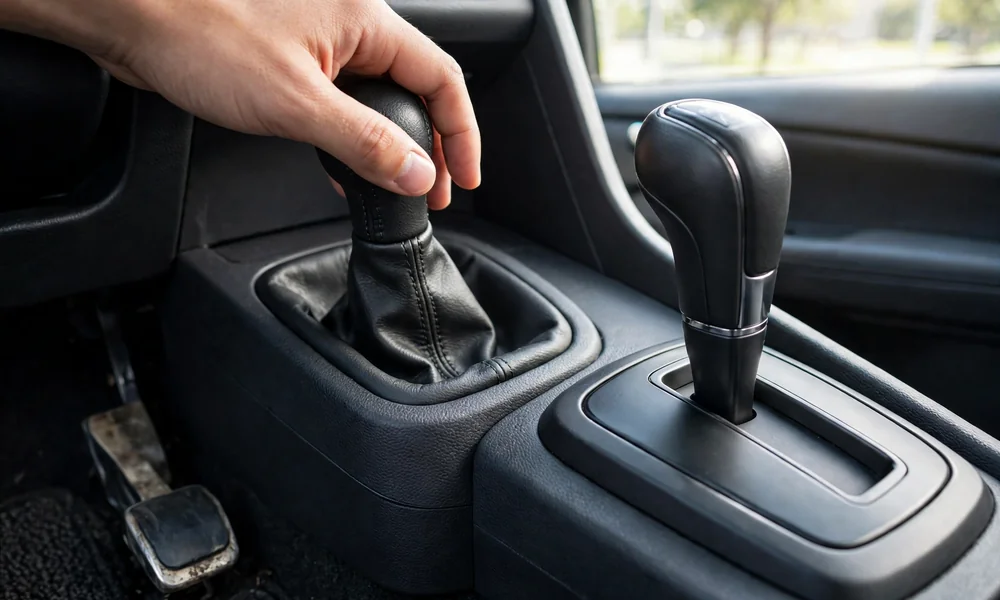
In a manual car, the driver selects the gear with a gear stick and controls the connection between engine and wheels with a clutch pedal. Pressing the clutch disconnects the engine, the driver moves the stick into the chosen gear, and releasing the clutch smoothly reconnects them. The driver decides when to change gear, usually by listening to the engine and watching the speed.
This gives the driver full control. On a steep hill, a low gear provides engine braking, and when overtaking, dropping a gear gives a burst of power. That control is satisfying once it becomes second nature. The price is attention: every gear change needs a hand, a foot, and a moment of thought, and in stop-start traffic that effort never stops.
How an Automatic Gearbox Works
In an automatic car, the gearbox chooses the gear for the driver. There is no clutch pedal, only a brake and an accelerator, and the selector is usually a simple lever or dial with positions for park, reverse, neutral, and drive. The driver selects drive, presses the accelerator, and the car takes care of the rest.
Most modern automatics change gear smoothly and quickly, often faster than a human driver could. Many also offer a manual mode or paddle shifters for occasional control, but a beginner can safely ignore those features for months. The result is a calmer drive, especially in heavy traffic, because the driver never has to juggle a clutch in a queue.

Manual vs Automatic: Head-to-Head Comparison
| Factor | Manual | Automatic |
|---|---|---|
| Ease of learning | Harder, clutch and gear changes to master | Easier, no clutch and no gear changes |
| Control | Full driver control over gear choice | Gearbox decides, manual mode on many models |
| Purchase price | Usually cheaper for the same model | Usually costs more for the same model |
| Fuel economy | Good in skilled hands, worse when learning | Often equal or better in modern cars |
| Traffic driving | Tiring in stop-start queues | Relaxed, two pedals only |
| Repair costs | Clutch wear can be costly, gearbox is simple | Repairs can be expensive if the gearbox fails |
| Licence coverage | Usually allows driving both types | Often limited to automatic cars only |
| Availability | Becoming rarer in new cars | Standard in most new cars and all electric cars |
Learning to Drive: Which Is Easier for a Beginner?
There is no honest debate about the first few weeks. An automatic is easier. A beginner in an automatic only has to manage steering, speed, mirrors, and observation, which is already a large amount to learn. A beginner in a manual has to manage all of that plus clutch control, gear selection, and hill starts, and the extra workload shows up in slower progress and more mistakes early on. That does not mean a manual is too hard: millions of drivers have learned in manuals, and most say the clutch becomes automatic after a few weeks of regular practice.
Learning in a Manual
Learning in a manual usually takes more lessons and more private practice than learning in an automatic, and the first test attempts can be harder because stalling and rolling back on hills are both possible faults. The reward is flexibility. In most licensing systems, passing the test in a manual car allows the driver to drive both manual and automatic cars, which keeps every option open when buying a first car.
A manual also teaches car control in a way that stays useful for life. A driver who understands gears, clutch bite, and engine braking has a better feel for what a car is doing,. It is also worth remembering that the car buying traps dealers still use catch first-time buyers of both gearbox types, so the choice of gearbox should come before any visit to a showroom, not during one.
Learning in an Automatic
Learning in an automatic lets a beginner build road confidence faster. Without a clutch to manage, lessons can focus on reading traffic, judging gaps, parking, and motorway driving, which are the skills that matter most for safety. Many learners who feel nervous or who have limited time for practice find that this faster progress keeps them motivated.
The main drawback is the licence restriction. In many countries, a test passed in an automatic limits the driver to automatic cars only, and upgrading later means taking another test in a manual. For a beginner who expects to drive only modern cars, that may never matter, since automatics now dominate new car sales.
Costs: Buying, Fuel, and Repairs
Money matters to most beginners, and the gearbox affects the bill in three places: the purchase price, the fuel, and the repairs. None of these differences is huge on its own, but together they can add up to a meaningful amount over the first years of driving.
Purchase Price and Choice
For the same model, a manual version is usually cheaper than the automatic version, sometimes by a useful margin. Manuals are also more common among older, cheaper used cars, which is where many beginners shop. That lower entry price is one of the strongest practical reasons to consider a manual, especially when the budget is tight and every saving counts towards insurance and running costs.
The picture is changing, though. Manufacturers are dropping manual gearboxes from more models every year, and some popular cars are now automatic only. A beginner who insists on a manual may find a smaller choice of newer cars, while a beginner open to an automatic can choose from almost everything on sale.
Fuel Economy and Repair Bills
Fuel economy used to favour manuals clearly, but that gap has largely closed. A skilled driver can still beat an automatic for economy in a manual, yet most beginners use more fuel in a manual while learning, because of over-revving and poor gear choice. Modern automatics, with more gears and smarter software, often match or beat a manual in real driving.
Repair costs tell a different story. A manual gearbox is mechanically simple and usually cheap to fix, but the clutch is a wearing part, and a beginner who rides the clutch can wear one out early. A clutch replacement is a sizeable bill. An automatic gearbox is more complex, and while it rarely fails, a failure can be very expensive. driving habits that wear out your car cost money regardless of the gearbox, so gentle driving pays off either way.
Everyday Driving: Traffic, Hills, and Long Journeys
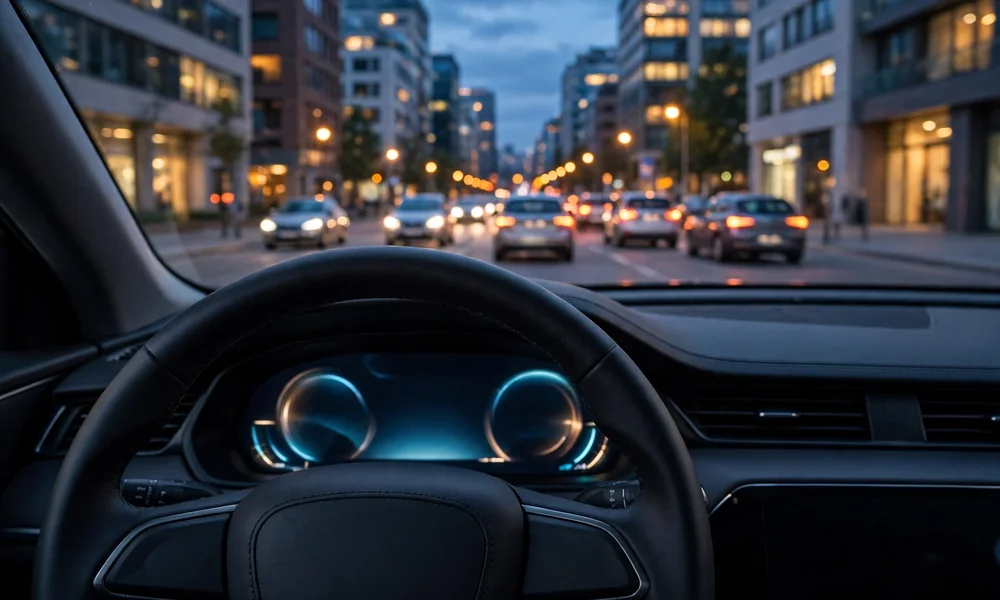
In heavy traffic, an automatic is clearly easier. The driver simply moves between brake and accelerator while the car creeps forward, while a manual driver works the clutch constantly and risks stalling at every restart. For a beginner who commutes through a busy town, that difference alone can settle the choice.
Which One Should You Choose?
There is no single best choice for every beginner. The right gearbox is the one that fits the driving the beginner will actually do, the budget available, and the amount of time they can give to learning. The checklist below turns the comparison into a practical decision.
Beginner Decision Checklist
- Choose an automatic if most driving will be in heavy town traffic or on congested commutes.
- Choose a manual if the budget is tight and a cheaper first car matters more than convenience.
- Choose a manual if keeping the option to drive any car, including work vehicles, is important.
- Choose an automatic if learning time is limited or confidence is low and faster progress matters.
- Choose a manual if the joy of driving and full control over the car is a real priority.
- Choose an automatic if the likely first car is new, large, or electric, since those are usually automatic only.
If the checklist points both ways, the tie-breaker is simple: test drive both. Most driving schools offer a trial lesson in each type, and half an hour behind the wheel teaches more than hours of reading. Pay attention to how relaxed the drive feels, not just how exciting it is, because the car that feels calm on a first drive is usually the car that will be easiest to live with.
One final consideration is resale: manuals are becoming rarer, which can make a good used manual cheap to buy but harder to sell later. And if the first vehicle turns out to be on two wheels instead, research carefully, since the worst motorcycles for beginners to buy share the same trap as a bad first car: too much power, too soon.
Frequently Asked Questions
Is it harder to pass the driving test in a manual car?
It can be, mainly because stalling, rolling back on hills, and choosing the wrong gear are all possible faults that do not exist in an automatic.
Can I drive a manual car if I passed my test in an automatic?
In most licensing systems, no. A test passed in an automatic usually restricts the licence to automatic cars only, and driving a manual requires passing another test in a manual car.
Are automatic cars more expensive to insure for beginners?
They can be slightly more expensive, because the car itself usually costs more to buy and repair.
Do manual cars use less fuel than automatics?
Not necessarily any more. Older automatics were thirstier, but modern automatics with more gears and smarter controls often match or beat a manual.
Is a manual car better for learning real driving skills?
A manual teaches more about how a car works, including clutch control, gear choice, and engine braking, and those skills stay useful for life. An automatic teaches the same road skills, such as observation and judgement, without the extra workload.
Will manual cars disappear soon?
Manuals are becoming rarer in new cars, and electric cars have no manual gearbox at all, but manuals will remain common on the used market for many years.
The Bottom Line
For most beginners, an automatic is the easier and calmer way to start driving, while a manual is the cheaper and more flexible way to learn the full skill. Choose the automatic for heavy traffic, limited practice time, and a quicker path to confidence, and choose the manual for a tight budget, maximum licence coverage, and the satisfaction of full control.