
The top marble slabs are not serving boards, and that distinction is the key to buying the right one. A marble slab is a thick, flat piece of stone you work on: a cool surface for rolling pastry, tempering chocolate, kneading dough and keeping butter firm, and only afterwards a surface for presenting cold food. The top marble slabs of 2026 stay cool under your hands and give pastry a surface wooden worktops cannot match. This guide explains which stones work, how thick a slab needs to be, and how to seal it, so you buy a working tool.
A marble slab does a different job from the boards around it. A serving board is a presentation surface: food arrives on it already cooked, and it stays on the table while people eat. Our guide to the best serving boards covers that job, from acacia to slate. A cutting board is a knife surface, built to take cuts all day, and our guide to the best cutting boards explains why wood and plastic suit knives better than stone ever will. A marble slab does neither job: never cut directly on marble, since it dulls knives and can scratch. Its job is temperature. Marble holds a low temperature for a long time, which is why pastry stays workable and chocolate sets with a snap.
Key Takeaways
- A marble slab is a work surface for pastry, chocolate and dough, not a cutting board: never cut directly on it.
- Thickness matters most: a slab at least 2 centimetres thick stays cool and stable, while thin slabs warm up fast and can crack.
- White Carrara marble is the best all-round choice, affordable and cool, while darker marbles hide stains but show dust and fingerprints.
- Seal a marble slab before first use and once or twice a year after, because marble is porous and stains easily.
- A slab around 40 by 30 centimetres suits most kitchens for pastry, while larger slabs suit keen bakers.
Why Marble Stays Cool, and Why That Matters
Marble feels cold to the touch because it conducts heat away from your hands quickly, and that same property makes it valuable in the kitchen. Pastry dough is mostly butter, and butter softens fast in warm hands and a warm room. Roll pastry on a wooden worktop in summer and the butter melts into the flour, the dough turns sticky, and the finished pastry loses its layers. Roll it on a cool marble slab and the butter stays firm, the dough stays workable, and the layers survive the oven. The same logic applies to chocolate: tempering needs a cool surface to bring melted chocolate down to the right temperature, and marble is the traditional surface for the job.
The coolness has limits. A marble slab left in a hot kitchen will warm up, just more slowly than wood, and a thin slab warms up far faster than a thick one. That is why thickness is the first specification to check, ahead of colour or veining. A slab of 2 centimetres is the minimum for real pastry work; 3 centimetres is better, and it also makes the slab heavy enough to stay put while you roll. Store the slab somewhere cool if you can, and chill it in the fridge for half an hour before serious pastry work in summer.

Which Marble Is Best for the Kitchen
Carrara marble, the white stone with soft grey veining from Italy, is the standard kitchen choice. It is widely available, it is one of the more affordable marbles, and its pale surface makes it easy to see dough, flour and chocolate clearly. It is also relatively soft for a stone, which means it can scratch and etch if acidic food sits on it, so it needs sealing and sensible care. Calacatta marble is similar but bolder, with thicker veining and a warmer white background; it costs more and is chosen mostly for looks.
Darker marbles, such as green, black and deep grey, hide stains far better than white marble, which suits a busy kitchen, but they show dust, flour and fingerprints more clearly, so they look messier between uses. Granite is sometimes sold alongside marble slabs: it is harder and more stain-resistant, but it does not stay as cool to the touch. Quartz needs no sealing, but it is not as cool as natural marble. For pastry and chocolate, natural marble remains the best choice.
White Carrara: The Best All-Round Slab
White Carrara is the slab to buy first. It is cool, it is pale enough to see your work, and it is available in every size and thickness at a fair price. The veining varies from slab to slab, so each one looks a little different. The main care need is sealing: Carrara is porous, and unsealed stone will stain from olive oil, red wine and tomato within minutes. Seal it before first use and the stone will stay pale and clean for years.
Dark Marble: Hides Stains, Shows Dust
Dark marble suits cooks who worry about stains more than dust. A black or deep green slab hides a splash of wine or a smear of oil that would mark white marble, and it looks dramatic on a light worktop. The trade-off is that every speck of flour shows, so the slab needs a wipe before it looks tidy, and the dark surface makes pale dough harder to see.
The Top Marble Slabs of 2026
The slabs below cover the sizes and stones that suit real kitchens, from a first pastry slab to a large baker’s work surface. Each was judged on thickness, coolness, flatness, edge finish and value.
Top Overall: 40 by 30cm White Carrara Slab, 2.5cm Thick
The best all-round marble slab is a 40 by 30 centimetre white Carrara slab, 2.5 centimetres thick, with a polished top and bevelled edges. It is large enough to roll a full sheet of pastry, heavy enough to stay put, and thick enough to stay cool through a long baking session. The polished surface releases dough easily with a dusting of flour, and the bevelled edges are comfortable to grip when you lift it.
Top for Pastry: Large 50 by 35cm Carrara Slab, 3cm Thick
Keen bakers should go larger and thicker. A 50 by 35 centimetre slab, 3 centimetres thick, gives room to roll pastry, rest dough and work on two batches at once, and the extra thickness keeps it cool for longer. It is heavy, so it lives on the worktop rather than in a cupboard, but for anyone who bakes weekly it is the most useful slab here. Look for a flat, even polish with no dips, since a dip will leave pastry uneven.
Top for Chocolate: 45 by 30cm Polished White Marble Slab
Chocolate work needs the coolest, smoothest surface you can get, and a polished white marble slab is the classic tool. Tempering chocolate means spreading melted chocolate across the stone, working it with a palette knife until it cools to the right temperature, then gathering it up again. The marble pulls heat out of the chocolate steadily, and the smooth polish lets the knife glide without catching.
Top for Cheese and Desserts: Round 35cm Marble Slab
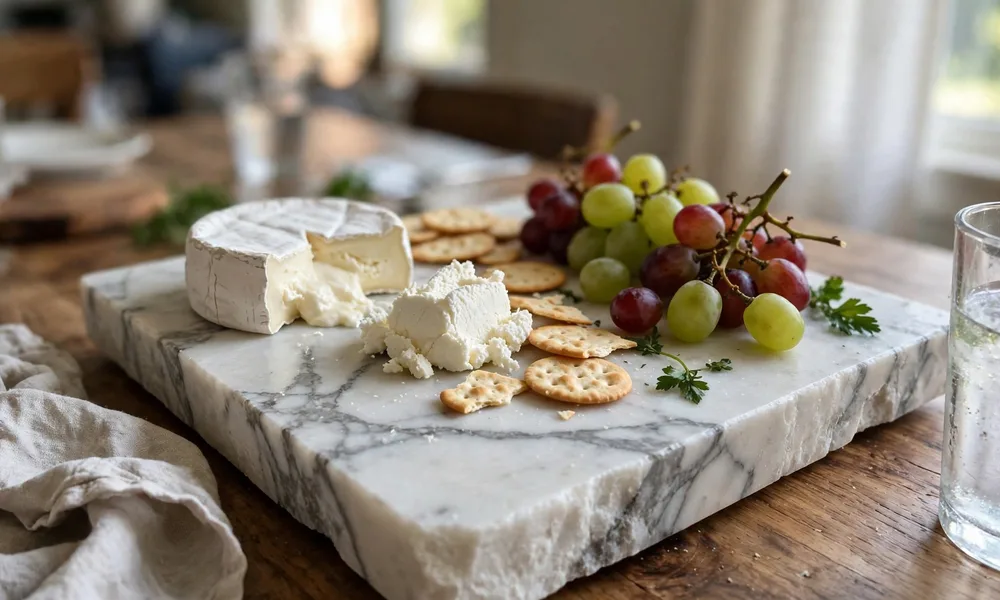
A round marble slab is the best choice when the job is keeping food cool at the table. At 35 centimetres across it holds a generous cheese selection, and the stone keeps soft cheese firm on a warm evening. Our guide to the best cheese boards covers wooden boards for everyday entertaining, but when the cheese is soft and the room is warm, marble is the better surface.
Marble Slabs Compared
| Slab | Stone | Size | Thickness | Best For |
|---|---|---|---|---|
| Top Overall | White Carrara | 40 by 30 cm | 2.5 cm | Everyday pastry |
| Top for Pastry | White Carrara | 50 by 35 cm | 3 cm | Serious baking |
| Top for Chocolate | Polished white marble | 45 by 30 cm | 2.5 cm | Tempering chocolate |
| Top for Cheese | White marble | 35 cm round | 2 cm | Cool serving |
How to Seal and Care for a Marble Slab
Sealing is the one job that decides whether a marble slab stays beautiful. Marble is porous, and unsealed stone absorbs oil, wine and acidic juices quickly, leaving stains that are hard to remove. Seal the slab before first use with a food-safe stone sealer: clean the stone, let it dry completely, apply the sealer evenly, let it soak in, and wipe off the excess. Repeat once or twice a year, or whenever water stops beading on the surface.
Cleaning is simple if you do it promptly. Wipe the slab with warm water and a soft cloth after use, and use a little mild washing-up liquid for greasy marks. Never use vinegar, lemon juice or harsh cleaners on marble, since acids etch the polished surface and leave dull patches. Never use a scouring pad, which scratches the polish. If a stain does appear, make a paste of baking soda and water, spread it over the stain, cover it with cling film, and leave it overnight before wiping it away.
Storage and handling matter because marble is heavy and brittle. Always lift a slab with two hands, supporting it from underneath, and never carry it by one edge. Store it flat, never leaning against a wall, since a leaning slab can slip and crack, and never stack heavy objects on top of it. If the slab lives on the worktop, put small silicone or felt feet underneath to stop it sliding and to protect the worktop.
Marble Slab Buying Checklist
- Choose at least 2 centimetres thick, and 2.5 to 3 centimetres if you bake often.
- Pick white Carrara for the best all-round slab, and dark marble only if hiding stains matters more.
- Measure your worktop first: 40 by 30 centimetres suits most kitchens.
- Check the slab is flat with no dips, the polish is even, and the edges are bevelled.
- Buy a food-safe stone sealer, and seal the slab before its first use.
- Confirm the weight suits you: a thick slab is heavy, so lift it with two hands.

Frequently Asked Questions
Can I cut food directly on a marble slab?
You can, but you should not make a habit of it. Marble dulls knife edges quickly, and a knife can leave fine scratches in the polish. Use the slab for rolling, kneading and tempering, and cut on a wooden or plastic board.
Does marble stain easily?
Unsealed marble stains easily from oil, wine, coffee and tomato, but a sealed slab resists most marks if they are wiped up promptly. Seal before first use and once or twice a year.
Can a marble slab go in the oven?
No. Marble is a cold-work surface, not a baking stone, and sudden heat can crack it. Use it for pastry, chocolate and cold food.
How do I keep a marble slab cool in summer?
Store it somewhere cool, and chill it in the fridge for thirty minutes before pastry work. A thick slab holds its coolness far longer than a thin one.
Is marble better than granite for pastry?
Yes, for pastry and chocolate. Marble stays cooler to the touch and has a smoother polish, which helps dough release and chocolate temper evenly. Granite is harder and more stain-resistant, but it is not as good for delicate pastry work.
Can I use a marble slab as a serving board?
Yes, for cold food: cheese, desserts, butter and chocolate all suit a cool marble surface. Do not use it for hot food straight from the oven, and do not cut on it at the table.
Bottom Line
Verdict: The Best. A marble slab earns its place by doing one job no other surface does as well: keeping pastry, chocolate and dough cool while you work. For most kitchens the 40 by 30 centimetre white Carrara slab at 2.5 centimetres thick is the right buy, large enough for real baking. Seal it before first use and never cut on it.


